Hi this is Team Merchant Navy Decoded !!!

Please fill the below form with your query and we will get back to you in next 12 hours.

Rest assured your data is safe with us !!!🙂

Ask Your Query

Life-Saving Appliances on Board

Life-Saving Appliances on Board

There’s a particular kind of equipment on a ship that everyone hopes never gets used for real. Lifeboats, liferafts, immersion suits, EPIRBs – all of it sits ready, drilled on weekly and monthly schedules, inspected and serviced on a calendar that never really stops, precisely because the one time any of it actually matters is the worst possible moment for something to be found not working. That’s really the whole logic behind how strictly this equipment is regulated: nothing on this list gets a second chance to work.

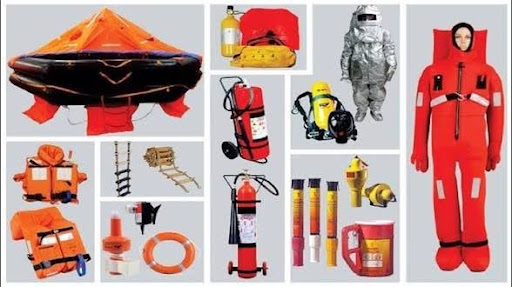
Life-saving appliances, LSA for short, cover everything on board specifically intended to protect life during an emergency and get people off a sinking or disabled ship. Understanding what’s actually in that category, how the key pieces of equipment work mechanically, and why the inspection regime is as strict as it is, matters well beyond just passing a drill.

The Regulatory Framework: SOLAS and the LSA Code

SOLAS and the LSA Code

Carrying life-saving appliances is a mandatory requirement under the SOLAS Convention, with SOLAS Chapter III setting out the regulatory requirements–37 regulations across three parts covering what has to be carried, in what numbers, and under what conditions. Chapter III is deliberately the regulatory shell rather than the engineering detail; the actual technical specifications for every individual appliance, its construction, performance, testing  live in the International Life-Saving Appliance Code, universally called the LSA Code, made mandatory through SOLAS reference.

The LSA Code is structured into chapters covering distinct categories of equipment: general requirements, personal life-saving appliances (lifebuoys, lifejackets, immersion suits, thermal protective aids), visual signals (flares and smoke signals), survival craft (liferafts and the different lifeboat categories), rescue boats, and launching and embarkation appliances. The exact number, type, and capacity of equipment a given ship carries depends on its size, the number of persons on board, and the trade it operates in; the LSA Code sets the minimum standard, not a one-size-fits-all list.

Quick pointer : Port State Control treats LSA deficiencies with real severity, not as a minor paperwork issue. An on-load release hook that hasn’t been tested, or a liferaft carrying an expired hydrostatic release unit, is exactly the kind of finding that can get a vessel detained  because unlike most deficiencies, this category of equipment has no room for “close enough.”

Personal Life-Saving Appliances

These are the items every person on board is meant to have direct access to, individually:

  • Lifejackets – Designed to keep a person afloat and, for SOLAS-compliant adult lifejackets, to turn an unconscious, face-down wearer face-up within a defined time. Performance standards for this have continued to tighten, with newer requirements applying to lifejackets delivered from recent dates.

Lifejackets

  • Lifebuoys – Ring-shaped flotation devices positioned around the ship, some fitted with self-igniting lights and smoke signals for a man-overboard situation, specifically so a lifebuoy thrown at night remains visible

Lifebuoys

  • Immersion suits and anti-exposure suits – Provide thermal protection against hypothermia in cold water, a genuinely critical piece of equipment given how quickly cold water incapacitates an unprotected person compared to how long rescue might actually take.

Immersion suits

  • Thermal protective aids – Lightweight bags or covers used to reduce heat loss for survivors in a lifeboat or liferaft who don’t have (or have already used) an immersion suit.

Thermal protective aids

Table of Contents

Survival Craft: Lifeboats and Liferafts

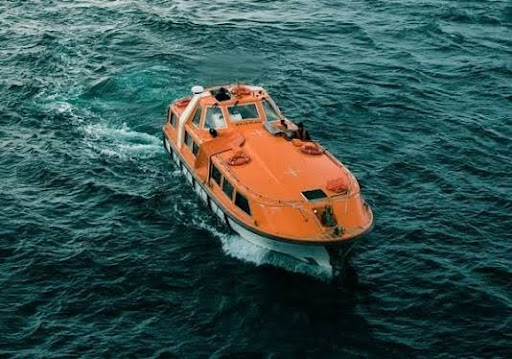
Lifeboats are rigid craft, and the totally enclosed type is the dominant design on modern cargo ships and tankers, a fully enclosed hull with self-bailing arrangements, capable of remaining watertight through the canopy seals even when waves are breaking over it. 

Launching happens through one of two general methods:

  • Davit-launched lifeboats are lowered by falls from davits, with an on-load release hook mechanism that lets the boat be released from the falls once waterborne, a mechanism deliberately engineered to require genuine, deliberate force to activate, specifically to prevent premature or accidental release during lowering.

  • Free-fall lifeboats work completely differently: the boat, fully loaded with its crew and equipment, is released to fall directly into the sea from a ramp at the stern, with no restraining apparatus at all during the drop. It’s a design that trades the complexity of a controlled lowering for speed and for getting the boat and crew clear of the ship’s side quickly, a real advantage in a fire or explosion scenario where lingering alongside the hull is itself dangerous.

Liferafts, by contrast, are inflatable and stow in a canister or valise. A critical design feature is that they must be able to float free automatically if the ship sinks before anyone can launch them manually  achieved through a hydrostatic release unit (HRU), a device that releases the liferaft container from its cradle once it reaches a set submersion depth, roughly four metres, letting the raft float clear and inflate on its own even if no crew member ever reaches it. Once triggered, a liferaft is required to inflate within about a minute at normal ambient temperature, with a longer allowance built in for extreme cold, since inflation gas behaves differently at very low temperatures without that being treated as a design fault.

Quick pointer: The hydrostatic release unit is one of the more quietly important pieces of equipment on the entire ship, precisely because it’s designed to work in the scenario where everything else has already gone wrong, the vessel is sinking and no one may be in a position to launch the raft manually. It has an expiry date for exactly that reason, and letting it lapse defeats the purpose of carrying the equipment at all.

Rescue Boats, Signals, and Locating Equipment

  • Rescue boats, including fast rescue boats, are intended for recovering a person from the water or marshalling liferafts together, and are distinct in role from lifeboats even though they may look superficially similar.


  • Pyrotechnic visual signals – parachute flares, hand flares, and buoyant smoke signals  provide high-visibility signalling for daytime and night-time distress situations, and carry their own expiry dates tied to the reliability of the pyrotechnic charge over time.


  • EPIRBs (Emergency Position Indicating Radio Beacons) transmit a distress signal and position to satellites once activated, either manually or automatically on immersion, giving search and rescue services a location to work from even if no other communication is possible.


  • SARTs (Search and Rescue Transponders) respond to a rescuing vessel’s radar with a distinctive signal, helping searchers home in on survival craft once they’re in the general search area, a different, complementary function to an EPIRB’s satellite alerting role.

Launching and Embarkation Appliances

Getting people from the deck into survival craft safely is its own category of equipment, covered separately in the LSA Code:

  • Davits and launching appliances for lifeboats and liferafts, engineered with the same deliberate resistance to premature release built into the hook mechanisms described above.
  • Embarkation ladders, rigged at embarkation stations to help crew and passengers board survival craft that may be sitting some distance below the embarkation deck.
  • Marine Evacuation Systems (MES), used particularly on passenger ships, providing a rapid, chute-based means of transferring large numbers of people from the embarkation deck directly down to a floating survival craft far faster than boarding one at a time down a ladder.

Inspection and Maintenance: Why the Schedule Is So Strict

The maintenance regime for LSA equipment is layered, deliberately, so that failures get caught long before an actual emergency:

  • Weekly – A visual check of every liferaft, launching appliance, and release gear, logged in the ship’s logbook; lifeboat and rescue boat engines are run for a minimum period to confirm they’ll actually start.
  • Monthly –  A full checklist inspection of all life-saving appliances, including liferaft equipment, entered in the logbook.
  • Annually – Class-witnessed examination of lifeboat hulls, engines, equipment, and release gear; shore servicing of inflatable liferafts, lifejackets, and hydrostatic release units at an approved service station, including full inflation and equipment checks, and replacement of any expired pyrotechnics or provisions.
  • Every five years – A load test of davits falls under a defined proof load, confirming the launching arrangement can genuinely handle a fully loaded boat under real conditions, not just its own weight.

This layering matters because different failure modes get caught at different intervals; a visibly damaged liferaft container gets caught on a weekly check, while an internal fault in a release mechanism only shows up under the kind of full teardown an annual service actually performs.

Conclusion

Life-saving appliances are built around a single, uncompromising design principle: this equipment has to work correctly the very first time it’s ever genuinely needed, often after months or years of sitting untouched, and often in the worst sea and weather conditions imaginable. That’s what justifies the strictness of SOLAS Chapter III and the LSA Code, the layered inspection schedule, and the real consequences  including detention  for letting any of it lapse. Understanding how a hydrostatic release unit or an on-load release hook actually works, not just that it exists, is what turns a weekly inspection from a box-ticking exercise into a genuine check that the one piece of equipment nobody wants to need will actually work the moment it’s needed.

Frequently Asked Questions (FAQs)

SOLAS Chapter III sets out the regulatory requirements for what life-saving equipment a ship must carry and under what conditions. The LSA Code, made mandatory through SOLAS reference, provides the detailed technical specifications, construction, performance, and testing requirements for each specific type of appliance.

It releases a liferaft’s container from its cradle automatically once the unit reaches a set submersion depth, roughly four metres, allowing the raft to float free and inflate even if the ship sinks before anyone can launch it manually. It’s specifically designed for the scenario where normal manual launching isn’t possible.

A davit-launched lifeboat is lowered by falls from davits and released from the falls once waterborne via an on-load release hook. A free-fall lifeboat is released, fully loaded, to fall directly into the sea from a stern ramp with no restraining apparatus during the drop, prioritising speed and getting clear of the ship’s side quickly.

An EPIRB transmits a distress signal and position to satellites, alerting search and rescue services to an emergency and its general location. A SART responds to a rescuing vessel’s radar once searchers are already in the area, helping them home in precisely on survival craft; the two serve different, complementary stages of a rescue.

Weekly visual checks and engine runs, monthly full checklist inspections, annual class-witnessed examinations and approved shore servicing (including hydrostatic release unit service and replacement of expired pyrotechnics), and a five-yearly load test of davits and falls under proof load.

Disclaimer :- The opinions expressed in this article belong solely to the author and may not necessarily reflect those of Merchant Navy Decoded. We cannot guarantee the accuracy of the information provided and disclaim any responsibility for it. Data and visuals used are sourced from publicly available information and may not be authenticated by any regulatory body. Reviews and comments appearing on our blogs represent the opinions of individuals and do not necessarily reflect the views of Merchant Navy Decoded. We are not responsible for any loss or damage resulting from reliance on these reviews or comments.

Reproduction, copying, sharing, or use of the article or images in any form is strictly prohibited without prior permission from both the author and Merchant Navy Decoded.

DIWALI SALE

Decoded Discount Alert! up to 50% OFF

DIWALI SALE

Decoded Discount Alert! up to 50% OFF

Use Coupon Code Deep50

Days
Hours
Seconds
0
Would love your thoughts, please comment.x
()
x