Hi this is Team Merchant Navy Decoded !!!
Please fill the below form with your query and we will get back to you in next 12 hours.
Rest assured your data is safe with us !!!🙂
Ask Your Query| For Beginner | For Professional |
|---|---|
| GME | Engine Side |
| G.P. Rating | Deck Side |
| ETO | G.P. Rating |
| IMUCET & Sponsorship | Combo Offers |
| Free Course | MEO |
| Free Course |
| For Beginner | For Professional |
|---|---|
| GME | Engine Side |
| G.P. Rating | Deck Side |
| ETO | G.P. Rating |
| IMUCET & Sponsorship | Combo Offers |
| Free Course | MEO |
| Free Course |
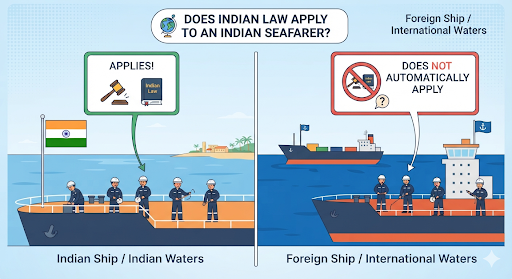
When a seafarer goes missing in international waters, the legal position can become complex because more than one framework may apply at the same time. The vessel’s Flag State, Seafarer Employment Agreement, Collective Bargaining Agreement, international maritime conventions, and in some cases the seafarer’s home-country law may all become relevant depending on the circumstances, so it is important to understand that an Indian seafarer going missing outside Indian territorial waters does not automatically mean only Indian law will apply.
Not necessarily. An Indian citizen working onboard a foreign-flagged vessel may be employed under a contract connected with another jurisdiction. If the incident occurs outside Indian territorial waters, the ship’s Flag State and the terms of the seafarer’s employment can become particularly important.
The fact that the seafarer is Indian can still be relevant in some situations, especially when the family considers legal remedies in India. However, citizenship alone does not automatically decide the complete legal framework governing a maritime incident.
One of the first things to check is the vessel’s Flag State. The Flag State is the country where the ship is registered, and it exercises important jurisdiction over vessels flying its flag.
For example, if the vessel is registered in Panama, the Panama maritime authorities and applicable Panamanian framework may become relevant. Similarly, vessels registered in the Marshall Islands or Liberia can come under the maritime administration and laws of those Flag States.
The Flag State can play an important role in investigating serious incidents onboard the vessel. If a seafarer disappears, dies, suffers a serious accident, or another major event occurs, the Flag State may have responsibilities relating to investigation and enforcement.
This principle is not limited to missing-seafarer cases. Serious incidents onboard, including criminal matters, can also create questions about Flag State jurisdiction along with any other jurisdiction that may legally apply.
The Flag State does not operate completely independently of international maritime rules. Ships and Flag States may be subject to important international conventions such as the Maritime Labour Convention (MLC), SOLAS, and other applicable maritime instruments.
These conventions establish international standards relating to areas such as safety, seafarer welfare, employment conditions, and shipowner responsibilities. Their relevance depends on the particular convention, the vessel, the Flag State, and the circumstances of the case.
One important protection under the Maritime Labour Convention framework is the requirement for shipowners to maintain financial security for certain seafarer-related liabilities.
The basic purpose is to reduce the risk of an eligible seafarer or family being left without support simply because a shipowner says it cannot afford to meet its obligations. Where the applicable financial-security requirements are not maintained, the vessel may also face enforcement consequences under the relevant framework.
The Seafarer Employment Agreement (SEA) is another major document in a missing-seafarer case. It defines the employment relationship between the seafarer and the shipping company and may contain or refer to important provisions relating to compensation, insurance, dispute resolution, and other employment rights.
This is why the family should obtain a copy of the SEA as soon as possible after a serious incident. The agreement may help establish what compensation is due and which legal or contractual provisions govern the employment.
A seafarer’s employment contract may also be governed by a Collective Bargaining Agreement, particularly when the company has entered into an agreement with a recognised maritime union.
The CBA can contain provisions regarding wages, death compensation, permanent disability, medical benefits, repatriation, leave, and other employment protections. In a missing-seafarer case, the applicable CBA may therefore become one of the most important documents for understanding the family’s contractual rights.
Some vessels and seafarers may work under employment arrangements connected with ITF-approved agreements or other union-negotiated conditions. Such agreements can contain specific provisions relating to crew compensation and employment protections.
If a seafarer goes missing, the family should therefore identify whether the vessel or employment contract was covered by an ITF agreement, another CBA, or only the company’s standard Seafarer Employment Agreement.
In some situations, the seafarer’s home-country law may also become relevant. For an Indian seafarer, the family may explore whether an Indian court or another Indian authority has jurisdiction over part of the dispute.
However, the ability to bring a case in India depends on the facts, the parties involved, the employment agreement, the jurisdiction clause, and other legal considerations. It should not be assumed that every missing-seafarer case involving an Indian citizen can automatically be decided entirely under Indian law.
There may not be one single answer. Compensation can depend on the Seafarer Employment Agreement, CBA, Flag State requirements, applicable maritime conventions, insurance or financial-security arrangements, and any law that has valid jurisdiction over the dispute.
This is why families should not rely only on what the shipping company tells them. They should identify the vessel’s Flag State, obtain employment documents, check the applicable CBA, understand the insurance or P&I arrangements, and keep copies of investigation reports and communications.
The family should first identify the vessel name, IMO number, Flag State, shipping company, manning agency, Seafarer Employment Agreement, applicable CBA, union membership, and nomination details.
They should also preserve communication from the company and obtain information about the Search and Rescue operation and subsequent maritime investigation. These details can become important when determining which authorities, contractual provisions, and legal remedies are relevant.
When a seafarer goes missing outside territorial waters, there may not be one single law that decides everything. Flag State law, the Seafarer Employment Agreement, applicable CBA, international maritime conventions, and potentially the seafarer’s home-country law can all become relevant, so seafarers should keep contracts, CBA details, nomination records, insurance information, and other important documents properly organised. Sailor Pro app, a platform built specifically to support seafarers with practical tools and guidance.
There may be several applicable frameworks, including Flag State law, the Seafarer Employment Agreement, the applicable CBA, international maritime conventions, and potentially the seafarer’s home-country law.
Flag State law refers to the legal and maritime framework of the country where the vessel is registered. The Flag State can have important responsibilities relating to incidents and investigations onboard its vessels.
Indian law may become relevant in certain circumstances, but it does not automatically become the only applicable law simply because the missing seafarer is Indian.
Yes. The applicable Collective Bargaining Agreement may contain important provisions relating to death compensation, disability, insurance, repatriation, and other employment benefits.
The SEA defines the employment relationship and may establish or refer to compensation rights, contractual obligations, dispute provisions, and the applicable CBA.
The Flag State can have jurisdiction and investigative responsibilities over incidents occurring onboard a vessel registered under its flag.
The family should try to obtain the SEA, CBA, vessel and company details, IMO number, Flag State information, nomination records, union membership details, and available investigation or Search and Rescue reports.
Disclaimer :- The opinions expressed in this article belong solely to the author and may not necessarily reflect those of Merchant Navy Decoded. We cannot guarantee the accuracy of the information provided and disclaim any responsibility for it. Data and visuals used are sourced from publicly available information and may not be authenticated by any regulatory body. Reviews and comments appearing on our blogs represent the opinions of individuals and do not necessarily reflect the views of Merchant Navy Decoded. We are not responsible for any loss or damage resulting from reliance on these reviews or comments.
Reproduction, copying, sharing, or use of the article or images in any form is strictly prohibited without prior permission from both the author and Merchant Navy Decoded.
Decoded Discount Alert! up to 50% OFF
Use Coupon Code Deep50