Hi this is Team Merchant Navy Decoded !!!
Please fill the below form with your query and we will get back to you in next 12 hours.
Rest assured your data is safe with us !!!🙂
Ask Your Query| For Beginner | For Professional |
|---|---|
| GME | Engine Side |
| G.P. Rating | Deck Side |
| ETO | G.P. Rating |
| IMUCET & Sponsorship | Combo Offers |
| Free Course | MEO |
| Free Course |
| For Beginner | For Professional |
|---|---|
| GME | Engine Side |
| G.P. Rating | Deck Side |
| ETO | G.P. Rating |
| IMUCET & Sponsorship | Combo Offers |
| Free Course | MEO |
| Free Course |
Fresh water is one of the most essential utilities onboard a ship, supporting everything from crew accommodation to critical machinery operations. However, unlike buildings on land that receive a constant supply from municipal water networks, ships require an independent system to maintain adequate water pressure throughout the vessel. This is where the Hydrophore Pump System plays a vital role.
A hydrophore system is designed to automatically maintain water pressure in the ship’s freshwater distribution network. By ensuring a steady and reliable supply of sanitary water to different parts of the vessel, it enhances operational efficiency while providing comfort and convenience to the crew.

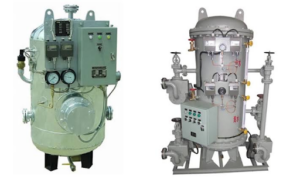
A hydrophore is a pressure-boosting system consisting primarily of a centrifugal pump, a pressure vessel (hydrophore tank), pressure switches, and associated piping. Its main purpose is to increase and maintain water pressure within the freshwater distribution system.
The hydrophore tank is partially filled with water and partially with compressed air. The air acts as a cushion that stores pressure, allowing water to be delivered smoothly without requiring the pump to run continuously.
The sanitary freshwater supplied by the hydrophore system is used for various onboard services, including:
These applications make the hydrophore one of the most important auxiliary systems onboard, ensuring uninterrupted freshwater availability throughout the vessel.

The hydrophore system operates automatically through a pressure-controlled cycle.
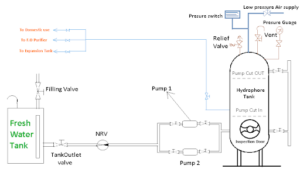
Fresh water is drawn from the ship’s freshwater storage tanks by an electrically driven centrifugal pump. Before entering the pump, the water passes through a filter that removes impurities and protects the pumping equipment.
The pump then delivers water into the hydrophore pressure vessel. Inside the vessel, compressed air occupies the upper portion while water fills the lower section. As more water enters the vessel, the trapped air is compressed, increasing the internal pressure.
A differential pressure switch continuously monitors the vessel pressure.
This automatic cycle continues without manual intervention, ensuring a constant supply of freshwater at the required pressure.
Maintaining the correct water level inside the hydrophore vessel is equally important for efficient operation.
When the vessel pressure drops to around 0.3 MPa, the water level should be near the MIN marking. This indicates that the vessel has discharged sufficient water and is ready for the pump to refill it.
As the pump raises the pressure to approximately 0.6 MPa, the water level should rise to the MAX marking. Proper synchronization between water level and pressure ensures efficient pressure storage and prevents unnecessary pump cycling.
If the air cushion is lost or the water level becomes incorrect, the pump may start and stop frequently, reducing equipment life and increasing maintenance requirements.
The hydrophore system offers several operational benefits:
Routine inspection and maintenance are essential to ensure dependable performance. Engineers should regularly:
Proper preventive maintenance significantly improves the reliability and lifespan of the entire freshwater distribution system.
The hydrophore pump system is an indispensable component of a ship’s freshwater supply network. By automatically maintaining pressure within the sanitary water system, it guarantees uninterrupted water delivery to accommodation spaces and essential machinery. Its simple yet highly effective design improves operational reliability, conserves energy, and reduces maintenance demands. Understanding its working principle and maintenance requirements is fundamental for every marine engineer, ensuring that the vessel’s freshwater system remains efficient throughout every voyage.
The primary purpose of a hydrophore pump system is to maintain constant pressure in the ship’s freshwater distribution network. It ensures a continuous supply of sanitary water to crew accommodation, galleys, bathrooms, and other onboard systems without the pump running continuously.
A hydrophore pump draws fresh water from the storage tank and pumps it into a pressure vessel containing both water and compressed air. As water is used onboard, the compressed air pushes water into the distribution system. When the pressure drops to the preset minimum level, the pressure switch automatically starts the pump, and it stops again once the maximum pressure is reached.
The compressed air inside the hydrophore tank acts as a pressure cushion. It stores energy by compressing as the tank fills with water and expands as water is consumed, maintaining steady water pressure and reducing frequent pump starts and stops.
Regular maintenance includes checking tank pressure and water levels, inspecting pressure switches, cleaning suction strainers, examining pumps and pipelines for leaks, verifying valve operation, and maintaining the correct air cushion in the pressure vessel. Proper maintenance improves system reliability and extends equipment life.
Disclaimer :- The opinions expressed in this article belong solely to the author and may not necessarily reflect those of Merchant Navy Decoded. We cannot guarantee the accuracy of the information provided and disclaim any responsibility for it. Data and visuals used are sourced from publicly available information and may not be authenticated by any regulatory body. Reviews and comments appearing on our blogs represent the opinions of individuals and do not necessarily reflect the views of Merchant Navy Decoded. We are not responsible for any loss or damage resulting from reliance on these reviews or comments.
Reproduction, copying, sharing, or use of the article or images in any form is strictly prohibited without prior permission from both the author and Merchant Navy Decoded.
Decoded Discount Alert! up to 50% OFF
Use Coupon Code Deep50