Hi this is Team Merchant Navy Decoded !!!

Please fill the below form with your query and we will get back to you in next 12 hours.

Rest assured your data is safe with us !!!🙂

Ask Your Query

Gear Pumps: Working Principle, Types, Applications, and Advantage

Gear pumps are among the most widely used positive displacement pumps in industrial and marine applications. Known for their simple design, reliability, and ability to handle high-viscosity fluids, gear pumps are extensively used for transferring fuel oils, lubricating oils, hydraulic fluids, chemicals, paints, and food products.

Unlike centrifugal pumps, which rely on velocity to move liquids, gear pumps deliver a fixed volume of fluid with each revolution, making them ideal for applications requiring accurate flow rates and high-pressure output.

What is a Gear Pump?

A gear pump is a type of positive displacement pump that moves fluid by trapping it between the teeth of rotating gears and the pump casing. As the gears rotate, they create a continuous flow of liquid from the suction side to the discharge side.

The pump delivers a smooth, pulse-free flow that is directly proportional to the rotational speed of the gears, making it highly efficient for metering and dosing operations.

Table of Contents

Working Principle of a Gear Pump

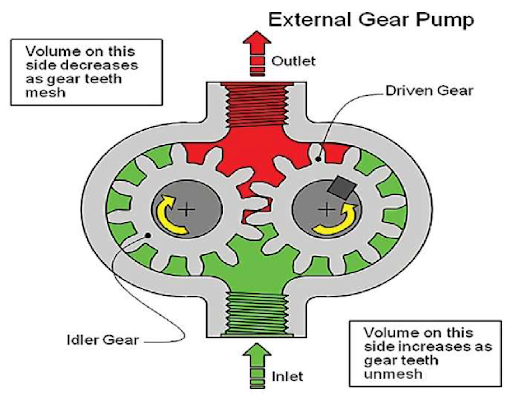
The operation of a gear pump is based on the meshing and unmeshing of gears.

  1. As the gear teeth separate at the suction side, a partial vacuum is created.
  2. This vacuum draws fluid into the spaces between the gear teeth.
  3. The trapped fluid is carried around the outer circumference of the gears within the pump casing.
  4. As the gears mesh together on the discharge side, the volume decreases.
  5. The fluid is squeezed out under pressure through the discharge port.

Since the gears prevent fluid from flowing backward, a continuous and positive flow is maintained.

Main Components of a Gear Pump

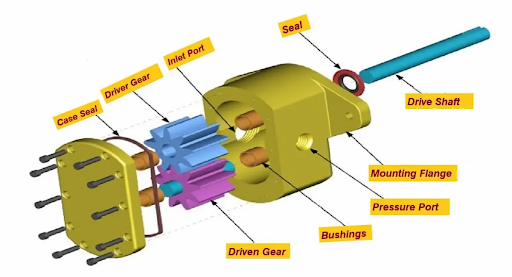
A typical gear pump consists of the following components:

  • Prime Mover (Electric Motor or Engine)
  • Driver Gear
  • Driven Gear (Idler Gear)
  • Pump Housing or Casing
  • Suction Port (Inlet)
  • Discharge Port (Outlet)
  • Pressure Relief Valve
  • Shaft Seal
  • Bearings

Each component plays an important role in ensuring smooth and efficient operation of the pump.

Types of Gear Pumps

1. External Gear Pump

An external gear pump consists of two identical external gears rotating in opposite directions inside a close-fitting casing.


One gear is connected to the driving shaft while the second gear rotates as a result of meshing with the first gear.

Features:

  • High pressure capability
  • Compact construction
  • Simple maintenance
  • Suitable for clean fluids

Common Gear Arrangements:

  • Spur Gears
  • Helical Gears
  • Herringbone Gears

Applications:

  • Fuel oil transfer
  • Hydraulic systems
  • Lubrication systems
  • Chemical dosing

2. Internal Gear Pump


An internal gear pump contains a larger internal gear (rotor) and a smaller external gear (idler) rotating inside it.

The idler gear is mounted eccentrically, creating cavities that trap and transport fluid. A crescent-shaped partition separates the suction and discharge sides.

Features:

  • Excellent suction capability
  • Handles extremely high-viscosity liquids
  • Suitable for shear-sensitive fluids
  • Smooth and quiet operation

Applications:

  • Bitumen and asphalt transfer
  • Food processing
  • Paints and coatings
  • Soaps and detergents
  • Resins and polymers

Advantages of Gear Pumps

  1. Accurate Flow Delivery: The output remains relatively constant regardless of discharge pressure, making gear pumps ideal for metering applications.
  2. High Pressure Capability: External gear pumps can generate pressures up to 3000 psi or higher in specialized designs.
  3. Self-Priming Operation: Gear pumps can create suction and lift liquids without requiring manual priming.
  4. Compact and Simple Design: With fewer moving parts, gear pumps are reliable and easy to maintain.
  5. Suitable for High-Viscosity Fluids: They efficiently handle oils, syrups, resins, and other thick liquids that are difficult for centrifugal pumps to move.
  6. Bidirectional Operation: Many gear pumps can operate in reverse, allowing the same pump to load and unload tanks.

Applications of Gear Pumps

Gear pumps are widely used across various industries:

Marine Industry

  • Fuel oil transfer
  • Lube oil circulation
  • Hydraulic steering systems
  • Cargo oil handling

Industrial Applications

  • Chemical transfer
  • Polymer processing
  • Hydraulic power units
  • Lubrication systems

Food Industry

  • Chocolate
  • Corn syrup
  • Peanut butter
  • Vegetable oils

Chemical Industry

  • Acids
  • Solvents
  • Resins
  • Caustic solutions

Gear Pumps in Marine Engineering

Onboard ships, gear pumps are commonly used for transferring heavy fuel oil (HFO), diesel oil, lubricating oil, and hydraulic fluids. Their ability to handle viscous fluids at relatively high pressures makes them an essential component of engine room operations.

Marine engineers frequently encounter gear pumps in:

  • Fuel transfer systems
  • Purifier feed systems
  • Hydraulic power packs
  • Lubrication systems

Understanding their operation and maintenance is therefore crucial for efficient shipboard machinery management.

Conclusion

Gear pumps are highly efficient positive displacement pumps designed for handling viscous liquids and delivering precise flow rates. Available in external and internal configurations, they offer excellent reliability, self-priming capability, and high-pressure performance. From marine fuel systems and hydraulic machinery to food processing and chemical plants, gear pumps continue to be one of the most versatile and dependable pumping solutions in modern industry. Proper maintenance and operation ensure long service life and optimal performance, making them indispensable in countless engineering applications.

Disclaimer :- The opinions expressed in this article belong solely to the author and may not necessarily reflect those of Merchant Navy Decoded. We cannot guarantee the accuracy of the information provided and disclaim any responsibility for it. Data and visuals used are sourced from publicly available information and may not be authenticated by any regulatory body. Reviews and comments appearing on our blogs represent the opinions of individuals and do not necessarily reflect the views of Merchant Navy Decoded. We are not responsible for any loss or damage resulting from reliance on these reviews or comments.

Reproduction, copying, sharing, or use of the article or images in any form is strictly prohibited without prior permission from both the author and Merchant Navy Decoded.

DIWALI SALE

Decoded Discount Alert! up to 50% OFF

DIWALI SALE

Decoded Discount Alert! up to 50% OFF

Use Coupon Code Deep50

Days
Hours
Seconds
0
Would love your thoughts, please comment.x
()
x