Hi this is Team Merchant Navy Decoded !!!

Please fill the below form with your query and we will get back to you in next 12 hours.

Rest assured your data is safe with us !!!🙂

Ask Your Query

Fuel Injector in Marine Diesel Engine

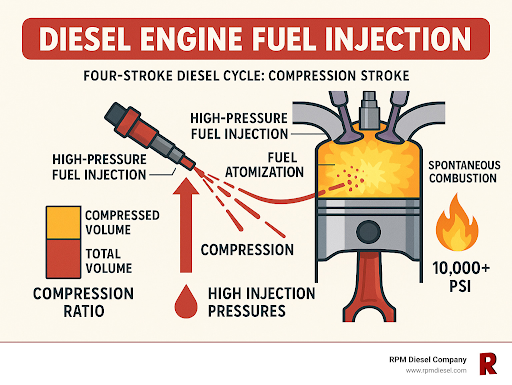
Fuel injectors are one of the most important components of a marine diesel engine. Their main function is to deliver fuel into the combustion chamber at the correct time, correct pressure, and in a finely atomized form. Proper fuel injection ensures efficient combustion, better engine performance, reduced fuel consumption, and lower exhaust emissions.

Marine diesel engines, especially auxiliary and main engines, operate under high pressure and temperature conditions. Therefore, fuel injectors are specially designed to withstand these harsh operating environments while maintaining precise fuel delivery.

Construction of a Fuel Injector

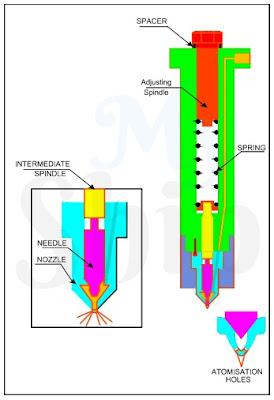
A marine fuel injector mainly consists of two basic parts:

  • Nozzle
  • Nozzle Holder or Injector Body


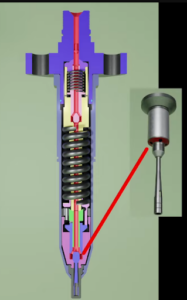
The nozzle and injector body are manufactured as a matching pair and are accurately ground to ensure a proper oil-tight seal. Both parts are connected together by a nozzle nut.


Main Parts of Fuel Injector

  • Needle valve
  • Spring
  • Compression nut
  • Intermediate spindle
  • Fuel passage
  • Nozzle holes
  • Circulation valve

Table of Contents

Working Principle of Fuel Injector

The working process of a marine diesel engine fuel injector can be explained in the following steps:

  1. Supply of High-Pressure Fuel

High-pressure fuel from the fuel injection pump enters the injector body through a fuel passage. The fuel then moves towards the nozzle chamber surrounding the needle valve.

  1. Needle Valve Remains Closed

The needle valve is normally kept closed by spring pressure acting through the intermediate spindle. This prevents fuel from entering the combustion chamber before the correct injection timing.

  1. Opening of Needle Valve

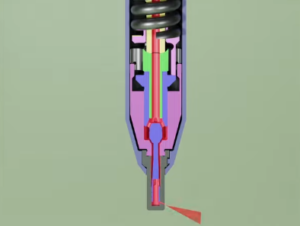
When fuel pressure increases sufficiently, the force acting on the tapered face of the needle valve overcomes the spring pressure. As a result, the needle valve lifts from its seat.

  1. Fuel Injection and Atomization

Once the valve opens, fuel flows into the lower chamber and exits through very small nozzle holes. These holes break the fuel into tiny droplets, a process known as atomization. Proper atomization helps the fuel mix efficiently with air for complete combustion.

  1. Closing of Needle Valve

When the fuel injection pump cuts off the high-pressure fuel supply, the fuel pressure decreases. The spring force then pushes the needle valve back onto its seat, stopping fuel injection immediately.

Fuel Circulation System

Most modern slow-speed two-stroke and medium-speed four-stroke marine diesel engines operate continuously on heavy fuel oil (HFO). Since heavy fuel oil becomes viscous at lower temperatures, a fuel circulating system is provided in the injector.

  • During engine operation, high-pressure fuel opens the circulation valve and injection takes place.
  • When the engine is stopped, the booster pump circulates heated fuel around the injector body to maintain proper temperature and prevent fuel solidification.

Older engine designs sometimes used cooling water circulation around injectors to control temperature.

Importance of Fuel Injector Maintenance

Regular inspection and maintenance of fuel injectors are essential because faulty injectors can lead to:

  • Poor combustion
  • Increased fuel consumption
  • Black smoke from exhaust
  • Loss of engine power
  • Engine knocking
  • Carbon deposits

Proper cleaning, pressure testing, and calibration of injectors help maintain efficient engine operation and improve the overall reliability of marine diesel engines.

Conclusion

Fuel injectors play a critical role in the operation of marine diesel engines by supplying fuel at the correct pressure and in atomized form. Their accurate functioning ensures efficient combustion, smooth engine performance, and fuel economy. Regular maintenance and inspection of injectors are therefore necessary for safe and efficient marine engine operations.

Disclaimer :- The opinions expressed in this article belong solely to the author and may not necessarily reflect those of Merchant Navy Decoded. We cannot guarantee the accuracy of the information provided and disclaim any responsibility for it. Data and visuals used are sourced from publicly available information and may not be authenticated by any regulatory body. Reviews and comments appearing on our blogs represent the opinions of individuals and do not necessarily reflect the views of Merchant Navy Decoded. We are not responsible for any loss or damage resulting from reliance on these reviews or comments.

Reproduction, copying, sharing, or use of the article or images in any form is strictly prohibited without prior permission from both the author and Merchant Navy Decoded.

DIWALI SALE

Decoded Discount Alert! up to 50% OFF

DIWALI SALE

Decoded Discount Alert! up to 50% OFF

Use Coupon Code Deep50

Days
Hours
Seconds
0
Would love your thoughts, please comment.x
()
x