Hi this is Team Merchant Navy Decoded !!!

Please fill the below form with your query and we will get back to you in next 12 hours.

Rest assured your data is safe with us !!!🙂

Ask Your Query

Drinking Water Analysis Report

Drinking Water Analysis Report

Fresh and clean waters are one of the most valuable resources for any ship’s crew. Only water carried on board or produced by the ship can be used when the vessel is in the middle of the ocean. Therefore water analysis is a routine procedure done by officers to examine the life supporting liquid and determine its suitability for consumption.

What is Drinking Water Analysis?

Drinking Water Analysis encompasses the tests conducted on water samples to establish their physicochemical and microbiological properties to ensure that the water is fit for human consumption. It checks if the onboard water is up to the quality standard and is safe for consumption before use by the crew and passengers.

Importance on Ships

  • Protects crew and passenger health
  • Prevents outbreaks of waterborne diseases
  • Ensures compliance with flag administration and company procedures
  • Helps detect contamination early
  • Supports safe operation of the Fresh Water Generator (FWG) and storage tanks

Sources of Drinking Water on Ships

  • Bunkered potable water – loaded from shore facilities
  • Fresh Water Generator (FWG) – produces water from seawater using evaporation or reverse osmosis
  • Shore supply – taken during port stay
  • Storage tanks – hold water for daily use

Clean tanks, pipelines and distribution systems are essential as contamination can occur even after water enters the ship in good condition.

Parameters Tested

Actual parameters tested depend on the applicable standard, shipboard procedure and laboratory requirements. Common ones include appearance, colour, odour, taste, pH, turbidity, TDS, conductivity, hardness, chloride, residual chlorine, iron, coliforms and E. coli.

Physical Analysis

  • Appearance/Colour – water should be clear; discolouration may indicate rust or organic matter
  • Odour/Taste – unusual smell or taste may indicate contamination or stagnation
  • Turbidity – measures cloudiness caused by suspended particles

Chemical Analysis

  • pH – indicates acidity or alkalinity, extreme values may cause pipe corrosion or scaling
  • TDS – total dissolved solids showing overall mineral content
  • Conductivity – related to dissolved salts/ions.
  • Hardness – amount of calcium and magnesium, high hardness can cause scaling
  • Chloride – indicates salinity or seawater ingress
  • Residual chlorine/disinfectant – confirms effective disinfection
  • Iron – excess iron affects taste, colour and pipework

Microbiological Analysis

  • Total coliforms – general indicator of possible contamination
  • E. coli – specific indicator of faecal contamination and health risk

Table of Contents

Common Tests and Purpose

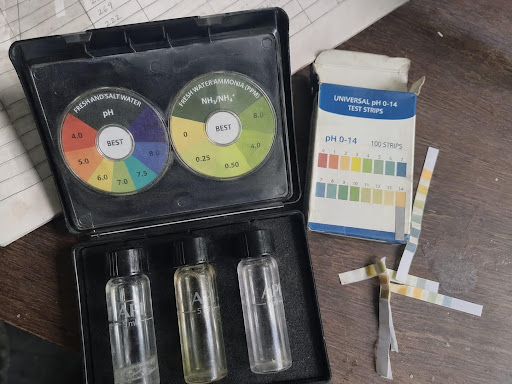
Tests are usually performed using test kits, comparator discs or portable meters, depending on ship’s equipment and company SMS requirements. The purpose is always the same to verify safety before consumption.

Sampling Procedure

  1. Select the correct sampling point
  2. Use a clean or sterile container as required
  3. Prepare the point 
  4. Collect the sample avoiding contamination.
  5. Label the sample properly
  6. Record date, time and location
  7. Send for analysis promptly within required conditions

Interpretation of Results

The results of water analysis need to be compared to the relevant regulations, flag administration requirements, company procedures and water quality standards to determine if any actions need to be taken. Engineers should use the appropriate reference values for the requirements and location of the vessel when interpreting the results. The results that indicate a deviation from the requirements and unusual trends need to be documented, reported to the master and investigated. If needed corrective measures should be taken to ensure that the quality of water is restored and the source of the problem is eliminated.

Common Problems Found

Common Problems Found
  • High turbidity
  • Unusual colour or odour
  • Incorrect pH
  • Excessive hardness
  • Low residual disinfectant
  • Microbiological contamination
  • Contaminated storage tanks

Measures

  • Inspect and clean tanks regularly.
  • Maintain proper disinfection as per SMS.
  • Repair leaks or damaged pipelines promptly.
  • Retest water after corrective action.
  • Report abnormal results to responsible officers.

Safety and Hygiene Precautions

  • Keep potable-water tanks clean
  • Prevent cross-contamination
  • Maintain hygienic sampling equipment
  • Follow proper sampling procedures
  • Regularly inspect tanks and pipelines
  • Maintain appropriate disinfection
  • Keep records of analysis results
  • Follow the vessel’s SMS and applicable regulations

Conclusion

Drinking water analysis is a routine obligation that should be performed to ensure that the ship’s water resources are not contaminated. The knowledge of the water’s characteristics like pH, turbidity, residual chlorine and microbiological quality can help detect any abnormalities in the water quality. Therefore, the information on water analysis and the standard permissible limits will be useful to future marine engineers in maintaining safe and healthy working conditions in the ships’ environment.

Frequently Asked Questions (FAQs)

To ensure that the water supplied on board is safe and suitable for consumption by the crew and passengers. Regular analysis helps detect contamination and maintain proper water quality.

pH testing checks whether the water is too acidic or too alkaline. Maintaining a suitable pH helps protect human health and prevents corrosion or damage to the ship’s water distribution system.

Residual chlorine is checked to confirm that the disinfection process is effective. It also helps ensure that the water remains protected against microbial contamination during storage and distribution.

Microbiological testing helps detect harmful bacteria and other microorganisms that may cause waterborne diseases. It is an important part of confirming that drinking water is safe for consumption.

Disclaimer :- The opinions expressed in this article belong solely to the author and may not necessarily reflect those of Merchant Navy Decoded. We cannot guarantee the accuracy of the information provided and disclaim any responsibility for it. Data and visuals used are sourced from publicly available information and may not be authenticated by any regulatory body. Reviews and comments appearing on our blogs represent the opinions of individuals and do not necessarily reflect the views of Merchant Navy Decoded. We are not responsible for any loss or damage resulting from reliance on these reviews or comments.

Reproduction, copying, sharing, or use of the article or images in any form is strictly prohibited without prior permission from both the author and Merchant Navy Decoded.

DIWALI SALE

Decoded Discount Alert! up to 50% OFF

DIWALI SALE

Decoded Discount Alert! up to 50% OFF

Use Coupon Code Deep50

Days
Hours
Seconds
0
Would love your thoughts, please comment.x
()
x