Hi this is Team Merchant Navy Decoded !!!
Please fill the below form with your query and we will get back to you in next 12 hours.
Rest assured your data is safe with us !!!🙂
Ask Your Query| For Beginner | For Professional |
|---|---|
| GME | Engine Side |
| G.P. Rating | Deck Side |
| ETO | G.P. Rating |
| IMUCET & Sponsorship | Combo Offers |
| Free Course | MEO |
| Free Course |
| For Beginner | For Professional |
|---|---|
| GME | Engine Side |
| G.P. Rating | Deck Side |
| ETO | G.P. Rating |
| IMUCET & Sponsorship | Combo Offers |
| Free Course | MEO |
| Free Course |
Hydraulic systems are widely used onboard ships and in industrial machinery because they provide reliable, powerful, and precise motion control. Whether operating a steering gear, cargo crane, hatch cover, or deck machinery, one component plays a critical role in controlling the movement of hydraulic actuators: the Directional Control Valve (DCV).

A directional control valve determines the path of hydraulic fluid within a system, allowing engineers to control the direction, start, stop, and holding position of hydraulic cylinders and motors. Without these valves, hydraulic systems would be unable to perform controlled movements safely and efficiently.

A directional control valve is a hydraulic valve designed to direct the flow of pressurized hydraulic fluid to different parts of a hydraulic circuit. By changing the internal flow path, the valve controls whether an actuator extends, retracts, stops, or remains in a neutral position.
In simple terms, a DCV acts like a traffic controller, deciding where hydraulic oil should flow at any given moment.

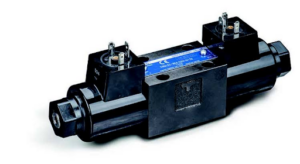
Most directional control valves use a sliding spool inside a valve body. The spool moves between different positions, opening and closing internal passages.
As the spool shifts:
The spool movement can be achieved manually, mechanically, hydraulically, pneumatically, or electrically using a solenoid.
Directional control valves are commonly identified by the number of ports and positions they possess.
A typical 4/3 directional control valve has:
When the spool moves to one side, hydraulic fluid is directed to one side of the cylinder, causing extension. Moving the spool to the opposite side reverses the flow, retracting the cylinder. Returning the spool to the center position stops or holds movement depending on the valve configuration.
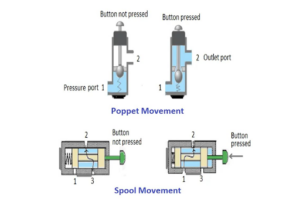
Spool valves are the most commonly used directional control valves in hydraulic systems. A cylindrical spool slides inside a precisely machined valve body, opening and closing different flow passages. They are simple, durable, and suitable for most industrial and marine applications.
A check valve is the simplest form of directional control valve. It allows hydraulic fluid to flow in only one direction while preventing reverse flow. These valves protect pumps and maintain system pressure.
Binary valves operate in only two states fully open or fully closed. They use poppets, plungers, or balls instead of spools and provide excellent sealing with minimal internal leakage.
Unlike standard on/off valves, proportional valves allow the spool to stop at intermediate positions. This enables smooth acceleration, deceleration, and precise speed control, making them ideal for advanced hydraulic machinery.
The center position of a 4/3 valve determines how hydraulic fluid behaves when the valve is not actuated.
Common center configurations include:
The choice of center configuration depends on the machine’s operational and safety requirements
Directional control valves can be operated using various mechanisms:
Modern marine hydraulic systems commonly use solenoid-operated pilot valves, where a small electrical signal controls pilot pressure that shifts the main spool. This arrangement enables remote operation while reducing electrical power requirements.
Directional control valves are extensively used onboard ships in systems such as:
Their ability to control heavy hydraulic loads safely makes them indispensable in marine engineering.
Directional control valves form the backbone of hydraulic motion control systems. By directing hydraulic fluid to the desired location, they enable precise control of cylinders and motors while ensuring safe, efficient, and reliable operation. From simple manually operated valves to sophisticated electro-hydraulic proportional systems, directional control valves remain essential components in modern marine and industrial hydraulic applications. A sound understanding of their construction, operation, and applications is fundamental for every marine engineer working with hydraulic machinery onboard ships.
A directional control valve (DCV) controls the direction of hydraulic fluid flow within a hydraulic system. It starts, stops, and changes the direction of fluid flow, allowing hydraulic cylinders and motors to extend, retract, or remain stationary as required.
A 4/3 directional control valve has four ports (Pressure, Tank, Port A, and Port B) and three spool positions (extend, neutral, and retract). It is one of the most commonly used valves in marine and industrial hydraulic systems because it provides precise control over actuator movement.
Directional control valves are widely used in marine hydraulic systems, including steering gear, cargo cranes, hydraulic winches, hatch cover systems, mooring equipment, deck machinery, stabilizer systems, bow thrusters, and hydraulic power units, where they control the movement of hydraulic actuators.
Directional control valves can be operated manually, mechanically, hydraulically, pneumatically, electrically using a solenoid, or through electro-hydraulic pilot operation. Modern ships commonly use solenoid-operated and electro-hydraulic valves for accurate remote control and improved system reliability.
Disclaimer :- The opinions expressed in this article belong solely to the author and may not necessarily reflect those of Merchant Navy Decoded. We cannot guarantee the accuracy of the information provided and disclaim any responsibility for it. Data and visuals used are sourced from publicly available information and may not be authenticated by any regulatory body. Reviews and comments appearing on our blogs represent the opinions of individuals and do not necessarily reflect the views of Merchant Navy Decoded. We are not responsible for any loss or damage resulting from reliance on these reviews or comments.
Reproduction, copying, sharing, or use of the article or images in any form is strictly prohibited without prior permission from both the author and Merchant Navy Decoded.
Decoded Discount Alert! up to 50% OFF
Use Coupon Code Deep50