Hi this is Team Merchant Navy Decoded !!!
Please fill the below form with your query and we will get back to you in next 12 hours.
Rest assured your data is safe with us !!!🙂
Ask Your Query| For Beginner | For Professional |
|---|---|
| GME | Engine Side |
| G.P. Rating | Deck Side |
| ETO | G.P. Rating |
| IMUCET & Sponsorship | Combo Offers |
| Free Course | MEO |
| Free Course |
| For Beginner | For Professional |
|---|---|
| GME | Engine Side |
| G.P. Rating | Deck Side |
| ETO | G.P. Rating |
| IMUCET & Sponsorship | Combo Offers |
| Free Course | MEO |
| Free Course |
A temperature transmitter is an important instrument used in industrial and marine systems to measure temperature and convert it into a standardized electrical signal. This signal is then transmitted to monitoring, control, or automation systems for further operation. Temperature transmitters are widely used onboard ships because machinery and engine systems require continuous temperature monitoring for safe and efficient functioning.
In marine applications, temperature transmitters help monitor critical parameters such as engine cooling water temperature, lubricating oil temperature, exhaust gas temperature, boiler temperature, and fuel oil heating systems. They improve automation, safety, and machinery protection onboard ships.
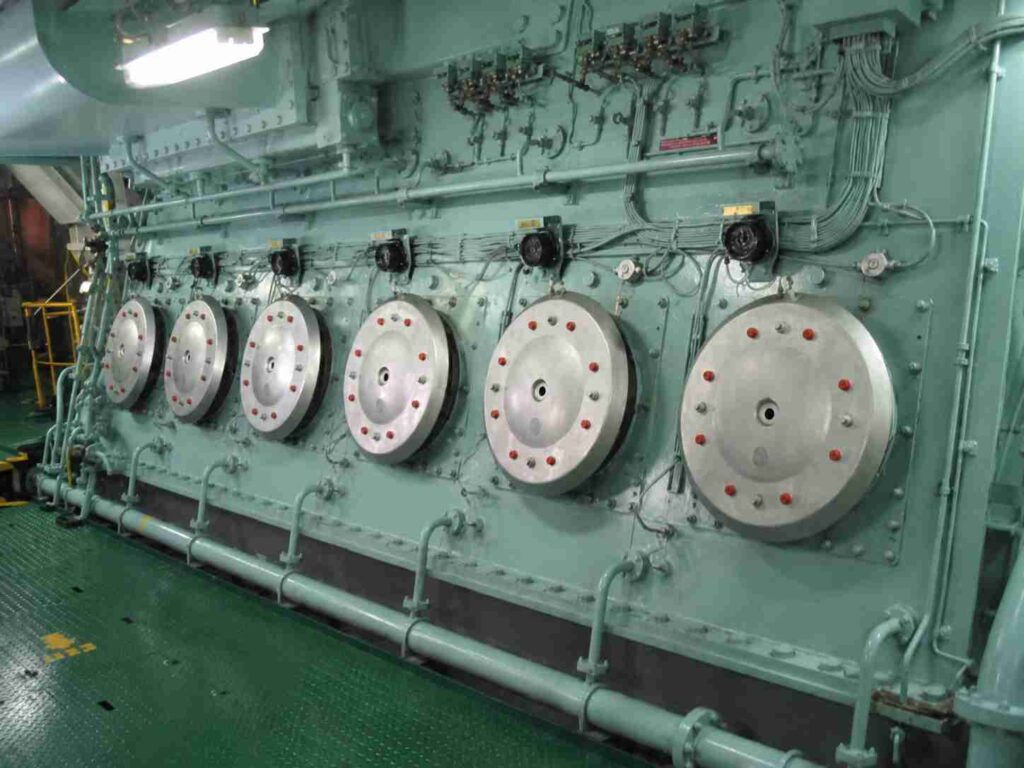
A Crankcase Explosion is an accidental explosion that occurs inside the crankcase of a marine diesel engine. It can happen in both the Main Engine and Auxiliary Engine onboard ships. Crankcase explosions are extremely dangerous because they can cause severe engine damage, fire, and injury to personnel working nearby.
Marine engineers must understand the causes, warning signs, preventive measures, and safety devices associated with crankcase explosions to ensure safe engine operation.
A crankcase explosion occurs when the three elements of the Fire Triangle are present:
The crankcase is connected to the atmosphere through the breather pipe, ensuring a continuous supply of air.
Lubricating oil droplets and vapors form an oil mist inside the crankcase.
A hotspot generated by an overheated bearing or mechanical friction acts as the ignition source.
When these three conditions combine, the risk of crankcase fire and explosion increases significantly.
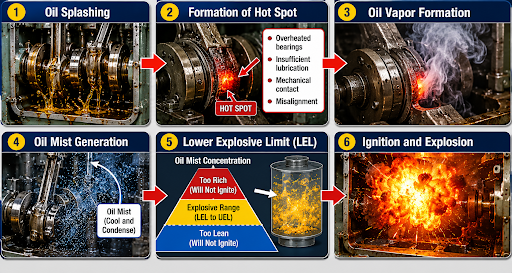
The complete process of crankcase explosion occurs in the following stages:
During normal engine operation, lubricating oil is continuously splashed onto cylinder liners and moving parts.
A hotspot may develop due to:
Oil that comes into contact with the hotspot evaporates and forms oil vapors.
As the vapors move away from the hotspot, they cool and condense into tiny oil droplets known as Oil Mist.
As oil mist concentration increases, a point is reached where the mixture becomes combustible. This point is called the Lower Explosive Limit (LEL).
If the hotspot temperature is sufficiently high, the oil mist ignites, causing a crankcase explosion. The severity of the explosion depends on the concentration of oil mist present inside the crankcase.
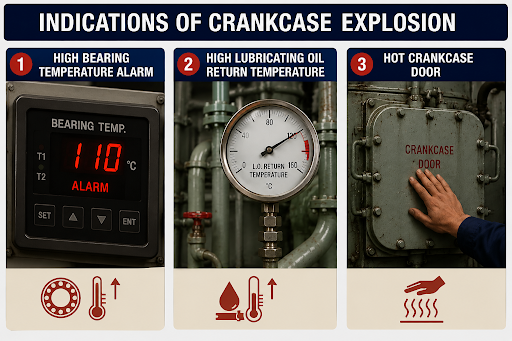
Marine engineers should immediately investigate the following warning signs:
An abnormal rise in bearing temperature may indicate overheating.
A sudden increase in lube oil return temperature can indicate excessive friction.
A crankcase door that feels unusually hot suggests internal overheating.
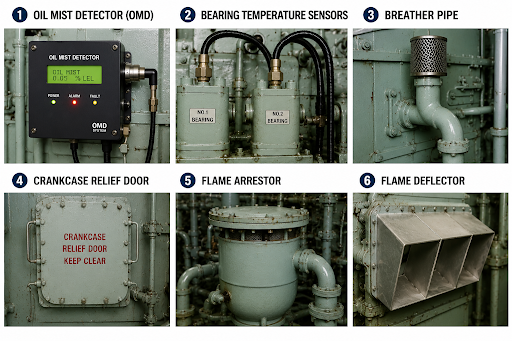
Modern marine diesel engines are equipped with multiple safety devices to prevent crankcase explosions.
Detects oil mist concentration inside the crankcase and provides an alarm before dangerous levels are reached.
Alarm Setting: Approximately 0.1% of LEL.
Monitor bearing temperatures continuously and trigger alarms when temperatures exceed safe limits.
Releases excess oil mist vapor and helps maintain safe crankcase pressure.
Fitted with explosion relief valves that release excess pressure during an explosion.
Prevents flames from escaping and spreading outside the crankcase.
Directs flames away from personnel standing near the engine.
According to International Maritime Organization SOLAS regulations:
Requirement | Value |
Minimum Free Area of Each Valve | 45 cm² |
Aggregate Valve Area | 115 cm² per m³ of crankcase volume |
Maximum Lifting Pressure | 0.2 Bar |
Separate relief valves are also required for:
when their volume exceeds 0.6 cubic meters.
To minimize the risk of crankcase explosions:
A Crankcase Explosion is one of the most critical hazards in marine diesel engines. It occurs when oil mist, air, and a heat source combine inside the crankcase. Understanding its causes, warning signs, explosion process, safety devices, and SOLAS requirements is essential for every marine engineer. Proper maintenance, continuous monitoring, and functioning safety devices significantly reduce the risk of crankcase explosions and ensure safe ship operations.
The primary cause is the ignition of oil mist formed due to an overheated bearing or hotspot inside the crankcase.
LEL is the minimum concentration of oil mist in air required for ignition and explosion.
An Oil Mist Detector monitors oil mist concentration and provides an early warning before explosive conditions develop.
They relieve excessive pressure generated during an explosion and prevent serious engine damage.
The maximum lifting pressure is 0.2 Bar.
Disclaimer :- The opinions expressed in this article belong solely to the author and may not necessarily reflect those of Merchant Navy Decoded. We cannot guarantee the accuracy of the information provided and disclaim any responsibility for it. Data and visuals used are sourced from publicly available information and may not be authenticated by any regulatory body. Reviews and comments appearing on our blogs represent the opinions of individuals and do not necessarily reflect the views of Merchant Navy Decoded. We are not responsible for any loss or damage resulting from reliance on these reviews or comments.
Reproduction, copying, sharing, or use of the article or images in any form is strictly prohibited without prior permission from both the author and Merchant Navy Decoded.
Decoded Discount Alert! up to 50% OFF
Use Coupon Code Deep50