Hi this is Team Merchant Navy Decoded !!!
Please fill the below form with your query and we will get back to you in next 12 hours.
Rest assured your data is safe with us !!!🙂
Ask Your Query| For Beginner | For Professional |
|---|---|
| GME | Engine Side |
| G.P. Rating | Deck Side |
| ETO | G.P. Rating |
| IMUCET & Sponsorship | Combo Offers |
| Free Course | MEO |
| Free Course |
| For Beginner | For Professional |
|---|---|
| GME | Engine Side |
| G.P. Rating | Deck Side |
| ETO | G.P. Rating |
| IMUCET & Sponsorship | Combo Offers |
| Free Course | MEO |
| Free Course |
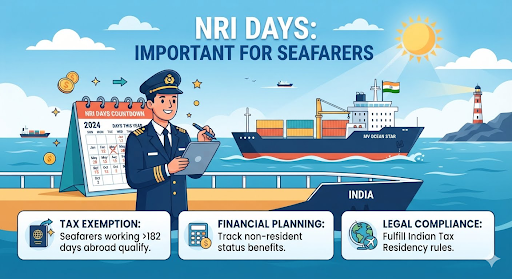
For seafarers, calculating the number of days spent outside India is important when determining residential status for a financial year. A financial year runs from 1 April to 31 March, and under the method discussed here, a seafarer who remains outside India for 182 days or more may qualify for the applicable non-resident treatment. However, the calculation depends on where you sign on and sign off, when you physically leave and return to India, and what your CDC and passport immigration records show.
The number of qualifying days outside India can affect a seafarer’s residential status and the tax treatment applicable to salary and other income. This is why a six-month sailing contract should not automatically be assumed to mean that 182 qualifying days have been completed. Actual departure and arrival dates need to be checked carefully.
For this calculation, one financial year runs from 1 April of a particular year to 31 March of the following year. Your qualifying days need to be calculated within this period.
If one contract crosses two financial years, the days falling in each financial year should be considered separately. You cannot simply combine the entire contract period and treat it as belonging to one financial year.
Suppose you are joining a vessel from an Indian port such as Visakhapatnam. In this situation, your CDC, sign-on details, and relevant Indian port or immigration records become important.
If your sign-on date is 17 September, the sign-on day itself is counted as a day in India under the method explained here. Therefore, your period outside India would begin from 18 September.
The same approach applies when you sign off at an Indian port. Suppose you sign off at Mumbai on 23 March. The sign-off day would again be treated as a day spent in India.
Your qualifying days outside India would therefore be counted up to the day before your sign-off or return date. The final total should then be checked to determine whether you have completed the required 182 days or more during that financial year.
The calculation becomes slightly different when you sign on and sign off at foreign ports. In such cases, the dates written in your CDC are important, but your actual departure from India and arrival back in India become even more important.
For example, you may leave India several days before your vessel sign-on date because you are travelling to a foreign joining port. Similarly, you may sign off abroad but return to India a few days later. Your actual time outside India can therefore be different from your shipboard service period.
Suppose you physically depart India on 13 September 2007 and return to India on 25 March 2008. Your passport immigration stamps will normally reflect these departure and arrival dates.
Under the calculation method discussed here, 13 September is treated as a day in India, and 25 March is also treated as a day in India. Therefore, the period outside India would be counted from 14 September 2007 to 24 March 2008.
If you sign on and sign off from Indian ports, your CDC and relevant port or immigration records may be used to understand your period outside India.
If you join or leave a vessel from foreign ports, passport immigration stamps become particularly important because they establish when you physically left India and when you returned. Seafarers should therefore maintain both CDC and passport records carefully rather than depending on only one document.
A foreign-flag vessel simply means that the ship is registered in another country. For example, the vessel may be registered in Panama, Liberia, Singapore, or another Flag State.
The shipping company itself may still be Indian or foreign. The nationality of the employer and the vessel’s flag are two different things. For the day calculation discussed here, your actual departure, arrival, sign-on, and sign-off records remain especially important.
A common mistake is calculating NRI days only from the date you joined the vessel until the date you signed off. This may not give the complete picture when you join or leave the ship at a foreign port.
Suppose your CDC shows that you joined on 17 September, but you actually left India on 13 September. Those additional days outside India may also become relevant under the method being discussed. The same principle applies when you return to India several days after signing off.
Keep clear copies of your passport immigration stamps, CDC entries, sign-on and sign-off dates, flight tickets, employment agreement, joining instructions, and other travel documents. These records can help establish when you actually left India and returned.
It is also useful to keep salary statements and bank records properly organised. If you later discuss your residential status or tax position with a Chartered Accountant, accurate records will make the process much easier.
Do not wait until the end of March to start checking your qualifying days. If your total is close to the required period, a small difference in travel dates can affect your final calculation.
After every sign-off, update your departure date, arrival date, sign-on date, and sign-off date. Maintaining a simple financial-year-wise record can prevent confusion when you eventually calculate your residential status.
To calculate NRI days correctly, first identify the financial year, then check where you signed on and signed off and when you actually departed from and returned to India. Use your CDC and passport immigration records instead of relying only on memory or contract length, and keep all supporting documents properly organised. For easier tracking, the Sailor Pro app for practical guidance that helps them stay more organised with taxation, finances, and other important aspects of their sailing career.
Under the criteria discussed here, a seafarer should complete 182 days or more outside India during the relevant financial year to qualify for the applicable non-resident treatment.
The financial year runs from 1 April of one year to 31 March of the following year.
Under the calculation method discussed here, the departure day is treated as a day in India. The period outside India starts from the following day.
Yes. Under the method discussed here, the arrival day is treated as a day spent in India.
CDC entries, sign-on and sign-off information, and relevant Indian port or immigration records may be important when a seafarer joins or leaves the vessel at an Indian port.
Passport immigration stamps become especially important because they show the actual dates on which the seafarer left India and returned.
Not necessarily. If you join or sign off at a foreign port, your physical departure from and return to India may be different from your CDC dates.
Yes. The Marine Calculator in SAILOR PRO can help seafarers enter relevant dates and calculate their qualifying period more easily.
Disclaimer :- The opinions expressed in this article belong solely to the author and may not necessarily reflect those of Merchant Navy Decoded. We cannot guarantee the accuracy of the information provided and disclaim any responsibility for it. Data and visuals used are sourced from publicly available information and may not be authenticated by any regulatory body. Reviews and comments appearing on our blogs represent the opinions of individuals and do not necessarily reflect the views of Merchant Navy Decoded. We are not responsible for any loss or damage resulting from reliance on these reviews or comments.
Reproduction, copying, sharing, or use of the article or images in any form is strictly prohibited without prior permission from both the author and Merchant Navy Decoded.
Decoded Discount Alert! up to 50% OFF
Use Coupon Code Deep50