Hi this is Team Merchant Navy Decoded !!!

Please fill the below form with your query and we will get back to you in next 12 hours.

Rest assured your data is safe with us !!!🙂

Ask Your Query

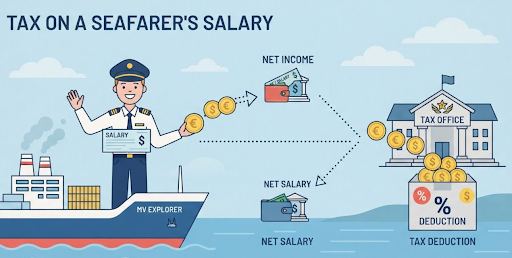
What is Tax Deduct on Seafarer Salary

A seafarer’s salary tax in India can depend on several factors, including whether the employer is an Indian or foreign company, the flag of the vessel, whether the ship is operating as coastal or foreign-going, and the seafarer’s tax-residency position during the financial year. Two seafarers earning the same salary may therefore have different TDS or tax situations depending on how and where they are employed.

What Decides Tax on a Seafarer’s Salary?

What is Tax Deduct on Seafarer Salary

The first thing to understand is that the company and the ship’s flag are two different things. You may work for an Indian company but sail on an Indian-flag or foreign-flag vessel. Similarly, a foreign company may operate foreign-flag vessels or use other structures. Along with this, whether the vessel is coastal or foreign-going can affect how the seafarer’s income and sailing period are treated.

Indian Company on an Indian-Flag Coastal Vessel

Suppose you are employed by an Indian company and working on an Indian-flag vessel operating only in coastal trade. In such a situation, the salary earned during coastal employment may generally be treated as Indian income according to the applicable tax rules.

The company may calculate the applicable income tax, deduct TDS or Tax Deducted at Source, and then credit the remaining salary into the seafarer’s bank account. The actual amount of TDS will depend on the applicable income-tax provisions and the individual seafarer’s taxable income.

What Is a Coastal Vessel?

A coastal vessel is a ship operating in coastal trade rather than continuously undertaking international voyages. A vessel may be designed or certified for foreign-going operations but may temporarily operate in coastal trade, subject to the required approvals, surveys, and formalities.

A vessel cannot simply change its operating status without meeting the applicable regulatory requirements. If a foreign-going vessel operates in coastal trade for the relevant period, the required conversion procedures may apply. When it later returns to international operations, the applicable reversion process may also be required.

Table of Contents

Indian Company on an Indian-Flag Foreign-Going Vessel

Now suppose the employer is still an Indian company and the vessel is Indian-flagged, but the ship is continuously operating on foreign-going routes. It may sail from India to destinations such as Dubai, Singapore, Myanmar, or other international ports.

The seafarer’s final tax treatment can then depend on whether the required conditions for non-resident tax status are satisfied during the financial year. At the time monthly salary is paid, however, the employer may not always know whether the seafarer will ultimately complete the required qualifying period.

Why Can TDS Be Deducted Initially?

Suppose a seafarer earns ₹1 lakh per month. Depending on the employer’s payroll and tax process, the company may initially deduct TDS and credit the balance into the seafarer’s bank account.

If the seafarer later satisfies the applicable conditions for non-resident tax treatment, the deducted tax may be dealt with through adjustment, refund, or the appropriate income-tax process. The exact procedure can depend on the company’s payroll system and the seafarer’s final tax position.

What Happens on a Mixed Coastal and Foreign-Going Route?

Some vessels do not remain completely coastal or completely foreign-going. For example, a ship may sail from Chennai to Mumbai, then to Dubai, return to an Indian port, and later sail internationally again.

For certain voyage patterns, a voyage involving a foreign port may be treated as part of the vessel’s foreign-going operation for the relevant calculation. However, if the vessel remains in coastal trade for a sufficiently long period and is formally converted to coastal status, the treatment of salary during that period can change.

Why the Vessel’s Operating Status Matters

The important point is that a vessel being capable of foreign voyages does not automatically mean that every period onboard will always be treated as foreign-going service. Its actual trading pattern and official status can matter.

Seafarers should therefore maintain proper records of joining, sign-off, vessel movements, foreign voyages, and any period during which the vessel was officially operating in coastal trade. These records can later become useful when determining the correct tax treatment.

Foreign Company and Indian-Flag Vessel

Foreign Company and Indian-Flag Vessel

A less common arrangement may involve a foreign company connected with an Indian-flag vessel through a particular corporate or registration structure. In such a case, the vessel’s coastal or foreign-going status may still remain important, but the employer’s responsibility for Indian TDS can differ from that of a normal Indian company.

The exact tax treatment in such structures should be checked according to the employment arrangement, vessel registration, and applicable tax rules rather than assuming that every foreign employer follows the same process.

Foreign Company on a Foreign-Flag Vessel

One of the more common arrangements for internationally sailing seafarers is employment with a foreign company on a foreign-flag vessel. The salary may be paid directly by the foreign employer, and the company may not deduct Indian TDS in the same way an Indian employer might.

In such situations, receiving the full salary without TDS does not automatically mean that no Indian tax responsibility exists. The seafarer still needs to determine the correct tax position according to residency status, qualifying days, income, and the applicable rules for that financial year.

Who Is Responsible for Tax When the Foreign Company Does Not Deduct TDS?

A foreign employer may simply pay the salary according to the employment contract and leave Indian tax compliance to the seafarer. This means the seafarer may need to work with a Chartered Accountant or qualified tax adviser to determine whether tax is payable and how the income should be reported.

This distinction is important. TDS and final tax liability are not always the same thing. Tax not being deducted from salary does not automatically mean that the income is tax-free, just as TDS being deducted initially does not always mean that the final tax liability will remain the same.

Why the Ship’s Flag Matters

Why the Ship’s Flag Matters

The flag represents the country in which the vessel is registered. An Indian-flag vessel is registered in India, while vessels registered in countries such as Panama, Liberia, Singapore, or the Marshall Islands are foreign-flag vessels.

For salary taxation, however, ship flag should not be looked at alone. The employer, vessel operation, coastal or foreign-going status, tax residency, and applicable income-tax rules should all be considered together.

What Should Seafarers Track During the Financial Year?

Seafarers should maintain accurate records of joining and sign-off dates, passport immigration entries, CDC records, vessel movements, salary statements, employment contracts, and bank credits. These documents can help establish the actual period spent outside India and the nature of employment.

Do not wait until the end of the financial year to start calculating sailing days. Tracking them throughout the year makes it easier to understand whether you are likely to satisfy the applicable residency conditions and whether any tax planning or documentation needs attention.

Do Not Assume Another Seafarer’s Tax Situation Applies to You

Two seafarers may work at the same rank and earn a similar salary but still have different tax situations. One may work on an Indian coastal vessel, another may be employed by an Indian company on a foreign-going vessel, and a third may work for a foreign company on a foreign-flag vessel.

That is why tax advice from colleagues should be treated carefully. Your own employment arrangement, sailing record, residency status, and income should be examined before deciding whether tax is payable or whether a particular exemption or treatment applies.

Final Advice on Seafarer Salary and Tax

The easiest way to understand seafarer taxation is to check four things: who employs you, what flag the vessel flies, whether the vessel is coastal or foreign-going, and whether you satisfy the applicable tax-residency conditions. Keep proper salary and sailing records and take professional tax advice when required instead of relying only on assumptions. Seafarers who want to understand taxation and organise their financial journey better can also explore  Sailor Pro app which is an initiative by Merchant Navy Decoded, can help seafarers stay more organised and confident in financial planning. 

Frequently Asked Questions (FAQs)

TDS may be deducted depending on the employer, nature of employment, tax position, and applicable rules. Indian employers may deduct TDS where required, while a foreign employer may not follow the same Indian payroll process.

Salary earned during coastal employment may generally be treated as Indian income according to the applicable tax rules. The final tax liability depends on the seafarer’s individual circumstances.

No. Sailing on a foreign-going vessel alone does not automatically make salary tax-free. The seafarer must also satisfy the applicable tax-residency and other legal conditions.

The ship’s flag can be relevant, but it is not the only factor. The employer, vessel’s operating status, residency conditions, qualifying sailing period, and applicable tax rules also matter.

A coastal vessel operates in coastal trade, while a foreign-going vessel operates on international routes. A vessel’s official operating status may change after the required regulatory procedures are completed.

Seafarers should keep employment contracts, salary statements, bank records, CDC entries, passport immigration records, joining and sign-off dates, and other evidence of their sailing period.

Yes. Seafarer taxation can depend on individual residency, salary, voyage patterns, and employment arrangements. A qualified tax professional can help determine the correct position for each financial year.

Disclaimer :- The opinions expressed in this article belong solely to the author and may not necessarily reflect those of Merchant Navy Decoded. We cannot guarantee the accuracy of the information provided and disclaim any responsibility for it. Data and visuals used are sourced from publicly available information and may not be authenticated by any regulatory body. Reviews and comments appearing on our blogs represent the opinions of individuals and do not necessarily reflect the views of Merchant Navy Decoded. We are not responsible for any loss or damage resulting from reliance on these reviews or comments.

Reproduction, copying, sharing, or use of the article or images in any form is strictly prohibited without prior permission from both the author and Merchant Navy Decoded.

DIWALI SALE

Decoded Discount Alert! up to 50% OFF

DIWALI SALE

Decoded Discount Alert! up to 50% OFF

Use Coupon Code Deep50

Days
Hours
Seconds
0
Would love your thoughts, please comment.x
()
x