Hi this is Team Merchant Navy Decoded !!!

Please fill the below form with your query and we will get back to you in next 12 hours.

Rest assured your data is safe with us !!!🙂

Ask Your Query

Clubbing of Income for Seafarers

Seafarers often transfer money to their spouse, children, or family members while working onboard. The money may be used for fixed deposits, mutual funds, property, household expenses, education, or long-term family planning. These transfers may look like simple family support, but they can create an Indian tax impact when the transferred money or asset starts generating income. A gift may be tax-free for the receiver, but interest, rent, dividend, capital gains, or other income from that gift may still be clubbed with the seafarer’s taxable income.

What is Clubbing of Income for Seafarers?

Clubbing of Income for Seafarers

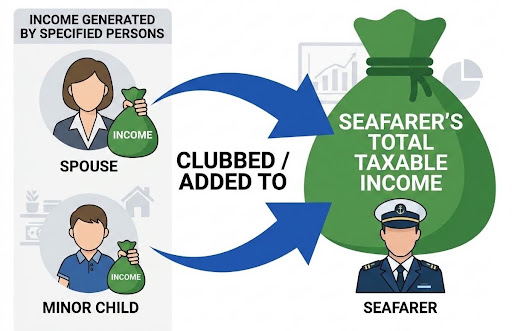
Clubbing of income means income earned by another person is added to your total income for tax calculation. The income may be received in the bank account of your spouse, minor child, son’s wife, or another specified person, but the tax law may still treat it as your income. The Income Tax Department explains that Schedule SPI is used to report income of specified persons included in the assessee’s total income under clubbing provisions.

Why Clubbing Rules Matter for Seafarers

Clubbing rules matter because seafarers often transfer large amounts to family members while sailing. A seafarer may send money to a spouse, who then opens a fixed deposit, invests in mutual funds, buys shares, or purchases property. The original transfer may be genuine family support, but the income generated from that transferred amount must be checked separately. Tax law does not only look at whose name appears on the investment. It also checks who transferred the asset and whether the income should be clubbed.

Gift and Income Are Not the Same

This is the most important point for seafarers. The gift amount and future income from that gift are two different things. Gifts received from specified relatives are generally exempt under Section 56. The Income Tax Department says relatives include spouse, brother, sister, brother or sister of spouse, brother or sister of either parent, lineal ascendant or descendant, and lineal ascendant or descendant of spouse. But future income from the gifted asset may still be taxable or clubbed.

Gift to Spouse and Clubbing of Income

A gift to spouse may be exempt when received because spouse is a specified relative. However, if the gifted money is invested and starts generating income, clubbing provisions may apply. For example, if a seafarer gifts ₹10 lakh to his wife and she opens a fixed deposit earning ₹70,000 interest, the gift itself may be exempt, but the interest may need to be added to the seafarer’s income depending on the facts. The FD name alone does not decide tax treatment.

Example of Clubbing on Gift to Spouse

Suppose a seafarer transfers ₹12 lakh to his spouse. The spouse invests the amount in mutual funds and later earns capital gains. The original transfer may not be taxable as a gift, but the capital gain should be examined under clubbing provisions. If the gain is linked to the asset transferred by the seafarer without adequate consideration, the income may be clubbed with the seafarer’s income. This is why family transfers should not be treated as automatic tax planning.

Spouse’s Independent Income is Not Clubbed

Spouse’s Independent Income is Not Clubbed

Clubbing does not mean every rupee earned by the spouse is taxed in the seafarer’s hands. If the spouse earns salary, professional income, business income, or investment income from her own savings, that income normally belongs to the spouse. For example, if the seafarer’s wife earns salary and creates a fixed deposit from her own salary, the interest is generally not clubbed only because she is married to the seafarer. The source of investment is very important.

Table of Contents

Income of Minor Child for Seafarers

Income of Minor Child for Seafarers

Income earned by a minor child may also be clubbed with the parent’s income. The Income Tax Department explains that clubbing provisions apply when a minor child earns income, and Schedule SPI covers income of specified persons such as spouse and minor child. For example, if a seafarer transfers money to a minor child’s bank account and that money earns interest, the interest may need to be included in the appropriate parent’s tax return.

When Minor Child Income May Not Be Clubbed

There are exceptions where minor child income may not be treated in the usual clubbing manner. If the child earns income through manual work, personal skill, talent, specialised knowledge, or experience, the treatment can be different. For example, income earned by a child through acting, music, sports, content creation, or another personal talent should be checked separately. But passive income from money gifted by parents, such as interest or investment returns, usually needs careful clubbing review before filing ITR.

Gift to Adult Child and Clubbing

Gifts to adult children are generally different from gifts to spouse or minor child. An adult son or daughter is a specified relative, so the gift itself may be exempt in the recipient’s hands. Future income from that gifted money is usually taxed in the adult child’s own hands, unless some special arrangement or indirect transfer creates a different result. For example, if a seafarer gifts ₹8 lakh to an adult daughter and she invests it, the future income is generally reported by her.

Transfer to Son’s Wife and Clubbing

Clubbing rules may also apply when a person transfers assets directly or indirectly to a son’s wife without adequate consideration. Many families miss this point because they assume that once money is transferred to another adult, all future income belongs only to that person. However, if a seafarer or family member transfers money or assets to a daughter-in-law and that asset generates income, the connection between the original transfer and future income should be examined carefully before filing tax returns.

Revocable Transfer and Clubbing of Income

A revocable transfer is another case where clubbing may apply. If an arrangement allows the asset or income to come back to the person who transferred it, the income may be taxable in the transferor’s hands. This means simply placing money, property, or investments in another person’s name does not always shift tax responsibility. The legal terms of transfer, control over the asset, and right to receive income are important. Seafarers should avoid artificial arrangements created only to reduce tax.

Clubbing on Fixed Deposit Income for Seafarers

Clubbing on Fixed Deposit Income

Fixed deposits are one of the most common examples. A seafarer may gift money to a spouse or minor child, and the recipient may open an FD. The FD interest may be credited to the recipient’s account, but that does not automatically mean it belongs to the recipient for tax purposes. If the investment was made from the seafarer’s transferred funds and clubbing provisions apply, the interest may need to be included in the seafarer’s income under the correct head.

Clubbing on Mutual Fund Income for Seafarers

Clubbing on Mutual Fund Income

Mutual fund investment can also create clubbing issues. If a seafarer transfers money to a spouse and the spouse invests it in mutual funds, future capital gains or IDCW income may need to be checked. A switch, redemption, or payout can create taxable income. If that income arises from an asset transferred without adequate consideration, clubbing provisions may apply depending on facts. Seafarers should keep investment statements, source-of-funds proof, and transfer records before assuming the income belongs only to the spouse.

Clubbing on Property Income for Seafarers

Clubbing on Property Income for Seafarers

Property income can also be affected. If a seafarer transfers funds or property to a spouse without adequate consideration and the property generates rent or capital gains, clubbing provisions may need review. For example, if money gifted to a spouse is used to buy a rental property, the rental income should not be blindly reported only in the spouse’s ITR. The source of funds, ownership structure, legal documentation, loan details, and transfer route should be checked carefully.

Clubbing Does Not Stop Family Support

Clubbing rules do not stop seafarers from supporting their family. Sending money to spouse, children, parents, or family members is normal and often necessary. The rule only decides who should report and pay tax on the income generated from certain transfers. A seafarer can still gift money, support household expenses, pay school fees, help parents, or invest for family goals. The key is to understand whether future income from the transfer will be taxed in the recipient’s hands or clubbed back.

How Seafarers Should Maintain Family Transfer Records

Seafarers Should Maintain Family Transfer Records

Every major family transfer should have a clear financial trail. The seafarer should preserve bank statements showing the transfer, recipient bank statements, gift declaration or gift deed where appropriate, and evidence of source of funds. Salary records, remittance advice, NRE/NRO statements, employment contracts, passport entries, CDC records, and sign-on/sign-off proof can support the money trail. The recipient should also keep investment statements, FD certificates, interest certificates, mutual fund statements, property papers, and capital-gain reports.

Why Gift Deed Helps in Clubbing Cases

A gift deed does not automatically remove clubbing provisions, but it helps prove the nature of transfer. It can show the donor, recipient, relationship, amount, date, bank route, and voluntary nature of the gift. This is useful if the Income Tax Department or bank asks about a large credit in the recipient’s account. However, seafarers should remember that a gift deed proves the gift; it does not automatically make future income tax-free. Future income must still be checked separately.

Reporting Clubbed Income in ITR

Reporting Clubbed Income in ITR

When clubbing applies, the income should not be ignored only because it appears in a family member’s bank account. It should be included under the correct income head, such as interest income, house property income, capital gains, or business income. The Income Tax Department’s ITR-2 user manual says Schedule SPI requires income of specified persons, such as spouse or minor child, that is includable or required to be clubbed with the taxpayer’s income under Section 64.

Schedule SPI for Seafarers

Schedule SPI is important when clubbed income has to be reported in the ITR. The Income Tax Department’s Schedule SPI guidance says the taxpayer has to provide details such as the name of the person whose income is includible, PAN or Aadhaar where applicable, relationship with the assessee, and amount of income to be included. This helps report income of spouse, minor child, son’s wife, or other specified persons in a structured way.

ITR Form Selection and Clubbing

Seafarers should also choose the correct ITR form. The Income Tax Department’s ITR-2 FAQ says ITR-2 can be used by individuals or HUFs who have income of another person like spouse or minor child to be clubbed, if the income to be clubbed falls in the relevant categories. However, the correct ITR depends on the seafarer’s total income, residential status, capital gains, foreign income, business income, and other facts.

AIS and Form 26AS for Clubbing of Income

Before filing ITR, seafarers should check AIS, Form 26AS, bank statements, investment records, and TDS details. AIS contains financial information reported against PAN and allows taxpayers to review and give feedback. The Income Tax portal explains that from AY 2023-24 onwards, Form 26AS mainly displays TDS/TCS data, while other taxpayer details are available in AIS. This is important because income may appear in one person’s records, but clubbing may require reporting by another person.

Common Clubbing Mistakes Seafarers Should Avoid

The biggest mistake is assuming that a tax-free gift always creates tax-free income. Another mistake is investing in spouse or minor child’s name only to reduce tax without checking clubbing provisions. Some seafarers do not maintain gift deeds, bank proof, salary records, or investment statements. Others report income only in the recipient’s ITR even when clubbing applies. These mistakes can create tax mismatch, wrong ITR filing, refund delay, AIS confusion, or future notices from the department.

Simple Clubbing Checklist for Seafarers

Before making a large family transfer, seafarers should check who is receiving the money, what relationship they have with the recipient, whether the transfer is a gift or loan, how the money will be invested, what income it may generate, and whether clubbing provisions may apply. They should also check which ITR schedule will be used, whether Schedule SPI is required, whose PAN will show the income, and what documents are needed to support the transaction.

When Should Seafarers Take CA Help?

Seafarers should take CA help if they transfer large amounts to spouse, minor child, son’s wife, or family members and the money is invested in FDs, mutual funds, shares, property, or business. CA guidance is also useful if AIS shows income in one person’s PAN but clubbing may require reporting in another person’s ITR. Professional review is strongly recommended when foreign salary, NRE/NRO accounts, capital gains, property income, or multiple family transfers are involved.

Keep Your Family Finances Tax-Safe

Download Sailor Pro App – Built for Seafarers, an Initiative by Merchant Navy Decoded, to stay more organised and confident in your financial planning. 

Frequently Asked Questions (FAQs)

Clubbing of income means income earned by another person, such as spouse or minor child, is added to the seafarer’s total income for tax calculation if clubbing provisions apply.

The gift itself may be exempt because spouse is a specified relative. However, income generated from the gifted asset may be clubbed with the seafarer’s income depending on the facts.

No, spouse’s independent salary is generally not clubbed with the seafarer’s income. Clubbing usually arises when income is linked to assets transferred by the seafarer without adequate consideration.

Yes, income of a minor child may generally be clubbed with the income of the appropriate parent, subject to exceptions such as income from the child’s own skill, talent, knowledge, or manual work.

A gift to parents may be exempt, and income generated from that gift is generally taxed in the parents’ hands. However, proper records should still be maintained.

Usually, future income from a gift to an adult child is taxed in the adult child’s own hands. However, documentation and facts should be checked properly.

Schedule SPI is used to report income of specified persons, such as spouse or minor child, that is required to be clubbed with the taxpayer’s income under Section 64.

Yes, if clubbing provisions apply, the income should be included in the seafarer’s ITR under the correct income head and reported through the relevant schedule.

Seafarers should keep bank statements, salary proof, remittance records, gift deed, recipient bank statement, investment records, FD certificates, mutual fund statements, property papers, AIS, and Form 26AS.

CA help is recommended when large family transfers, spouse investments, minor child investments, property income, mutual fund gains, NRE/NRO accounts, or AIS mismatch issues are involved.

Disclaimer :- The opinions expressed in this article belong solely to the author and may not necessarily reflect those of Merchant Navy Decoded. We cannot guarantee the accuracy of the information provided and disclaim any responsibility for it. Data and visuals used are sourced from publicly available information and may not be authenticated by any regulatory body. Reviews and comments appearing on our blogs represent the opinions of individuals and do not necessarily reflect the views of Merchant Navy Decoded. We are not responsible for any loss or damage resulting from reliance on these reviews or comments.

Reproduction, copying, sharing, or use of the article or images in any form is strictly prohibited without prior permission from both the author and Merchant Navy Decoded.

DIWALI SALE

Decoded Discount Alert! up to 50% OFF

DIWALI SALE

Decoded Discount Alert! up to 50% OFF

Use Coupon Code Deep50

Days
Hours
Seconds
0
Would love your thoughts, please comment.x
()
x