Hi this is Team Merchant Navy Decoded !!!
Please fill the below form with your query and we will get back to you in next 12 hours.
Rest assured your data is safe with us !!!🙂
Ask Your Query| For Beginner | For Professional |
|---|---|
| GME | Engine Side |
| G.P. Rating | Deck Side |
| ETO | G.P. Rating |
| IMUCET & Sponsorship | Combo Offers |
| Free Course | MEO |
| Free Course |
| For Beginner | For Professional |
|---|---|
| GME | Engine Side |
| G.P. Rating | Deck Side |
| ETO | G.P. Rating |
| IMUCET & Sponsorship | Combo Offers |
| Free Course | MEO |
| Free Course |
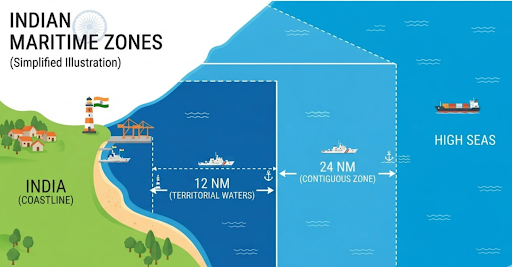
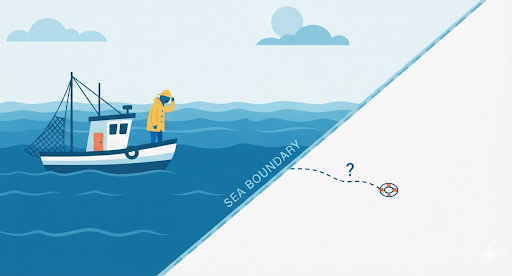
The term Indian waters is often used generally by seafarers, but legally India’s maritime area is divided into different zones. The three important limits to understand are 12 nautical miles, 24 nautical miles, and 200 nautical miles. Each represents a different maritime zone and gives India a different level of sovereignty, enforcement power, or economic rights under the Territorial Waters, Continental Shelf, Exclusive Economic Zone and Other Maritime Zones Act, 1976.
India’s territorial waters extend up to 12 nautical miles from the appropriate baseline, not 24 nautical miles. The 24-nautical-mile limit refers to the Contiguous Zone, where India has specific enforcement powers but not the same full sovereignty that applies within the Territorial Sea.
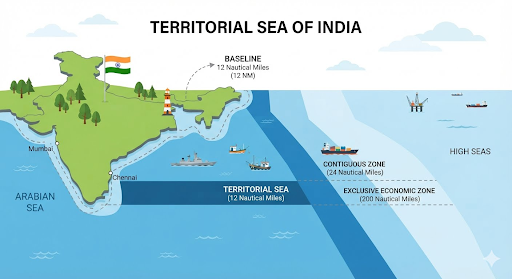
The Territorial Sea extends up to 12 nautical miles from India’s baseline. Within this zone, India’s sovereignty extends over the waters as well as the seabed, subsoil, and airspace above them. This is the maritime zone most closely connected with what people usually mean when they refer to India’s territorial waters.
However, territorial sovereignty does not mean that foreign merchant ships can never enter these waters. Indian law recognises the right of innocent passage for foreign ships, provided the passage is not prejudicial to India’s peace, good order, or security.
The confusion arises because India also has a Contiguous Zone extending up to 24 nautical miles from the baseline. Since the Territorial Sea already extends to 12 nautical miles, the Contiguous Zone lies beyond it and extends outward to the 24-nautical-mile limit.
India does not exercise the same complete territorial sovereignty throughout this zone. Instead, the Central Government can exercise powers relating to areas such as security, immigration, sanitation, customs, and fiscal matters. This is why saying that “Indian territorial waters extend up to 24 nautical miles” is not legally accurate.
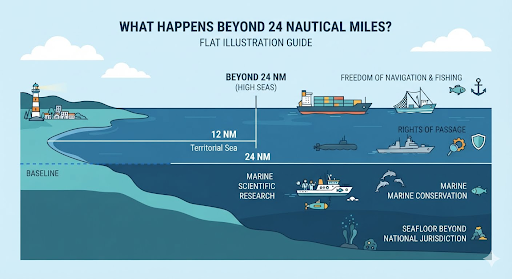
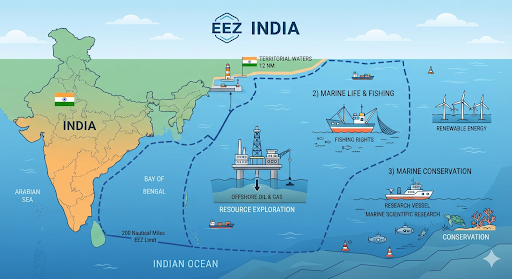
Beyond the Contiguous Zone comes a much larger maritime area known as the Exclusive Economic Zone, or EEZ. India’s EEZ extends up to 200 nautical miles from the appropriate baseline.
This does not mean the entire 200-nautical-mile area is Indian territory in the same way as the Territorial Sea. Instead, India has important sovereign rights over natural resources and jurisdiction over specific activities within the EEZ.
Within the EEZ, India has sovereign rights for the exploration, exploitation, conservation, and management of natural resources, including living and non-living resources. These rights can cover resources such as fish, oil, gas, minerals, and energy generated from tides, winds, and currents.
India also has jurisdiction relating to artificial islands and offshore installations, scientific research, and protection of the marine environment. At the same time, ships and aircraft of other States continue to enjoy freedom of navigation and overflight, subject to India’s lawful rights within the zone.
The location of an incident can become important when there is an accident, disappearance, death, pollution incident, or another maritime casualty. Whether an event happened within territorial waters, the Contiguous Zone, the EEZ, or farther offshore may affect which authorities investigate and what jurisdictional questions arise.
However, location alone does not decide every issue. The vessel’s flag State, employment agreement, applicable law, investigation findings, and circumstances of the casualty may also be relevant when determining responsibility or compensation.
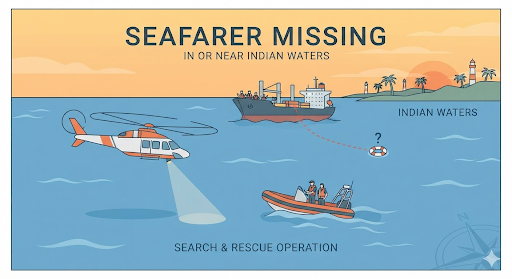
If a seafarer goes missing, Search and Rescue authorities and maritime investigators may examine witness statements, vessel records, CCTV footage, logbooks, the ship’s position, and other evidence to understand what happened.
Investigation reports may eventually describe a seafarer as missing or missing, presumed dead, depending on the evidence. This classification can later become important when the family seeks compensation or other employment-related benefits.
Older legal references commonly describe the seven-year rule under Section 108 of the Indian Evidence Act, 1872. However, that Act has now been replaced by the Bharatiya Sakshya Adhiniyam, 2023, which came into force on 1 July 2024. The corresponding current provision is Section 111.
Section 111 provides that where a person has not been heard of for seven years by people who would naturally have heard from them if they were alive, the burden of proving that the person is still alive shifts to the person asserting it.
Not necessarily. The seven-year evidentiary rule should not automatically be understood to mean that every family of a missing seafarer must wait seven years before any compensation can be considered.
If marine casualty reports, Search and Rescue findings, witness evidence, Flag State investigations, and other available records strongly establish the circumstances of the disappearance, the contractual or compensation position may need to be considered under the applicable CBA, Seafarer Employment Agreement, insurance arrangements, and maritime law.
For seafarers, the simplest point to remember is that India’s Territorial Sea is 12 nautical miles, not 24 nautical miles. The limit up to 24 nautical miles is the Contiguous Zone, while the EEZ extends up to 200 nautical miles and primarily gives India sovereign rights over resources and certain activities.
Keeping these important career and financial matters organised through. Sailor Pro app, a platform built specifically to support seafarers with practical tools and guidance.
India’s Territorial Sea extends up to 12 nautical miles from the appropriate baseline.
Not in the same sense as territorial waters. The area up to 24 nautical miles is the Contiguous Zone, where India has specified enforcement powers.
India’s Exclusive Economic Zone extends up to 200 nautical miles from the baseline. India has sovereign rights over natural resources and certain economic and regulatory activities within this zone.
India exercises sovereignty within the Territorial Sea up to 12 nautical miles. In the Contiguous Zone up to 24 nautical miles, India exercises more limited powers relating to matters such as security, customs, immigration, sanitation, and fiscal matters.
Search and Rescue operations and maritime investigations may be conducted. Evidence such as witness statements, CCTV, vessel records, and logbooks can be used to determine the circumstances of the disappearance.
Under current Section 111 of the Bharatiya Sakshya Adhiniyam, 2023, if a person has not been heard of for seven years by those who would naturally have heard from them, the burden shifts to anyone claiming that the person is still alive.
Disclaimer :- The opinions expressed in this article belong solely to the author and may not necessarily reflect those of Merchant Navy Decoded. We cannot guarantee the accuracy of the information provided and disclaim any responsibility for it. Data and visuals used are sourced from publicly available information and may not be authenticated by any regulatory body. Reviews and comments appearing on our blogs represent the opinions of individuals and do not necessarily reflect the views of Merchant Navy Decoded. We are not responsible for any loss or damage resulting from reliance on these reviews or comments.
Reproduction, copying, sharing, or use of the article or images in any form is strictly prohibited without prior permission from both the author and Merchant Navy Decoded.
Decoded Discount Alert! up to 50% OFF
Use Coupon Code Deep50