Hi this is Team Merchant Navy Decoded !!!

Please fill the below form with your query and we will get back to you in next 12 hours.

Rest assured your data is safe with us !!!🙂

Ask Your Query

Ship Repair and Maintenance: How PMS and Drydocking Actually Fit Together

Ship Repair and Maintenance

Every ship is losing a quiet battle against itself from the day it’s delivered. Steel corrodes, bearings wear, seals harden, coatings break down none of it happens fast enough to notice day to day, but all of it happens constantly. Ship repair and maintenance is really just the organised, documented effort to stay ahead of that decline rather than discover it the hard way, at sea, at the worst possible moment.

Most of that effort happens through two very different mechanisms working together. One runs continuously, in the background, for the ship’s entire operating life, the Planned Maintenance System.
The other happens periodically, with the ship pulled out of the water entirely drydocking. They’re not really separate topics so much as two halves of the same picture, and understanding how they connect is more useful than treating either one in isolation.

Why This Isn't Just Good Practice It's a Regulatory Requirement

It’s tempting to think of maintenance as simply sensible operational discipline, the kind of thing any well-run company would do anyway. That’s true, but it undersells how deeply maintenance is actually woven into the regulatory structure a ship operates under. The ISM Code requires every company holding a Document of Compliance to run a documented system keeping the ship and its equipment in conformity with the rules, and SOLAS Chapter II-1 sets out the underlying maintenance obligations for machinery and structure that sit behind it. Flag states, port state control, and classification societies all expect to see evidence of a systematic approach, not a good working memory and a shrug.

Classification societies take this a step further than most people realise. A properly implemented Planned Maintenance System isn’t just accepted as evidence it can actually be used as an alternative to certain class surveys, spreading machinery inspection across the year through what’s called a Continuous Machinery Survey rather than concentrating everything into one intense session during drydock. That’s a genuinely significant deal for a ship’s operating schedule, and it only works if the PMS records are actually good enough to survive a surveyor’s scrutiny.

Table of Contents

Routine Maintenance and the Planned Maintenance System

At its core, a PMS is a complete registry of everything on board that needs attention, linked to scheduled jobs, tracking when each one comes due and recording what was actually done, by whom, and with what parts. That sounds almost administrative when you say it plainly, but the result is what actually matters: a continuous, auditable history of the ship’s mechanical condition that a chief engineer, a technical superintendent, or a class surveyor can all read the same way.

Modern maintenance programmes don’t lean on a single strategy. They blend a few:

  • Preventive maintenance runs on fixed intervals: A quarterly check on lifeboat appliances, an annual gas detector calibration, a fuel pump overhaul every couple thousand running hours. It doesn’t wait for something to actually go wrong; it assumes wear is happening on a predictable schedule and gets ahead of it.
  • Corrective maintenance is what happens when something breaks anyway a cargo pump seal starts leaking, say  and it gets logged as a defect in the PMS and tracked through to a close, rather than fixed quietly and forgotten. That tracking matters more than it sounds like it should, because it’s what keeps unplanned work visible to everyone who needs to see it, not just the person holding the wrench.
  • Condition-based maintenance is the newer layer on top of both: Lube oil analysis, vibration trends, exhaust temperature spreads, that kind of thing  adjusting the maintenance cycle based on how the equipment is actually behaving rather than sticking rigidly to a calendar that might be either too conservative or not conservative enough for a specific machine’s real condition.


None of this replaces the class survey calendar entirely; items like the annual survey, intermediate survey, boiler survey, and tailshaft survey still happen on schedule regardless of how good the PMS is. What a strong PMS actually buys is flexibility and evidence: flexibility in when certain machinery gets opened up, and evidence, when a surveyor asks, that the equipment’s actual condition justifies the interval it’s being maintained on.

Drydocking: The Part That Can't Be Done Afloat

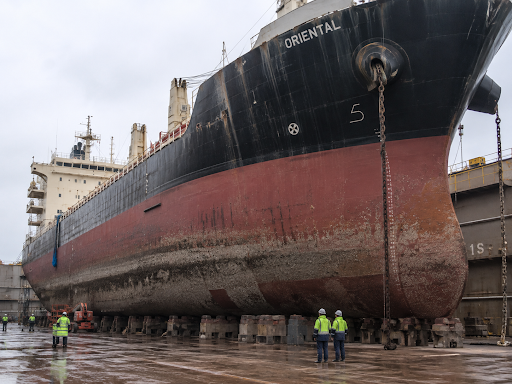
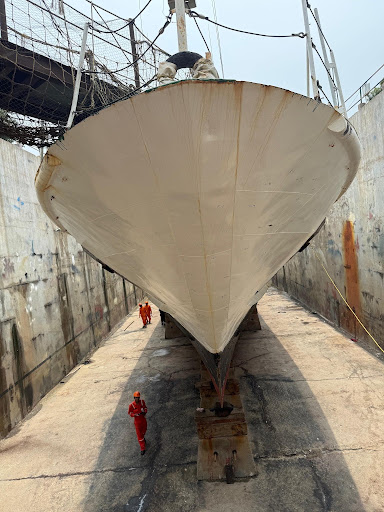
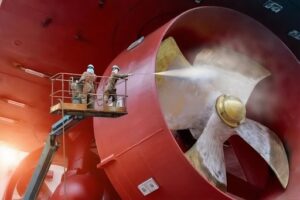
Some things about a ship simply can’t be inspected, cleaned, or repaired while it’s still floating. The underwater hull, the propeller, the rudder, sea valves, the tailshaft  all of it sits permanently submerged during normal operation, invisible and inaccessible to the crew no matter how good the PMS is. Drydocking exists specifically to solve that problem, by lifting the entire vessel out of the water so all of it can actually be seen and worked on.

The regulatory rhythm behind this is fairly consistent across classification societies: Ships generally need two dockings within any five-year period, with a special survey the most thorough inspection a vessel undergoes  occurring roughly every five years and usually combined with one of those dockings, while an intermediate docking or survey happens somewhere around the midpoint, typically not more than about 36 months after the last one. 

Special surveys get more demanding as a ship ages too; the inspection done at five years old is noticeably lighter than the one done at fifteen, with more material actually being removed and tested to assess genuine condition rather than just visual appearance.

Not every docking has to be a physical one. An in-water survey, carried out by an approved underwater inspection provider, can sometimes substitute for an intermediate docking if it gives equivalent information  and some classification societies now run Extended Dry-Docking programmes that push the interval out from five years to as much as seven and a half, provided the ship meets stricter conditions along the way, including underwater inspections in the interim. It’s a genuine operational benefit for an owner, but it’s earned through consistently demonstrated condition, not simply requested.

What actually happens once a ship is in dock follows a fairly predictable shape: 

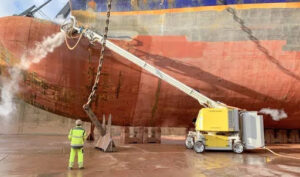
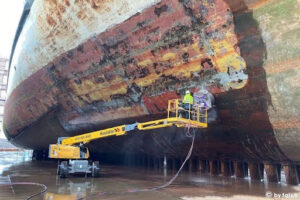
  • High-pressure washing to strip off marine growth and old coating, then a structured programme of inspection covering hull plating, the stern frame, rudder, sea chests and valves, followed by cleaning.
  • Steel renewal wherever thickness measurements come back below limits, and repainting with an antifouling system that keeps the hull efficient until the next docking. A class surveyor attends throughout to verify the structural and machinery items required for that survey cycle actually get done and done properly; this isn’t work that happens quietly with paperwork filed afterward, it happens under direct observation.

  • None of it is quick or cheap. A routine docking might run ten to fourteen days; a full special survey with a heavier scope of work can stretch to three or four weeks, and unexpected findings  corrosion worse than expected, steel that needs renewing beyond what was planned  extends that further almost every time. Planning genuinely starts months, sometimes the better part of a year, before the ship actually enters the dock, because between yard selection, tendering, spare parts procurement, and coordinating everyone from the technical superintendent to specialist contractors, there are a lot of ways for a schedule to slip.

Conclusion

Ship repair and maintenance isn’t really two separate disciplines, it’s a continuous effort that happens to switch modes periodically.

The Planned Maintenance System does the ongoing work: tracking every piece of equipment, catching wear before it becomes a failure, and building the kind of auditable record a surveyor can actually trust.

Drydocking handles what simply can’t be done any other way, pulling the ship fully out of the water so the hull, propeller, rudder, and everything else normally hidden beneath the surface can be properly inspected and put right. Treat either one as an afterthought and the other ends up doing more work than it should have to. Run both well, and a ship spends far less of its working life being surprised by its own condition.

Frequently Asked Questions (FAQs)

It’s a documented system tracking every piece of shipboard equipment, its scheduled maintenance intervals, and a record of what was actually done. It’s required in substance under the ISM Code, which mandates a documented maintenance system for every company holding a Document of Compliance, and SOLAS Chapter II-1 sets the underlying machinery and structural maintenance obligations behind it.

Yes, to a meaningful degree. Classification societies accept a properly implemented, class-aligned PMS as the basis for Continuous Machinery Survey, letting machinery be inspected progressively through the year rather than concentrated entirely into a single docking period though it doesn’t eliminate mandatory hull surveys and dockings entirely.

Generally twice within any five-year period, with a special survey  the most thorough inspection cycle  usually combined with one docking roughly every five years, and an intermediate docking or survey around the midpoint, typically not more than about 36 months later.

Sometimes, yes  an approved in-water survey can substitute for an intermediate docking if it provides equivalent information to a physical docking survey, subject to approval and suitable conditions such as adequate water visibility and vessel draught.

Primarily everything normally underwater and inaccessible while the ship is afloat  hull plating, the stern frame, rudder, propeller, sea chests and valves, and the tailshaft along with hull cleaning, steel renewal where needed, and repainting, all carried out under the attendance of a classification society surveyor.

Disclaimer :- The opinions expressed in this article belong solely to the author and may not necessarily reflect those of Merchant Navy Decoded. We cannot guarantee the accuracy of the information provided and disclaim any responsibility for it. Data and visuals used are sourced from publicly available information and may not be authenticated by any regulatory body. Reviews and comments appearing on our blogs represent the opinions of individuals and do not necessarily reflect the views of Merchant Navy Decoded. We are not responsible for any loss or damage resulting from reliance on these reviews or comments.

Reproduction, copying, sharing, or use of the article or images in any form is strictly prohibited without prior permission from both the author and Merchant Navy Decoded.

DIWALI SALE

Decoded Discount Alert! up to 50% OFF

DIWALI SALE

Decoded Discount Alert! up to 50% OFF

Use Coupon Code Deep50

Days
Hours
Seconds
0
Would love your thoughts, please comment.x
()
x