Hi this is Team Merchant Navy Decoded !!!

Please fill the below form with your query and we will get back to you in next 12 hours.

Rest assured your data is safe with us !!!🙂

Ask Your Query

Corrosion in Ships

Corrosion in Ships

Steel and seawater were never really meant to get along, and a ship spends its entire working life forcing the two into constant contact anyway. The hull sits in salt water around the clock. Ballast tanks fill and empty on a routine cycle. Engine room piping, exhaust systems, cargo tanks almost every space on board has some mix of moisture, oxygen, and steel working against each other, quietly, for years. Corrosion isn’t something that shows up because a ship was poorly looked after. It’s happening on every ship, all the time, whether anyone’s watching or not. The only real question is how well it’s being controlled.To actually understand it, and then enlist prevention methods, it helps to start with the chemistry, because everything else follows from it.

What's Actually Happening at the Surface

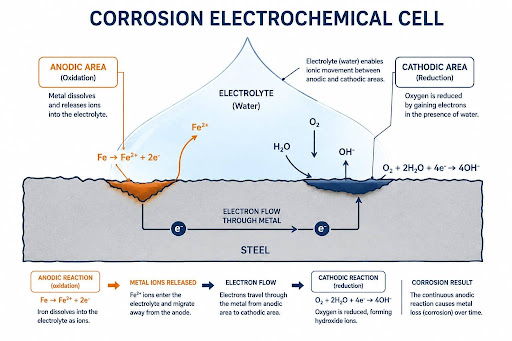
Corrosion electrochimical cell

Rust needs two things to form: oxygen and water, both present at the same time. What’s going on underneath that simple fact is genuinely electrical. One patch of the metal surface acts as an anode and starts giving up electrons, dissolving into the surrounding water as metal ions. Somewhere else on that same surface, a cathode reaction is taking place, where oxygen and water are soaking up those electrons. The iron that dissolved at the anode then reacts with the by-products of that cathode reaction, and you get rust that reddish-brown flaking everyone recognizes immediately and nobody wants to see on their own watch.

Once you see it that way, a lot of the prevention methods stop looking like a random list and start looking like variations on one idea: either stop water from ever touching the steel, or control which part of the steel gets to be the anode. That’s really it. Coatings do the first. Cathodic protection does the second.

The Different Faces Corrosion Actually Takes

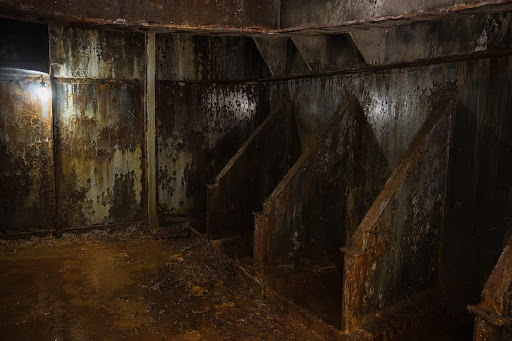
Corrosion

Not all corrosion looks or behaves the same, and knowing which kind you’re looking at changes what you should actually do about it. General corrosion spreads out fairly evenly across a surface, thinning it gradually and predictably. It’s the most forgiving type, strangely, because it’s predictable enough that classification societies build a corrosion allowance into a ship’s design, extra steel thickness specifically there to be eaten away over the vessel’s life without anyone needing to panic about it.

  • Galvanic corrosion shows up when two different metals are electrically connected in the presence of seawater. Whichever one is more reactive becomes the anode and takes the damage, protecting the other. This is, not coincidentally, exactly the mechanism sacrificial anodes are built around; it’s only a problem when it happens by accident, say a bronze fitting sitting against unprotected steel with nobody having planned for it.
  • Pitting is the one that catches people out. Instead of spreading evenly, it drills down into small, concentrated points, and a surface with active pitting can still look mostly fine from a distance while a pit underneath has already gone deep enough to threaten structural or pressure integrity. General corrosion you can see coming. Pitting you often can’t, not without actually looking closely.
  • Crevice corrosion hides in tight, poorly ventilated gaps under a bolt head, behind a gasket, between overlapping plates anywhere stagnant water can sit and quietly turn more aggressive than the open water around it.
  • Erosion corrosion is what happens when fast-moving water physically strips away a protective layer faster than it can rebuild itself. You’ll find it at pipe bends, around pump impellers, anywhere flow gets turbulent.
  • Microbiologically influenced corrosion gets a boost from bacteria, especially in stagnant conditions: a poorly maintained ballast tank, or a fuel system that’s picked up water contamination it shouldn’t have.
  • Stray current corrosion is the odd one out, because it’s not really about the seawater at all  it’s electrical current leaking somewhere it shouldn’t and finding its way through underwater fittings. This one can move fast. There are documented cases of a propeller blade or a rudder failing within days rather than years, once stray current gets involved.

Table of Contents

Where It Actually Concentrates

Some spaces on a ship corrode faster than others, mostly because they happen to combine everything corrosion wants at once. Ballast tanks are usually near the top of that list. They don’t sit permanently full or permanently empty; they cycle, filled with oxygenated seawater one leg of the voyage and standing open to humid air the next, and that wet-dry cycling is genuinely harder on steel than constant immersion would be. Add in all the stiffeners and brackets inside a typical ballast tank, and you’ve also got no shortage of crevices for crevice corrosion to settle into.

Cargo tanks carry their own version of the problem, shaped by whatever cargo and ballast history they’ve actually had. The underwater hull deals with general corrosion, galvanic effects around fittings, and erosion near the propeller and rudder, more or less simultaneously. Exhaust systems and engine room piping get hit by something else entirely  heat combined with condensation, and sulphur compounds from combustion turning into acidic moisture wherever it lands on a cooler surface. And void spaces, cofferdams, anywhere that doesn’t get walked through often, tend to be where corrosion quietly gets the most uninterrupted time to work, simply because nobody’s looking.

Coatings Come First

The single most important line of defence is just keeping water off the bare steel in the first place. Modern ballast tanks are generally built to the IMO’s Performance Standard for Protective Coatings, which exists because a coating applied badly fails years before an identical product applied properly. Surface prep, thickness, application conditions all of it matters more than which brand of paint ends up in the tin. A good coating, properly applied, is the main event. Everything else is backup.

Cathodic Protection: Letting Something Else Take the Hit

Where a coating alone isn’t trusted to do the whole job the underwater hull, the inside of ballast tanks- cathodic protection takes that same galvanic mechanism that causes accidental corrosion and points it somewhere useful on purpose. The structure you actually care about gets deliberately made the cathode, so it’s protected, and something else takes the anode role and corrodes instead.

Sacrificial anodes are the simplest version: blocks of zinc, aluminium, or magnesium, chosen because they sit higher up the reactivity scale than steel does. Wire them electrically to the structure, and they corrode first, on purpose, so the surrounding steel doesn’t have to. They get consumed over time and need replacing; that’s expected, not a failure. Inside enclosed ballast tanks specifically, they’re usually preferred over the alternative below, partly because they don’t carry the same hydrogen gas risk in a confined space.

Impressed current cathodic protection does the same underlying job differently  an external power source drives current between an inert anode and the structure, rather than relying on a metal’s own natural reactivity to burn itself down. No replacement cycle, which is why a lot of owners like it for hull protection, but it does mean a powered system that has to actually keep working.

Neither of these is really competing with the coating. A coating handles the overwhelming majority of the surface. Cathodic protection only has to pick up the scratches, holidays, and aging patches where the coating has already let something through  which is a much smaller job than protecting the whole tank from bare steel.

The Rest of the Toolkit

A few other things round out the picture. Corrosion allowance, already mentioned, is really an admission that some corrosion is simply inevitable, so the design accounts for it rather than pretending it won’t happen. Corrosion inhibitors get dosed into closed systems like engine cooling water to make the water itself less aggressive. Keeping void spaces ventilated and dry where it’s practical takes away some of the stagnant, humid conditions both general corrosion and MIC depend on. And regular inspection especially in ballast tanks and the spaces nobody walks through often  is really what catches a coating that’s starting to fail, or a pit that’s gone further than it should have, before it becomes a structural conversation instead of a maintenance one.

Conclusion

Corrosion isn’t a maintenance failure you’re trying to catch after the fact  it’s a chemical process that never actually stops, and the whole discipline around it is about managing its rate and location rather than pretending you can switch it off. A properly applied coating does most of the work. Cathodic protection backs up what the coating can’t fully cover. Corrosion allowance builds in an honest margin for what still gets through anyway. And inspection is what tells you whether all of that is actually holding, rather than just assumed to be. Once you’re thinking about it as an anode-and-cathode problem rather than just “steel wearing out,” the whole toolkit makes a lot more sense.

Frequently Asked Questions (FAQs)

Oxygen and water, both present together. The process is electrochemical: an anodic reaction dissolves iron into solution, and a cathodic reaction elsewhere on the same surface consumes the released electrons, with the two combining to produce rust.

They cycle between being full of oxygenated seawater and standing empty in humid air, and that wet-dry cycling is harder on steel than constant immersion. Their internal stiffeners and brackets also create plenty of tight crevices where corrosion can settle in undisturbed.

Sacrificial anodes are a more reactive metal, such as zinc or aluminium, that typically corrodes in place of the steel it’s protecting, and gets physically replaced once consumed. Impressed current systems use an external power source to drive protective current instead, avoiding the replacement cycle but depending on a powered system staying operational.


Extra steel thickness built into a ship’s design from the start, specifically so a defined amount of general corrosion can happen over the vessel’s life without threatening structural strength.

Because it concentrates into deep, narrow points rather than spreading out, a pitted surface can look largely fine while already threatening structural or pressure integrity underneath  the kind of damage that general, evenly spread corrosion would show far earlier.

Disclaimer :- The opinions expressed in this article belong solely to the author and may not necessarily reflect those of Merchant Navy Decoded. We cannot guarantee the accuracy of the information provided and disclaim any responsibility for it. Data and visuals used are sourced from publicly available information and may not be authenticated by any regulatory body. Reviews and comments appearing on our blogs represent the opinions of individuals and do not necessarily reflect the views of Merchant Navy Decoded. We are not responsible for any loss or damage resulting from reliance on these reviews or comments.

Reproduction, copying, sharing, or use of the article or images in any form is strictly prohibited without prior permission from both the author and Merchant Navy Decoded.

DIWALI SALE

Decoded Discount Alert! up to 50% OFF

DIWALI SALE

Decoded Discount Alert! up to 50% OFF

Use Coupon Code Deep50

Days
Hours
Seconds
0
Would love your thoughts, please comment.x
()
x