Hi this is Team Merchant Navy Decoded !!!
Please fill the below form with your query and we will get back to you in next 12 hours.
Rest assured your data is safe with us !!!🙂
Ask Your Query| For Beginner | For Professional |
|---|---|
| GME | Engine Side |
| G.P. Rating | Deck Side |
| ETO | G.P. Rating |
| IMUCET & Sponsorship | Combo Offers |
| Free Course | MEO |
| Free Course |
| For Beginner | For Professional |
|---|---|
| GME | Engine Side |
| G.P. Rating | Deck Side |
| ETO | G.P. Rating |
| IMUCET & Sponsorship | Combo Offers |
| Free Course | MEO |
| Free Course |
Many seafarers start earning a good salary after joining ships, clearing exams, and moving up in rank. But when it comes to investing, confusion starts quickly. Some people say mutual funds are better. Some say stocks create real wealth. A beginner should not blindly copy others. Mutual funds and stocks both have their own role. The right choice depends on your goal, time, knowledge, risk comfort, and how much attention you can give to investing.
Seafarers work hard for every rupee. Long contracts, watchkeeping, engine-room work, inspections, paperwork, and time away from family make money valuable. That money should not be invested blindly. Before choosing mutual funds or stocks, understand what each option means. SEBI says investors should invest based on investment objective and risk appetite, and should read documents carefully before signing. This is important because a good product can become a bad decision if it does not match your life.
A high salary can help, but it does not automatically create wealth. Many seafarers earn well during contract but spend heavily during leave. Some invest randomly after watching videos or listening to friends. Some buy stocks without understanding the company. Good investing needs planning, not only income. A seafarer should first build emergency money, protect the family, understand goals, and then invest. Salary is the starting point. Wealth is created when salary is managed with discipline.
Stocks mean ownership in a company. When you buy a stock, you buy a small part of that company. If the company grows and performs well, the stock price may rise. If the company performs badly, the stock price may fall. Direct stock investing needs knowledge, patience, and regular study. SEBI says investors should understand goals, objectives, and risk appetite before investing in securities markets. For seafarers, this is important because stock investing should not be based on tips.
Stocks look exciting because people often share success stories. Someone bought a stock at a low price and made good profit. Someone else says a stock will double. Social media makes stock investing look fast and easy. But the visible success story is not the full story. Behind serious stock investing, there is research, patience, risk control, and emotional discipline. A beginner seafarer should not enter stocks only because the return potential looks attractive.
Direct stock investing needs time. You must study the company, business model, profit, debt, management, competition, valuation, and future growth. You also need to track results and market changes. For busy seafarers, this can be difficult during contract due to duty pressure and limited internet access. SEBI explains that investors should assess risk appetite and understand that higher-return investments often come with higher risk. This is why direct stocks are not for blind investing.
Stock tips from reels, friends, Telegram groups, or WhatsApp forwards can be risky. The person giving the tip may not know your goals, family responsibilities, loan pressure, emergency fund, or risk comfort. A stock may suit someone else but may not suit you. If the price falls, you may panic and sell at a loss. SEBI advises investors to read documents carefully and invest according to objective and risk appetite. Tips are not financial planning.
A mutual fund pools money from many investors and invests it into securities according to the scheme objective. SEBI explains that mutual funds can offer benefits such as diversification, professional management, and ease of access. For seafarers, this can be useful because they may not have time to select every company personally. The fund manager manages the portfolio. But this does not mean mutual funds are risk-free. The fund category, risk level, and time period must still be understood.
Mutual funds can be easier than direct stocks because the seafarer does not need to pick every stock himself. A fund usually invests across multiple securities, which can reduce dependence on one company. SEBI notes that mutual fund schemes must hold a diversified portfolio as mandated through regulations, except in certain cases. This can help beginner seafarers start with a more structured route. Still, the investor must understand the fund type, risk, expense ratio, and goal suitability.
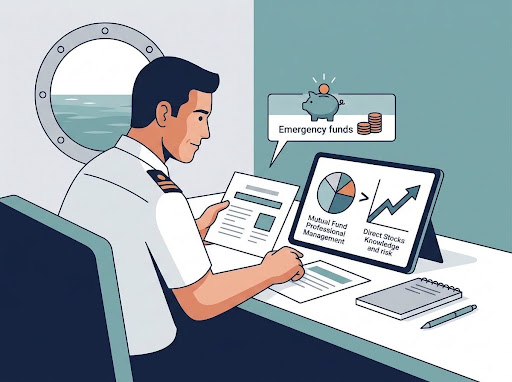
The main difference is simple. Stocks mean you directly invest in individual companies. Mutual funds mean your money is managed through a scheme that may invest in many securities. Stocks need more personal study and tracking. Mutual funds give professional management and diversification, but they still carry risk. For a busy seafarer, mutual funds may be easier to start with. For someone who enjoys studying businesses deeply, stocks can be considered later with proper learning and discipline.
Mutual funds may feel easier for beginners because they provide diversification and professional management. But mutual funds are not risk-free. Stocks can carry higher risk because money may be concentrated in fewer companies if the investor does not diversify properly. SEBI’s investor education material says diversification can help reduce risk, but some risks such as market-wide price volatility cannot be diversified away. So, neither option is fully safe. Risk depends on product, category, market, and investor behaviour.
Stocks may offer higher growth potential if selected correctly, but they also need higher knowledge, time, and emotional control. Mutual funds may offer managed growth through professional portfolio management. The better option depends on the investor. A seafarer who cannot track companies regularly may find mutual funds more practical. A seafarer who can study businesses seriously may later consider stocks. SEBI says investment choices should depend on goals, risk tolerance, investment horizon, and financial situation.
Seafarers are usually busy during contracts. Long working hours, watchkeeping, inspections, port operations, and limited internet access can make daily market tracking difficult. Mutual funds can be more practical because the fund manager handles portfolio decisions. SEBI mentions professional management as one benefit of mutual funds. A seafarer still needs to choose the right fund category and review periodically, but he does not need to study every individual company daily. This makes mutual funds beginner-friendly for many sailors.
Seafarers can consider direct stocks when they have proper knowledge, time, patience, and risk control. They should understand company analysis, valuation, business quality, and market behaviour. Direct stocks should not be the first step for someone who only wants quick returns. A seafarer can first build emergency money, start learning mutual funds, and slowly study stocks. If interest and knowledge grow, a small allocation to direct stocks can be explored carefully, without disturbing family security.
Mutual funds are market-linked products. Their value can go up or down depending on the securities held by the scheme. AMFI clearly states that mutual fund schemes are not guaranteed or assured return products, and investments may involve risks, including possible loss of principal. This is very important for seafarers. Do not treat mutual funds like fixed deposits. Before investing, check fund category, Riskometer, expense ratio, exit load, time period, and goal suitability.
Stocks can move up and down sharply. When prices rise, greed can push beginners to buy more. When prices fall, fear can push them to sell quickly. This emotional pressure is one reason many beginners lose money. A seafarer should not buy stocks if he cannot handle volatility. Direct stock investing needs patience and control. A good investor does not act only because the market is exciting. He studies, waits, reviews, and avoids panic decisions.
One seafarer may have time to study stocks. Another may not. One may have low family responsibility. Another may have loans, children, parents, and emergency needs. Copying another investor can be harmful because your financial life is different. A friend may show profit but may not show earlier losses. Social media may show success but not risk. Your investment route should depend on your goals, risk comfort, knowledge, and time availability.
For many beginner seafarers, mutual funds may be a better starting point than direct stocks. This is because mutual funds offer professional management, diversification, and easier access. Stocks can be considered later after learning. But before both, emergency money and insurance should be in place. A beginner should not jump into high-risk investing without safety. The simple order is: protect first, learn second, invest third, and take higher risk only when understanding improves.
A simple plan starts with emergency money. Keep money ready for contract gaps, medical needs, family expenses, travel, and document renewal. Then protect the family with medical and term insurance if needed. After that, learn mutual funds for long-term goals. Start small and invest with discipline. Direct stocks can be explored later only after proper study. Do not rush. A beginner seafarer does not need a complicated portfolio. A simple, balanced plan is better.
Common mistakes include buying stocks from tips, choosing mutual funds only by last year’s returns, investing without emergency money, ignoring risk, stopping investments during market falls, and copying friends. Another mistake is thinking high salary can cover every loss. Hard-earned salary should not be risked casually. Before investing, ask: Why am I investing? When do I need this money? Can I handle loss? Do I understand this product? These questions can prevent many mistakes.
For seafarers, financial planning is not only about selecting one product. It is about understanding your goals, knowing the risks, protecting your future, and making disciplined financial decisions. Download Sailor Pro app – Built for Seafarers, an Initiative by Merchant Navy Decoded, to stay more organised and confident in your financial planning. You can also follow finance_for_seafarers on Instagram and join the WhatsApp channel Financial Management for Seafarer for practical money guidance created especially for seafarers.
Stocks mean direct investment in individual companies. Mutual funds pool money from investors and invest through a professionally managed scheme.
For many beginner seafarers, mutual funds may be easier because they offer professional management and diversification. Stocks need deeper study and regular tracking.
Mutual funds may reduce single-company risk through diversification, but they are still market-linked and not risk-free.
Yes, seafarers can invest in stocks, but only after understanding company analysis, market risk, valuation, and emotional control.
Mutual funds can be beginner-friendly because the fund manager manages the portfolio, and the investor does not need to pick every stock personally.
Stocks may give higher returns if selected correctly, but they also carry higher risk and require more knowledge, time, and patience.
Busy seafarers should avoid direct stocks if they do not have time to study companies properly. Mutual funds may be more practical for them.
No. Mutual funds are not guaranteed-return products. Their value can go up or down depending on market conditions and the securities held.
Seafarers should first build emergency money, protect family with insurance, learn the basics, start with suitable mutual funds, and consider stocks later after study.
Yes, some seafarers may use both, but only if they understand the role, risk, and purpose of each. Beginners should start simple.
Disclaimer :- The opinions expressed in this article belong solely to the author and may not necessarily reflect those of Merchant Navy Decoded. We cannot guarantee the accuracy of the information provided and disclaim any responsibility for it. Data and visuals used are sourced from publicly available information and may not be authenticated by any regulatory body. Reviews and comments appearing on our blogs represent the opinions of individuals and do not necessarily reflect the views of Merchant Navy Decoded. We are not responsible for any loss or damage resulting from reliance on these reviews or comments.
Reproduction, copying, sharing, or use of the article or images in any form is strictly prohibited without prior permission from both the author and Merchant Navy Decoded.
Decoded Discount Alert! up to 50% OFF
Use Coupon Code Deep50