Hi this is Team Merchant Navy Decoded !!!

Please fill the below form with your query and we will get back to you in next 12 hours.

Rest assured your data is safe with us !!!🙂

Ask Your Query

FD vs Mutual Funds vs Stocks for Seafarers

Many seafarers start earning well, but they often feel confused about where to keep or invest   money. Some people say fixed deposits are safe. Some say mutual funds are better. Some say stocks can create big wealth. With so many opinions from friends, reels, tips, and random advice, beginners can easily make mistakes. The truth is simple: fixed deposits, mutual funds, and stocks are different tools. A beginner should not ask only, “Which is best?” The better question is, “Which is right for my goal?”

Choosing Between FD, Mutual Funds, and Stocks

FD vs Mutual Funds vs Stocks for Seafarers

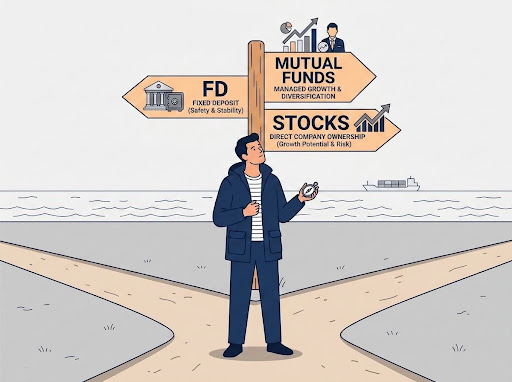
A beginner seafarer should choose based on purpose. If the goal is safety and short-term use, fixed deposits can be useful. If the goal is long-term managed growth, mutual funds can be considered after learning the basics. If the goal is direct company ownership, stocks may be considered only after proper study. SEBI says investment choices should depend on financial goals, risk tolerance, investment horizon, and overall financial situation.

Why Seafarers Should Understand Investment Options First

Seafarers work hard for every rupee. Long contracts, time away from family, duty pressure, and uncertain schedules make money valuable. So, money should not be invested blindly. Before choosing FD, mutual fund, or stocks, understand the role of each product. Fixed deposits are mainly for safety. Mutual funds are for managed investing. Stocks need deeper knowledge. SEBI advises investors to understand investment goals, objectives, and risk appetite before investing in securities markets.

Why High Salary Needs the Right Money Plan

High Salary Needs the Right Money Plan

A high salary can help, but it does not automatically create wealth. Many seafarers earn well during contract but spend heavily during leave. Some keep all money idle. Some take loans. Some invest randomly. A good money plan decides how much money should stay safe, how much should be invested, and how much should be used for family needs. Salary is only the starting point. Wealth is created when salary is managed with discipline, safety, and long-term planning.

Table of Contents

What is Fixed Deposit for Seafarers?

A fixed deposit means keeping money with a bank for a fixed period at a fixed interest rate. It is simple and familiar. The amount does not move daily like stocks or mutual funds. This is why many seafarers use FDs for safer money parking. FD can be useful for money needed for family expenses, course fees, document renewal, travel, emergency backup, or short-term goals. It is mainly a safety and stability tool, not a high-growth wealth creation product.

Why Fixed Deposits Are Useful for Safety

Fixed Deposits

Fixed deposits are useful because they offer stability and predictable returns. For seafarers, this can help during contract gaps, delayed joining, medical needs, or family expenses. Bank deposits also have deposit insurance protection. DICGC states that each depositor in a bank is insured up to ₹5,00,000 for principal and interest in the same right and same capacity, subject to its rules. This makes FDs useful, but the insurance limit should be understood clearly.

When Should Seafarers Choose Fixed Deposits?

When Should Seafarers Choose Fixed Deposits

Seafarers can choose fixed deposits when money should remain safer and may be needed in the short term. Examples include school fees, family expenses, medical backup, document renewal, travel, and emergency funds. FD can also be useful when a seafarer does not want market risk for a particular goal. But all money should not stay in FD for every goal. Long-term goals may need growth. FD is good for safety, but it may not be enough for wealth creation.

What are Stocks for Seafarers?

Stocks for Seafarers

Stocks mean ownership in a company. When you buy a stock, you buy a small part of that company. If the company performs well, the stock price may rise. If the company performs badly, the stock price may fall. Stocks can create wealth, but they also carry higher risk. A seafarer should understand the company, business, profit, debt, management, competition, and valuation before buying. Stocks are not for blind tips or quick excitement.

Why Direct Stocks Need More Knowledge and Time

 Direct Stocks Need More Knowledge and Time

Direct stock investing needs study and tracking. A seafarer may be onboard with limited time, internet issues, and work pressure. Studying companies properly during contract can be difficult. Stocks require patience, research, and emotional control. Buying a stock only because someone shared a tip can be risky. SEBI says investors should read documents carefully and invest in products depending on investment objective and risk appetite. For beginners, learning should come before direct stock buying.

Why Seafarers Should Avoid Stock Tips and Reels

Avoid Stock Tips and Reels

Stock tips from friends, WhatsApp groups, Telegram channels, or reels can be dangerous. The person giving the tip may not know your goals, family responsibility, emergency fund, loan pressure, or risk comfort. A trending stock may not be suitable for you. If the price falls, you may panic and sell at a loss. A seafarer should never treat stock tips as financial planning. First learn the basics. Then decide based on research, not social media excitement.

What are Mutual Funds for Seafarers?

Mutual Funds for Seafarers

A mutual fund pools money from many investors and invests it in different assets based on the fund’s objective. SEBI explains that open-ended funds pool money from multiple investors to create a diversified portfolio of securities such as stocks, bonds, or other assets, with a fund manager overseeing the portfolio. For seafarers, mutual funds can be useful because professionals manage the portfolio. But seafarers still need to understand fund type, risk, time period, and suitability.

Why Mutual Funds Can Be Easier Than Direct Stocks

Mutual Funds Can Be Easier Than Direct Stocks

Mutual funds can be easier than direct stocks because the investor does not need to select every company personally. The fund manager manages the portfolio according to the fund objective. Mutual funds can also offer diversification and professional management. SEBI investor education material describes mutual funds as offering benefits like diversification, professional management, and ease of access. This can help beginner seafarers who want market-linked growth but do not have time to study individual companies daily.

Mutual Funds vs Stocks for Beginner Seafarers

Mutual Funds vs Stocks for Beginner Seafarers

Mutual funds and stocks are both market-linked, but they are not the same. Stocks mean investing directly in one company. Mutual funds usually invest in many securities through a managed portfolio. This can reduce dependence on one company, but it does not remove risk. A beginner seafarer may find mutual funds easier to start than direct stocks. But mutual funds should still be selected carefully. Check fund category, Riskometer, expense ratio, exit load, time period, and goal suitability.

Fixed Deposit vs Mutual Fund for Seafarers

Fixed Deposit vs Mutual Fund for Seafarers

FD and mutual fund have different roles. FD is mainly for safety and predictable return. Mutual fund is for investment and can carry market risk. AMFI clearly states that mutual fund schemes are not guaranteed or assured return products and may involve risks, including possible loss of principal. So, a seafarer should not compare FD and mutual fund only by return. FD is useful for safety. Mutual fund is useful for long-term goals when risk is understood.

FD vs Mutual Fund vs Stocks: Main Difference

FD vs Mutual Fund vs Stocks

The main difference is purpose and risk. FD is for safer money parking. Mutual funds are for managed investment through different fund categories. Stocks are for direct company ownership and need more study. FD gives stability. Mutual funds give growth potential with risk. Stocks can offer higher growth potential but also higher risk. A beginner seafarer should not start with the riskiest option just because it looks exciting. Safety, learning, and goal clarity should come first.

Which Option Is Safer for Beginner Seafarers?

Which Option Is Safer for Beginner Seafarers

FD is generally safer than mutual funds and stocks because it is not directly linked to daily market movement. Bank deposits also have DICGC insurance up to ₹5,00,000 per depositor per bank, subject to rules. Mutual funds and stocks can go up or down depending on markets and underlying investments. So, emergency money and short-term money should not be kept in high-risk options. A beginner should first build safety before taking investment risk.

Which Option Is Better for Long-Term Growth?

Which Option Is Better for Long-Term Growth

For long-term growth, mutual funds and stocks may offer more growth potential than FDs, but they also carry higher risk. Stocks need deeper knowledge and time. Mutual funds may be easier for beginners because of professional management and diversification. SEBI says the choice of investment avenues depends on goals, risk tolerance, investment horizon, and overall financial situation. For seafarers, long-term money can be invested carefully, but emergency money should stay safe.

Why Emergency Money Should Not Be Invested in Stocks

Emergency Money Should Not Be Invested in Stocks

Emergency money should be safe and easy to access. It is meant for contract gaps, delayed joining, family emergencies, medical needs, travel, and urgent expenses. If emergency money is invested in stocks and the market falls, a seafarer may be forced to sell at a loss. This can create stress. Emergency money is not for high return. It is for protection. Keep it separate from long-term investments. First build safety, then start investing.

Why Seafarers Should Not Put All Money in One Place

How Seafarers Should Choose Based on Goals

Keeping all money in one place is risky. If all money is in FD, growth may be limited. If all money is in mutual funds, market falls can create stress. If all money is in stocks, risk can become very high. SEBI’s investor education material explains asset allocation as dividing assets across asset classes to balance risk and reward. A seafarer should use different options for different goals instead of depending on one product.

Simple Investment Plan for Beginner Seafarers

A simple plan starts with emergency money. Keep enough money for family expenses, medical needs, travel, and contract gaps. Then protect the family with proper insurance. After that, use fixed deposits for short-term safety. Start learning mutual funds for long-term goals. Consider stocks only after gaining knowledge and confidence. Do not rush. Start small, stay consistent, and review your plan. A beginner does not need a complicated portfolio. A simple and disciplined plan is better.

Common Mistakes Beginner Seafarers Should Avoid

Common mistakes include investing from reels, following stock tips, choosing mutual funds only by last year’s returns, keeping no emergency fund, putting all money in FDs, buying stocks without research, and ignoring risk. Another mistake is investing because friends made profit. Your situation is different. Your family needs, loans, time period, and risk comfort are different. A beginner seafarer should not chase quick returns. Learn first, build safety, and invest only after understanding the product.

Start Simple, Then Grow

Start Simple, Then Grow

For seafarers, financial planning is not only about selecting one product. It is about understanding your goals, knowing the risks, protecting your future, and making disciplined financial decisions. Download Sailor Pro app – Built for Seafarers, an Initiative by Merchant Navy Decoded, to stay more organised and confident in your financial planning. You can also follow finance_for_seafarers on Instagram and join the WhatsApp channel Financial Management for Seafarer for practical money guidance created especially for seafarers.

Frequently Asked Questions (FAQs)

FD is mainly for safety and fixed returns. Mutual funds are managed investments. Stocks mean direct ownership in a company and need more study.

There is no single best option. Beginners should first build emergency money, then learn mutual funds, and consider stocks only after proper study.

FD is generally safer because it is not directly linked to market movement. Mutual funds carry market risk and returns are not guaranteed.

Mutual funds can be easier for beginners because they offer professional management and diversification. Stocks require more research and regular tracking.

Seafarers should invest directly in stocks only after learning company analysis, risk, valuation, and market behaviour. Avoid tips and random advice.

Emergency money should stay safe and accessible. Savings accounts, fixed deposits, or liquid options may be used based on personal comfort.

Yes, seafarers can use mutual funds for long-term goals after understanding fund category, risk level, time period, and suitability.

Stock tips may not match your goal, risk comfort, or financial situation. Blind tips can lead to wrong buying and panic selling.

No. FD is useful for safety, but long-term goals may need growth options. Keeping all money in FD may limit wealth creation.

Beginner seafarers should start with emergency savings, proper insurance, basic financial learning, suitable mutual funds, and later stocks only after study.

Disclaimer :- The opinions expressed in this article belong solely to the author and may not necessarily reflect those of Merchant Navy Decoded. We cannot guarantee the accuracy of the information provided and disclaim any responsibility for it. Data and visuals used are sourced from publicly available information and may not be authenticated by any regulatory body. Reviews and comments appearing on our blogs represent the opinions of individuals and do not necessarily reflect the views of Merchant Navy Decoded. We are not responsible for any loss or damage resulting from reliance on these reviews or comments.

Reproduction, copying, sharing, or use of the article or images in any form is strictly prohibited without prior permission from both the author and Merchant Navy Decoded.

DIWALI SALE

Decoded Discount Alert! up to 50% OFF

DIWALI SALE

Decoded Discount Alert! up to 50% OFF

Use Coupon Code Deep50

Days
Hours
Seconds
0
Would love your thoughts, please comment.x
()
x