Hi this is Team Merchant Navy Decoded !!!
Please fill the below form with your query and we will get back to you in next 12 hours.
Rest assured your data is safe with us !!!🙂
Ask Your Query| For Beginner | For Professional |
|---|---|
| GME | Engine Side |
| G.P. Rating | Deck Side |
| ETO | G.P. Rating |
| IMUCET & Sponsorship | Combo Offers |
| Free Course | MEO |
| Free Course |
| For Beginner | For Professional |
|---|---|
| GME | Engine Side |
| G.P. Rating | Deck Side |
| ETO | G.P. Rating |
| IMUCET & Sponsorship | Combo Offers |
| Free Course | MEO |
| Free Course |
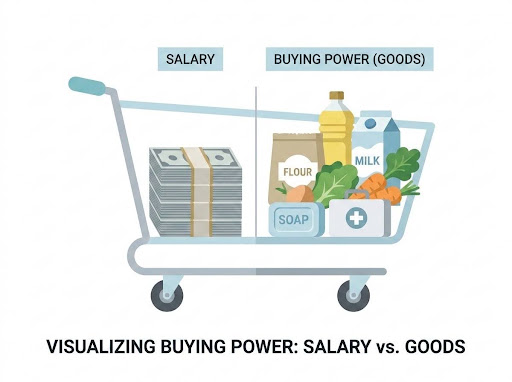
Many seafarers feel financially stronger when salary increases. A higher salary can improve family life, savings, investments, and future planning. But salary alone does not show the full financial picture. The real question is not only how much you earn. The real question is how much your salary can actually buy. This is called buying power. Gold is one simple way to understand this because it shows how the value of money changes over time.
Buying power means the real strength of your money. It shows what your salary can actually buy in real life. If your salary increases, but prices of gold, land, education, property, medical care, and daily expenses rise faster, your real financial strength may not improve much. SEBI explains that inflation reduces the value of money, meaning the same amount can buy fewer goods and services than before. For seafarers, buying power matters more than salary number alone.
A salary slip shows income, but it does not show real wealth. Wealth is what remains after expenses, loans, EMIs, family needs, and lifestyle costs. A seafarer may earn a high salary but still feel financial pressure if there is no emergency fund, no insurance, no investments, and too much debt. Real wealth is built through assets, protection, savings, and disciplined planning. Salary is the starting point. It becomes powerful only when converted into long-term financial strength.
High salary can create comfort, but it can also create overconfidence. Many seafarers increase lifestyle as income increases. Better phone, better car, bigger holidays, expensive shopping, and high EMIs may look manageable during contract. But during sign-off or delayed joining, the same expenses can create pressure. A high salary without planning can disappear quickly. Financial strength means having money ready for emergencies, family protection, retirement, children’s education, and future goals. Income alone is not enough.
Inflation means prices rise over time. When prices rise, the same salary buys fewer things. For example, if grocery, fuel, school fees, rent, medical bills, and travel costs increase, your salary must also grow enough to handle those expenses. SEBI says inflation reduces money value because you can purchase fewer goods and services with the same amount than before. This is why seafarers should not only focus on salary growth. They should also focus on real value growth.
₹1 lakh today may feel strong, but after some years, it may not buy the same amount of goods and services. Education costs may rise. Medical bills may rise. Property prices may rise. Gold prices may change. Household expenses may increase. This is why money should be planned with future costs in mind. A seafarer should ask: will my current salary and savings support my family after 10 or 20 years? Future buying power matters.
Gold vs salary is not about saying gold is better than salary. Salary gives income. Gold is an asset. Salary helps you live today. Assets help protect your future. If salary increases but assets do not grow, long-term wealth may remain weak. Gold teaches one simple money lesson: money should be measured by what it can buy, not only by the number shown in the salary slip. A smart seafarer converts salary into useful assets.
Gold is often used to understand long-term value because it has been treated as a store of value in many families. The World Gold Council says gold has a key role as a strategic long-term investment and can be part of a well-diversified portfolio. Gold prices can rise, fall, or stay flat in different periods. So, gold should not be seen as a guaranteed-return product. But it can help seafarers understand buying power over time.
In many Indian homes, gold is treated as a family backup. Families may keep gold for emergencies, marriage needs, uncertain times, or long-term security. It also carries emotional value. For seafarers who stay away from home, having some family backup can give peace of mind. But gold should be used wisely. Physical gold has making charges, purity issues, storage risk, and selling differences. Gold can support a financial plan, but it should not become the whole plan.
Gold can be a useful support asset for seafarers if it fits the overall financial plan. It may help with diversification and value protection during uncertain periods. The World Gold Council says gold has long-term investment relevance and portfolio diversification value. But gold also has limitations. It does not give regular salary-like income. Physical gold has costs and storage concerns. Seafarers should use gold as one part of planning, not as the only investment.
Gold can support a portfolio, but it cannot do every job. It cannot replace emergency funds, insurance, fixed deposits, mutual funds, retirement planning, or proper asset allocation. Gold may protect value in some situations, but it may not always give strong growth. A seafarer should not put all money only into gold because every asset has a different purpose. Gold is useful for support. Long-term financial freedom needs a balanced plan with safety, protection, liquidity, and growth.
Salary helps you earn. Assets help you build wealth. A seafarer’s salary should not only be used for spending. It should be converted into assets over time. Assets may include emergency funds, fixed deposits, mutual funds, gold, property, retirement investments, and business income. Salary stops when you stop working, but good assets can support you even during career breaks or retirement. Real wealth is not only high income. Real wealth is income converted into useful assets.
Seafarers work hard for every rupee. That income should not disappear only into lifestyle, EMIs, and random expenses. A part of salary should be used to build assets. Assets can support the family during contract gaps, medical emergencies, retirement, children’s education, or shore transition. Converting income into assets gives future strength. Without assets, a seafarer may remain dependent only on the next contract. With assets, salary becomes a tool for freedom, not only survival.
Real assets for seafarers are things that can support future goals, grow in value, or create income. These may include emergency savings, fixed deposits, mutual funds, gold, property, retirement funds, and planned business income. Some assets give safety. Some give growth. Some give liquidity. Some give long-term security. A seafarer should understand the role of each asset before investing. Do not buy any asset only because others are buying. Buy because it fits your financial plan.
A high salary looks good, but an emergency fund protects your family. Seafarers may face delayed joining, medical needs, family emergencies, document renewal, or contract gaps. If there is no emergency fund, even a high-income seafarer may need loans during difficult times. Emergency money should be safe and easily accessible. Bank deposits are generally used for safety, and DICGC insures eligible deposits up to ₹5,00,000 per depositor per bank, subject to rules.
Before buying gold or investing aggressively, seafarers should check family protection. Insurance protects the family from sudden financial shocks. Medical insurance can help during hospitalisation. Term insurance can support dependents if something unfortunate happens. Gold and investments may help build wealth, but insurance protects the base of the financial plan. Do not ignore protection while chasing returns. If your family depends on your income, insurance should be understood properly before making big investment decisions.
Gold, fixed deposits, mutual funds, and property have different roles. Gold can act as a support asset. Fixed deposits can provide stability and safer money parking. Mutual funds can support long-term growth but carry market risk. AMFI clearly states mutual fund schemes are not guaranteed or assured return products and involve risks, including possible loss of principal. Property can give long-term security, but it is not easily liquid. A balanced plan uses each product for the correct purpose.
A balanced financial plan protects money from different risks. If everything is in savings, growth may be low. If everything is in gold, liquidity and growth may be limited. If everything is in mutual funds, market falls can create stress. If everything is in property, urgent cash may be difficult. A seafarer should divide money based on purpose. Emergency money for safety. Insurance for protection. Fixed deposits for stability. Investments for growth. Assets for long-term security.
Seafarers can protect buying power by saving for emergencies, investing for long-term goals, avoiding unnecessary loans, and building assets. Money should not sit idle for years without a plan. SEBI says inflation reduces purchasing power, so investors should consider inflation while planning money. A seafarer should review whether savings and investments are growing enough for future expenses. Buying power is protected when income is converted into assets that can support future needs.
A simple plan starts with emergency money. Keep 6 to 8 months of family expenses safely. Then protect the family with medical and term insurance. Avoid unnecessary EMIs. Keep short-term money in safer options. Invest long-term money based on goals and risk comfort. Use gold as a support asset, not the full plan. Buy property only after checking legal documents, EMI, location, and liquidity. Real wealth is built slowly through discipline, not only through salary.
For seafarers, financial planning is not only about selecting one product. It is about understanding your goals, knowing the risks, protecting your future, and making disciplined financial decisions. Download Sailor Pro app – Built for Seafarers, an Initiative by Merchant Navy Decoded, to stay more organised and confident in your financial planning. You can also follow finance_for_seafarers on Instagram and join the WhatsApp channel Financial Management for Seafarer for practical money guidance created especially for seafarers.
Buying power means what your money can actually buy. If prices rise, the same salary may buy fewer goods, services, or assets in the future.
Buying power matters because seafarers may earn well, but family expenses, education, medical costs, property, and gold prices may also rise over time.
No. High salary is useful, but it must be converted into savings, insurance, investments, and assets to create long-term financial strength.
Inflation reduces the real value of salary. Even if income increases, rising prices can reduce how much that income can actually buy.
Gold is familiar, widely accepted, and trusted in many Indian families. It is often kept for emergencies, marriage needs, and long-term security.
Gold can be a support asset, but it should not be the only investment. It should be part of a balanced financial plan.
Both have different purposes. Gold can support diversification. Mutual funds may support long-term growth but carry market risk. The choice depends on goals.
Assets support future needs. They can help during contract gaps, retirement, family responsibilities, emergencies, and financial freedom planning.
Seafarers can build emergency savings, fixed deposits, insurance protection, mutual funds, gold, property, and other planned assets based on goals.
Seafarers can protect salary value by controlling expenses, avoiding bad loans, saving for emergencies, investing for long-term goals, and building real assets.
Disclaimer :- The opinions expressed in this article belong solely to the author and may not necessarily reflect those of Merchant Navy Decoded. We cannot guarantee the accuracy of the information provided and disclaim any responsibility for it. Data and visuals used are sourced from publicly available information and may not be authenticated by any regulatory body. Reviews and comments appearing on our blogs represent the opinions of individuals and do not necessarily reflect the views of Merchant Navy Decoded. We are not responsible for any loss or damage resulting from reliance on these reviews or comments.
Reproduction, copying, sharing, or use of the article or images in any form is strictly prohibited without prior permission from both the author and Merchant Navy Decoded.
Decoded Discount Alert! up to 50% OFF
Use Coupon Code Deep50