Hi this is Team Merchant Navy Decoded !!!

Please fill the below form with your query and we will get back to you in next 12 hours.

Rest assured your data is safe with us !!!🙂

Ask Your Query

Chrome Liner

Chrome Liner

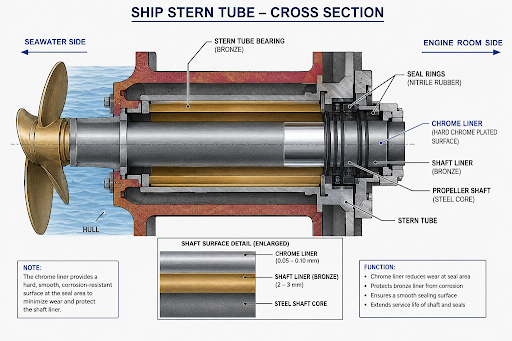
The stern tube is the tube through which the propeller shaft passes out through the stern of the ship, connecting the engine room equipment to the propeller. As the shaft rotates inside the tube, it is exposed to the high pressure of water surrounding the ship. Hence, the bearing and sealing arrangement of the shaft inside the tube is of great importance for the operation and maintenance of the ship.

In order to ensure smooth functioning and reduce the wear and tear of the shaft surface in contact with the bearings/seals, a chrome liner is provided on the surface area of the shaft. The present work focuses on studying the concept, installation location and importance of a chrome liner on the ship’s stern tube.

What is a Chrome liner?

A chrome liner is a sleeve or lined surface on a propeller shaft over which a harder material such as chrome is deposited as a facing. It is not the shaft itself, but rather the shaft liner or shaft carrying such a facing at the critical wearing surface.

Key properties of chrome plating include:

  • High hardness – resists wear from continuous rotation
  • Smooth surface finish – reduces friction against seals or bearings
  • Good corrosion resistance – withstands exposure to seawater and lubricants
  • Dimensional stability – maintains a consistent running surface over time

The exact coating thickness and specification always depends on the manufacturer and shaft design, so these values should be taken from the relevant maker’s manual rather than assumed.

Location and Arrangement in a Stern Tube

The chrome liner is generally fitted at the shaft liner or on the shaft surface exactly at the point where it passes through the stern tube seals or bearings. In many designs, the propeller shaft is protected by a separate shaft liner (often bronze or similar material) and the chrome coating may be applied over this liner surface or directly on the shaft area contacting the seal.

  • The chrome-coated surface directly contacts the sealing rings or bearing surface.
  • It provides a hard, smooth-running track that the seals or bearing material rub against.

Table of Contents

Why Chrome Liner is Used in Stern Tube

  • Wear resistance – reduces surface wear from continuous shaft rotation
  • Corrosion resistance – protects against seawater ingress and moisture
  • Smooth surface finish – minimizes friction and heat generation
  • Reduced friction – helps seals last longer without excessive drag
  • Protection of shaft surface – prevents damage to the costlier shaft/liner underneath
  • Longer service life – reduces frequency of costly shaft or liner replacement
  • Compatibility with sealing arrangements – works well with common seal types used in stern tubes

Working Principle

As the propeller shaft rotates, the seal rings (or bearing surface) remain in constant contact with the chrome coated surface. Because chrome is extremely hard and smooth:

  • Friction between the seal and shaft surface stays low.
  • Minor lubricant films can form and stay stable on the smooth chrome finish.
  • Wear and scoring on the rotating surface are minimized.
  • Leakage risk is reduced because the seal maintains good contact with a true, unworn surface.

Advantages of Chrome Liner

Advantages of Chrome Liner
  • Extended component life – the shaft/liner beneath is protected from direct wear
  • Better sealing performance – smooth surface improves seal contact
  • Lower maintenance frequency – hard surface resists everyday wear
  • Reduced risk of water ingress – supports reliable sealing over time
  • Cost effective protection – cheaper to maintain a coating than replace an entire shaft

Common Problems

  • Surface wear from long term rubbing against seals
  • Scratches or scoring caused by debris or improper handling
  • Corrosion or pitting if the coating is damaged or seawater penetrates
  • Damage to the chrome coating from mechanical impact or poor storage
  • Improper surface finish after repair, leading to poor seal contact
  • Leakage when the sealing surface is no longer smooth or true

Inspection and Maintenance

During routine inspection or shaft withdrawal engineers should check:

  • Surface condition for scoring, pitting or flaking of the coating
  • Wear patterns at the seal contact area
  • Signs of corrosion beneath or around the coating
  • Shaft/liner dimensions against manufacturer’s permissible limits
  • Condition of stern tube seals for wear or hardening
  • Proper alignment of the shaft within the stern tube
  • Comparison of all readings with the manufacturer’s manual since permissible limits vary by design

Safety and Maintenance Precautions

Safety and Maintenance Precautions

Conclusion

The chrome liner may be a small part of the overall stern tube system but it plays a big role in keeping the shaft sealing arrangement reliable. By providing a hard, smooth and corrosion resistant running surface, it helps reduce wear, minimizes leakage risk and extends the service life of expensive shaft components.

Frequently Asked Questions (FAQs)

It provides a hard, smooth, wear resistant surface for the seal or bearing to run against.

Because of its high hardness, smooth finish and good corrosion resistance.

At the shaft or shaft liner surface, where it contacts the stern tube seals or bearing.

It can cause increased wear, poor sealing and possible water leakage into the stern tube.

By checking for scoring, pitting, wear and comparing dimensions against manufacturer limits.

A shaft liner is the protective sleeve fitted on the shaft, while the chrome liner refers to the hard chrome coating applied on that surface for wear protection.

Disclaimer :- The opinions expressed in this article belong solely to the author and may not necessarily reflect those of Merchant Navy Decoded. We cannot guarantee the accuracy of the information provided and disclaim any responsibility for it. Data and visuals used are sourced from publicly available information and may not be authenticated by any regulatory body. Reviews and comments appearing on our blogs represent the opinions of individuals and do not necessarily reflect the views of Merchant Navy Decoded. We are not responsible for any loss or damage resulting from reliance on these reviews or comments.

Reproduction, copying, sharing, or use of the article or images in any form is strictly prohibited without prior permission from both the author and Merchant Navy Decoded.

DIWALI SALE

Decoded Discount Alert! up to 50% OFF

DIWALI SALE

Decoded Discount Alert! up to 50% OFF

Use Coupon Code Deep50

Days
Hours
Seconds
0
Would love your thoughts, please comment.x
()
x