Fuel is the lifeblood of a ship. The quality of bunkers directly affects the main engine, auxiliary engines, boilers, fuel pumps, purifiers, exhaust valves, cylinder liners and even the vessel’s regulatory compliance. A Fuel Oil Analysis Report helps the Chief Engineer and engine-room team understand whether newly bunkered fuel is suitable for storage, treatment and use on board.
A laboratory report should not simply be filed away. It must be studied, compared with the Bunker Delivery Note (BDN) and Certificate of Quality of fuel (COQ), and converted into practical operating instructions.
What Is a Fuel Oil Analysis Report?
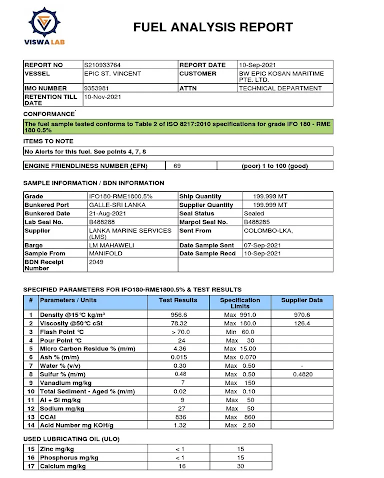
A Fuel Oil Analysis Report is a laboratory document that presents the physical and chemical properties of a fuel sample taken during bunkering. The results are normally compared with the fuel grade ordered under the applicable edition of ISO 8217, along with relevant MARPOL Annex VI and SOLAS requirements. CIMAC’s 2024 guidance explains that marine fuel analysis should be interpreted using recognized test methods and the statistical principles of ISO 4259-2.
The report usually identifies:
Vessel name and IMO number.
Bunker port and date of delivery.
Bunker supplier and barge details.
Fuel grade and quantity supplied.
Sample number and seal number.
Laboratory report number.
Test methods used.
Test results and specification limits.
Compliance or non-compliance statement.
Operational recommendations.
The report relates only to the sample tested. Therefore, proper sampling during the entire bunkering operation is essential. IMO guidance recommends representative continuous sampling at the receiving ship’s bunker manifold, with samples sealed, labelled and signed by both the supplier and ship’s representative.
Why Is Fuel Analysis Important?
Fuel analysis allows the ship’s engineers to identify potential problems before the fuel reaches the engine. An unsuitable fuel may cause:
Fuel pump and injector wear.
Excessive filter and purifier blockage.
High-temperature corrosion.
Exhaust valve burning.
Poor combustion and loss of power.
Sludge formation in tanks and purifiers.
Fuel instability and incompatibility.
Excessive deposits on pistons and turbochargers.
Sulphur non-compliance and possible detentions.
Serious machinery failure during the voyage.
A fuel may be technically “within specification” but still require careful handling. Conversely, a test result slightly outside a specification limit should not be interpreted without considering the test method and measurement uncertainty. CIMAC notes that ISO 4259-2 provides a statistical framework for assessing whether a result demonstrates compliance or non-compliance.
Table of Contents
Important Parameters to Check
Parameter
What it indicates
Operational importance
Density at 15°C
Mass per unit volume of the fuel
Used for fuel quantity calculations and purifier settings
Viscosity
Resistance of fuel to flow
Determines heating requirements and injection conditions
Water content
Free or dissolved water in the fuel
Causes poor combustion, corrosion, sludge and purifier overload
Sulphur content
Sulphur concentration in the fuel
Determines MARPOL compliance and cylinder-oil requirements
Aluminium plus silicon
Catalytic fines, commonly called cat fines
Causes abrasive wear of pumps, liners and fuel valves
Vanadium and sodium
Metallic contaminants
Can cause high-temperature corrosion and ash deposits
Carbon residue
Carbon-forming tendency
Indicates possible deposits and poor combustion
Total sediment
Insoluble material and instability risk
Can result in sludge, filter blockage and purifier problems
Flash point
Temperature at which vapour may ignite
Important for shipboard fire safety
Pour point
Lowest temperature at which the fuel flows
Helps determine storage and transfer heating requirements
CCAI
Calculated ignition quality indicator
High values may indicate delayed ignition and combustion problems
Acid number
Acidity of the fuel
May indicate corrosive tendencies or problematic blending components
Density
Density is normally reported in kilograms per cubic metre at 15°C. It is important for calculating the mass of fuel received and for adjusting conventional centrifugal purifiers. A density value on the BDN is supplied by the bunker supplier, but the laboratory result may differ. Engineers should use the laboratory result, where appropriate, to confirm purifier settings and fuel management arrangements. Modern purification systems may not require the traditional gravity-disc adjustment, but density remains an important fuel property.
Viscosity
Residual fuels are often supplied in grades such as RMG 380 or RMG 180, where the number refers to the maximum viscosity at 50°C. The engine does not normally receive fuel at this storage viscosity. It is heated before injection to achieve the viscosity required by the engine maker. The analysis report may include a viscosity-temperature chart. This chart helps engineers determine the correct fuel temperature at the engine inlet. Too little heating can produce poor atomisation, while excessive heating can reduce viscosity below the safe operating range and affect fuel-pump lubrication.
Water
Water reduces the effective heating value of fuel and may lead to:
Poor combustion.
Corrosion in tanks and fuel systems.
Increased sludge formation.
Purifier overload.
Difficulty in transferring fuel.
Microbial growth where conditions permit.
Water should be drained regularly from bunker, settling and service tanks. The fuel should be heated sufficiently to support effective separation, while purifier throughput should be adjusted according to the fuel condition and equipment manufacturer’s instructions.
Sulphur
Sulphur is one of the most important values in the report because it affects both emissions compliance and engine lubrication. Under MARPOL Annex VI, the global sulphur limit is 0.50% m/m, while the limit in designated Emission Control Areas is 0.10% m/m.
The ship’s crew must confirm:
The sulphur result agrees with the BDN and COQ.
The fuel is suitable for the vessel’s trading route.
Correct fuel changeover procedures are followed before entering an ECA.
Cylinder-oil feed rate and alkalinity are appropriate for the fuel in use.
Fuel samples and documentation are properly retained.
If the vessel operates with an approved exhaust gas cleaning system, the applicable compliance procedure may be different. However, the ship must always follow its approved documentation, SMS procedures and flag-State requirements.
Aluminium and Silicon
Aluminium and silicon are generally associated with catalytic fines, or cat fines. These hard abrasive particles may pass through inadequate fuel treatment and damage:
Fuel-pump plungers and barrels.
Fuel injectors.
Cylinder liners.
Piston rings.
Exhaust valves.
When cat-fine levels are elevated, the engineering team should review purifier temperature, throughput, separation efficiency and sludge discharge arrangements. Fuel should normally be purified at a reduced throughput to improve separation. Filters should be monitored frequently, but safety devices and automatic filters must never be bypassed without an approved procedure.
Vanadium and Sodium
Vanadium is naturally present in some residual fuels. When vanadium compounds combine with sodium during combustion, low-melting-point deposits may form. These deposits can contribute to high-temperature corrosion of exhaust valves, valve seats and piston crowns. Sodium contamination may often be reduced through effective purification, particularly when it is associated with water. Correct fuel treatment, suitable combustion temperatures and good maintenance of exhaust valves and turbochargers are essential when metallic contamination is elevated.
Carbon Residue and CCAI
Carbon residue indicates the tendency of the fuel to form carbon deposits after combustion. A high result may be associated with deposits on piston crowns, piston lands, exhaust valves and fuel-injector tips. CCAI is an indicator of ignition quality calculated from fuel density and viscosity. A high CCAI may indicate delayed ignition, resulting in rough combustion, higher exhaust temperatures, pressure rise problems and increased deposits. The CCAI should always be reviewed together with the engine maker’s guidance and the vessel’s operating condition.
How to Act on an Analysis Report
The analysis report should be converted into a short fuel-management plan. The following procedure is useful for the Chief Engineer:
Verify the documents. Compare the laboratory report with the BDN, COQ, fuel grade, sample seal number, quantity and delivery date.
Confirm the specification. Check the applicable ISO 8217 edition and the exact fuel grade stated in the bunker contract.
Review critical values first. Give immediate attention to sulphur, water, flash point, aluminium plus silicon, total sediment, viscosity and compatibility.
Check the operational recommendations. Note purifier temperature, recommended purification rate, transfer temperature, injection viscosity and any compatibility warning.
Inspect the fuel system. Monitor purifier sludge, filter differential pressure, settling-tank drains, service-tank water and fuel temperature.
Maintain separate storage where possible. Do not mix new bunkers with existing fuel until compatibility has been assessed and the company’s procedure permits blending.
Monitor machinery closely. Record exhaust temperatures, engine load, scavenge condition, fuel-pump leakage, injector performance and abnormal deposits.
Report abnormalities early. Inform the superintendent, technical department and supplier immediately if the results indicate possible off-specification fuel or if machinery problems develop.
A fuel that is declared off-specification should not automatically be used or discarded without professional assessment. CIMAC states that some fuels found not to meet a specification may still be handled successfully when the actual fuel quality is understood and the ship has competent fuel-treatment and operating procedures.
Good analysis begins with a good sample. A poorly taken sample can produce a misleading report and weaken the ship’s position in a commercial dispute.
During bunkering:
Use continuous drip sampling at the ship’s manifold.
Take a separate representative sample for each fuel grade.
Use clean, suitable sample containers.
Fill and divide the primary sample correctly.
Seal and label every sample.
Record the seal numbers on the BDN.
Obtain signatures from the ship and supplier representatives.
Retain the ship’s sample according to company and regulatory procedures.
Send the correct sample to an independent competent laboratory.
The IMO best-practice guidance also emphasizes traceability through the supply chain, laboratory testing using recognized methods and documentation linking the analysis report to the product’s origin.
The laboratory should preferably operate according to ISO/IEC 17025 or an equivalent accreditation standard. A proper report should state the test method, sample identity, units, test dates, laboratory details and, where relevant, uncertainty and compliance interpretation.
A Fuel Oil Analysis Report is a laboratory document that shows the physical and chemical properties of a fuel sample taken during bunkering. It helps the Chief Engineer determine whether the fuel is suitable for storage, purification and use in the ship’s engines.
The most important parameters include sulphur, water, viscosity, density, aluminium plus silicon, vanadium, sodium, flash point, total sediment, carbon residue and CCAI. These values help identify risks such as abrasive wear, poor combustion, corrosion, sludge formation and regulatory non-compliance.
Aluminium and silicon indicate the presence of catalytic fines, commonly known as cat fines. These hard particles can cause serious abrasive wear to fuel pumps, injectors, piston rings and cylinder liners if they are not effectively removed through proper fuel purification.
The crew should immediately inform the Chief Engineer, superintendent, technical department and fuel supplier. The fuel should be kept separate where possible, and its use should be based on laboratory recommendations, company procedures, engine-maker guidance and a professional risk assessment.
A representative sample is essential because the analysis report reflects only the sample tested. During bunkering, continuous drip sampling should be carried out at the ship’s bunker manifold, and the samples should be properly sealed, labelled, documented and signed by both the ship and supplier representatives.
Disclaimer :- The opinions expressed in this article belong solely to the author and may not necessarily reflect those of Merchant Navy Decoded. We cannot guarantee the accuracy of the information provided and disclaim any responsibility for it. Data and visuals used are sourced from publicly available information and may not be authenticated by any regulatory body. Reviews and comments appearing on our blogs represent the opinions of individuals and do not necessarily reflect the views of Merchant Navy Decoded. We are not responsible for any loss or damage resulting from reliance on these reviews or comments.
Reproduction, copying, sharing, or use of the article or images in any form is strictly prohibited without prior permission from both the author and Merchant Navy Decoded.