Hi this is Team Merchant Navy Decoded !!!
Please fill the below form with your query and we will get back to you in next 12 hours.
Rest assured your data is safe with us !!!🙂
Ask Your Query| For Beginner | For Professional |
|---|---|
| GME | Engine Side |
| G.P. Rating | Deck Side |
| ETO | G.P. Rating |
| IMUCET & Sponsorship | Combo Offers |
| Free Course | MEO |
| Free Course |
| For Beginner | For Professional |
|---|---|
| GME | Engine Side |
| G.P. Rating | Deck Side |
| ETO | G.P. Rating |
| IMUCET & Sponsorship | Combo Offers |
| Free Course | MEO |
| Free Course |
Data management is becoming one of the strongest upcoming shore career options for deck officers and seafarers. Shipping companies are becoming more digital, vessels are sending more data to shore, and management teams now want decisions based on facts rather than guesswork. For Third Officers, Second Officers, and even senior officers, this can be a strong ship-to-shore career option if they are ready to learn practical tools such as Advanced Excel, Power BI, Python, and basic data analysis.
Introduction
A data management career does not mean leaving shipping completely. It means using sailing experience in a modern, technology-driven maritime role. Ships now generate information through noon reports, weather systems, voyage reports, performance platforms, navigation tools, and digital dashboards. Companies need people who can understand this information and convert it into useful insights. Deck officers can add value because they understand vessel operations, voyage conditions, navigation decisions, and the practical meaning behind the numbers coming from ships.
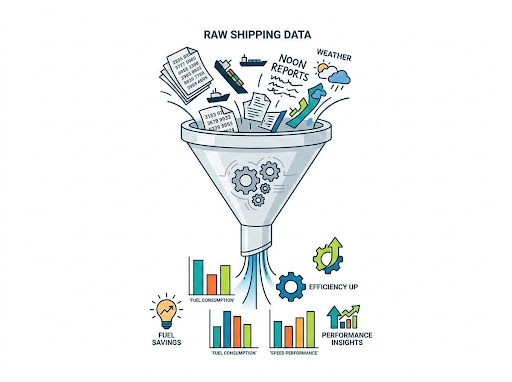
Data management means collecting, processing, analysing, and presenting information in a useful way. In shipping, this data may come from noon reports, vessel performance systems, weather-routing tools, navigation systems, voyage reports, fuel consumption reports, and digital platforms. Earlier, much of this information was recorded manually or not captured properly. Today, companies receive regular digital data from vessels. Raw data alone does not help much. The real value comes when someone finds patterns, identifies problems, and explains what action should be taken.
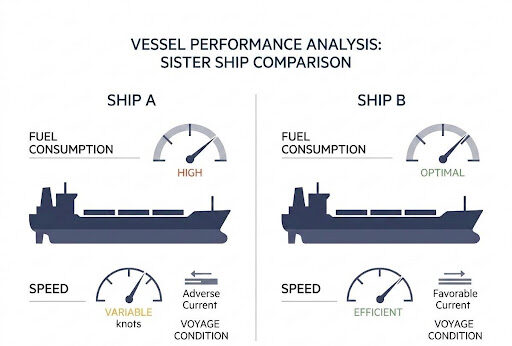
Shipping companies want to understand how their vessels are performing. They want to know why one ship is consuming more fuel, why another ship is giving better speed, why a voyage took longer, or how weather affected performance. A company may compare one vessel with a sister vessel and check whether performance differences are caused by weather, current, route, vessel condition, Master’s decisions, speed management, or engine performance. This analysis helps improve performance, save fuel, reduce delays, and support better commercial decisions.
A normal data analyst may understand numbers, charts, software, and dashboards, but may not understand what sea state, wind direction, current, or vessel behaviour means in real life. A deck officer understands navigation, weather, currents, route planning, voyage conditions, and vessel movement. For example, if a vessel shows very good speed after leaving a particular area, a mariner may know whether favourable current helped the vessel. This practical interpretation makes deck officers valuable in maritime data roles.
Data management can be a strong option for junior and operational-level deck officers. Third Officers and Second Officers have enough shipboard exposure to understand vessel operations. If they add data skills, they can enter roles connected with vessel performance, voyage analysis, marine data management, weather-routing support, and maritime analytics. Earlier, salaries for Second Officer-level candidates were around ₹8 lakh to ₹9 lakh per annum. Today, suitable candidates with strong data skills may get around ₹20 lakh to ₹21 lakh per annum in some roles.
For Captains and Chief Engineers, the role may be different. A senior officer may not work as a basic data analyst. Instead, they may manage teams, projects, or digital transformation work. Senior officers can explore roles such as Project Manager, Program Manager, Vessel Performance Manager, Marine Technology Manager, Data Team Lead, or Digital Transformation Manager. Deep coding may not be required at this level, but they must understand what data tools can do and how digital systems support shipping operations.
An MBA is not compulsory for a data management career in shipping. Companies will value sailing experience, domain knowledge, analytical ability, and practical data skills more than just a degree. A deck officer is useful because they understand vessels and can explain data from a shipping point of view. Short-term courses, practical projects, and tool-based learning can be more useful at the entry stage. An MBA may help later in management, strategy, product, or leadership roles.
Deck officers who want to enter data management should develop both maritime and technical skills. Advanced Excel is the best starting point because it is widely used for reports, calculations, data cleaning, and analysis. After Excel, officers can learn Power BI, basic Python, data visualisation, dashboard creation, and basic statistics. Weather data understanding, voyage performance analysis, fuel consumption analysis, and routing knowledge can also help. Communication is equally important because findings must be explained clearly to managers and technical teams.
A good data professional does not only prepare charts. They explain what the chart means and what action should be taken. This is where deck officers can stand out. They can connect wind, current, route, speed, sea state, fuel consumption, and voyage performance with real shipboard situations. If they learn how to present this clearly through dashboards, reports, and presentations, they can become useful to vessel performance teams, commercial teams, technical teams, and digital shipping companies.
Certificates are useful, but projects are even more powerful. A deck officer can create a small shipping-related dashboard showing vessel speed, fuel consumption, weather impact, and voyage performance. They can also show how performance changes due to wind, current, sea state, route, or speed variation. A practical project proves that the officer can apply data skills to real shipping problems. It also gives recruiters something meaningful to discuss during interviews and shows serious interest in the career shift.
In a data management role, you may work with vessel reports, noon data, performance systems, weather data, routing tools, and digital dashboards. The work may include cleaning data, checking errors, preparing reports, comparing vessels, analysing fuel consumption, studying speed trends, and presenting insights to management. This is mostly a shore-based role, but it remains closely connected with ship operations. It is suitable for deck officers who like analysis, technology, reports, voyage performance, and practical problem-solving.
Data management may not suit someone who dislikes computers, numbers, reports, or detailed data checking. This career requires patience, accuracy, and attention to detail because small errors in data can lead to wrong conclusions. It is better suited for deck officers who enjoy technology, analysis, voyage performance, and structured problem-solving. The work may not have the same action as shipboard operations, but it offers a modern way to stay connected with shipping while building a future-ready shore career.
Data management is a future-ready shore career option for deck officers. Shipping is becoming more digital, and companies need people who understand both vessels and data. Third Officers and Second Officers can enter this field by learning Advanced Excel, Power BI, Python basics, and data analysis. Senior officers can target higher roles in project management, program management, vessel performance, marine technology, or digital transformation. The key is to combine maritime experience with data skills and present that combination clearly.
For deck officers who want to move ashore without leaving the maritime industry completely, data management can be a practical, modern, and high-potential career path. Moving into a digital shipping role becomes easier when you understand which skills to build and how to position your sailing experience for shore opportunities. Sailor Pro App, an initiative by Merchant Navy Decoded, helps seafarers explore career paths, understand industry trends, and make smarter decisions for life at sea and beyond.
Data management in shipping means collecting, analysing, and presenting vessel data from noon reports, weather systems, performance tools, voyage reports, and digital platforms.
Yes, deck officers can work in data management because they understand navigation, weather, route planning, vessel behaviour, voyage conditions, and real ship operations.
Yes, it can be a strong shore career for deck officers who are interested in technology, analysis, vessel performance, reports, and digital shipping roles.
Important skills include Advanced Excel, Power BI, basic Python, data analysis, dashboard creation, basic statistics, communication, and voyage performance understanding.
No, MBA is not compulsory. Practical data skills, maritime domain knowledge, analytical ability, and relevant projects matter more at the entry stage.
Earlier, Second Officer-level candidates earned around ₹8 lakh to ₹9 lakh per annum. Today, strong candidates with data skills may get around ₹20 lakh to ₹21 lakh per annum in some roles.
Senior officers can explore roles such as Project Manager, Program Manager, Vessel Performance Manager, Marine Technology Manager, Data Team Lead, or Digital Transformation Manager.
Projects show that you can apply data skills to real shipping problems. A dashboard on vessel speed, fuel consumption, weather impact, and voyage performance can strengthen your CV.
Deep coding is not always required, but basic Python, SQL, Excel, Power BI, and data-analysis knowledge can make a deck officer more suitable for such roles.
Deck officers should learn Advanced Excel, Power BI, basic Python, data analysis, dashboards, voyage performance concepts, and create at least one practical maritime data project.
Disclaimer :- The opinions expressed in this article belong solely to the author and may not necessarily reflect those of Merchant Navy Decoded. We cannot guarantee the accuracy of the information provided and disclaim any responsibility for it. Data and visuals used are sourced from publicly available information and may not be authenticated by any regulatory body. Reviews and comments appearing on our blogs represent the opinions of individuals and do not necessarily reflect the views of Merchant Navy Decoded. We are not responsible for any loss or damage resulting from reliance on these reviews or comments.
Reproduction, copying, sharing, or use of the article or images in any form is strictly prohibited without prior permission from both the author and Merchant Navy Decoded.
Decoded Discount Alert! up to 50% OFF
Use Coupon Code Deep50