Hi this is Team Merchant Navy Decoded !!!
Please fill the below form with your query and we will get back to you in next 12 hours.
Rest assured your data is safe with us !!!🙂
Ask Your Query| For Beginner | For Professional |
|---|---|
| GME | Engine Side |
| G.P. Rating | Deck Side |
| ETO | G.P. Rating |
| IMUCET & Sponsorship | Combo Offers |
| Free Course | MEO |
| Free Course |
| For Beginner | For Professional |
|---|---|
| GME | Engine Side |
| G.P. Rating | Deck Side |
| ETO | G.P. Rating |
| IMUCET & Sponsorship | Combo Offers |
| Free Course | MEO |
| Free Course |
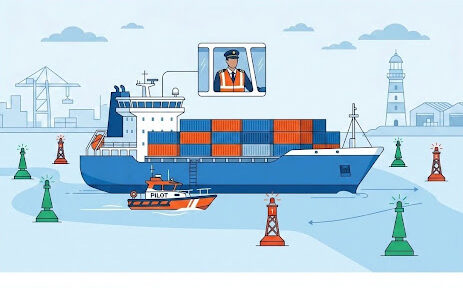
Pilotage is one of the most natural shore career options for Master Mariners. When a vessel enters or leaves a port, canal, strait, or restricted waterway, it usually needs the Pilotage support of a pilot. The pilot guides the vessel safely through local waters and assists with navigation, manoeuvring, and port approach. For Masters, this career can feel familiar because the work remains closely connected with ship handling, navigation, port movement, and command-level responsibility.
Introduction
For a Master who enjoys navigation, manoeuvring, and ship handling, pilotage can be a highly satisfying shore career. It allows them to move ashore while still remaining connected with vessels and real-time marine operations. The main difference is that after becoming a pilot, they receive specific training about local port conditions. This may include tides, currents, traffic patterns, berths, port rules, restricted waters, local procedures, and safety practices. This makes pilotage a practical ship-to-shore transition.
Pilotage means guiding vessels safely through port limits, canals, channels, straits, or restricted waters. A marine pilot boards the vessel and assists the Master with local navigation, manoeuvring, berthing, unberthing, shifting, and safe passage. The pilot has detailed local knowledge of the area, including depths, tides, currents, traffic, hazards, port rules, and berth conditions. In simple words, a pilot helps the vessel move safely in waters where local knowledge and precise ship handling are very important.
Many shore jobs require seafarers to adjust to office culture, corporate communication, reporting structures, and sometimes office politics. Pilotage is different because the core responsibility is clear. The main job is to take the vessel safely from one point to another within port limits or restricted waters. If this is done safely, professionally, and consistently, the career path can become more structured. For Masters who want shore stability without leaving ships completely, pilotage can be a strong option.
Pilotage is mainly suitable for Master Mariners. In most Indian ports, sailing experience as Master is very important. Some ports may consider a person who holds a Master CoC, but generally ports prefer someone who has actually sailed as Master. This is because pilotage requires confidence, judgement, ship-handling ability, calm decision-making, and maturity to handle large vessels in restricted waters. A Master with exposure to different ports, traffic situations, weather conditions, and manoeuvring scenarios can adapt better.
There are mainly two types of port employers: government ports and private ports. In government or public ports, salary details are usually mentioned in the official vacancy advertisement. These advertisements are generally available on the port authority website whenever vacancies are open. In government ports, a pilot’s salary may start around ₹1 lakh to ₹1.5 lakh per month. The exact salary depends on the port, position, experience, grade, licence level, and official pay structure.
In the beginning, a new pilot may not be allowed to handle all types of vessels independently. The licence may be issued gradually. For example, initially, the pilot may be permitted to handle vessels only up to a certain size or tonnage. With experience, training, assessment, and performance, the licence level may increase, and the pilot may be allowed to handle larger vessels. As licence level and responsibility increase, salary, seniority, and professional standing may also improve.
Private ports can offer better salaries compared to many government ports. In good private ports in India, pilot salaries can reach around ₹4 lakh to ₹5 lakh per month. This makes pilotage financially attractive for Masters who want to move ashore without leaving ship handling completely. For those willing to work abroad, salaries can be even stronger. Ports in countries such as the UAE may offer attractive tax-free packages, depending on experience, port requirements, vessel traffic, and contract terms.
Pilotage jobs can be contractual or permanent, depending on the port and employer. In some private ports, pilots may work on contract patterns such as one month on and one month off, or two months on and two months off. This can suit someone who does not want to shift family permanently to the port location. A stationed job is different. In that case, the pilot stays near the port and becomes part of regular marine operations.
Pilotage is not only about becoming a pilot and staying in the same position forever. A pilot can become a senior pilot and later move into port management roles. One important growth position is Harbour Master. A Harbour Master is responsible for vessel movement, berthing, port rules, safety, regulations, traffic management, and overall marine operations inside the port. In some cases, pilots have grown into senior port management and even CEO-level positions with strong experience and leadership.
Pilotage is a good career, but it is not risk-free. A pilot has to board and disembark vessels using pilot ladders, which can be risky during bad weather, rough sea conditions, poor visibility, or poor boarding arrangements. The job also carries high responsibility because a pilot handles large vessels in restricted waters, near berths, channels, breakwaters, terminals, and port traffic. Any mistake can affect the vessel, port, cargo, environment, and people involved.
Pilotage is a shore career, but it is not a normal office job. Working hours can be irregular because vessel movements may happen during the day, night, early morning, weekends, or holidays. A pilot must remain alert, physically fit, disciplined, and ready for operational pressure. The role requires courage and strong professional judgement. For Masters who still enjoy live ship operations and do not want a desk-only career, this lifestyle can be suitable and satisfying.
Apart from salary, some ports may provide additional benefits such as accommodation. This can be a major advantage, especially in expensive cities. For example, if a pilot gets accommodation in a good area of Mumbai, it can become very valuable for the family. Housing, location, schooling environment for children, healthcare access, and family stability should also be considered while evaluating pilotage jobs. Sometimes these benefits can make a slightly lower salary more valuable in real life.
Masters interested in pilotage should regularly check port authority websites for vacancies. Government ports usually publish official advertisements with eligibility criteria, salary details, experience requirements, selection process, and application instructions. Private port operators should also be targeted through company websites, recruitment platforms, professional networks, and industry references. If your vessel calls Indian ports, you can speak to working pilots and understand the process, training structure, licence progression, and real expectations of the role.
Pilotage is one of the smoothest ship-to-shore transitions for Master Mariners. It keeps you close to navigation, ship handling, manoeuvring, and command-level responsibility. Government ports may offer structure, stability, and benefits, while private ports may offer higher packages. Abroad, the earning potential can be stronger.
Choosing the right shore career after command requires clarity, preparation, and a realistic understanding of your strengths. Sailor Pro app, an initiative by Merchant Navy Decoded, helps seafarers explore career options, understand maritime pathways, and make smarter decisions for life at sea and beyond.
Pilotage means guiding vessels safely through ports, channels, canals, straits, or restricted waters using local navigation and ship-handling knowledge.
Pilotage is mainly suitable for Master Mariners. Most ports prefer candidates who have actually sailed as Master and have strong ship-handling experience.
Yes, pilotage can be a good shore career for Masters who enjoy navigation, manoeuvring, port operations, and command-level responsibility.
In government ports, pilot salary may start around ₹1 lakh to ₹1.5 lakh per month, depending on port, grade, experience, and official structure.
In good private ports in India, pilot salary can reach around ₹4 lakh to ₹5 lakh per month, depending on port, experience, and responsibility.
Yes, experienced pilots may find opportunities abroad. Ports in countries such as the UAE may offer attractive tax-free packages depending on requirements.
Pilotage jobs can be contractual or permanent. Some private ports offer rotation patterns, while government or stationed roles may provide long-term stability.
A pilot can grow into Senior Pilot, Harbour Master, marine operations leadership, senior port management, and in some cases even CEO-level positions.
Yes, pilotage has risks such as pilot ladder boarding, rough weather, restricted-water navigation, high responsibility, and irregular working hours.
Masters should check port authority websites, private port career pages, recruitment platforms, industry references, and speak with working pilots for practical guidance.
Disclaimer :- The opinions expressed in this article belong solely to the author and may not necessarily reflect those of Merchant Navy Decoded. We cannot guarantee the accuracy of the information provided and disclaim any responsibility for it. Data and visuals used are sourced from publicly available information and may not be authenticated by any regulatory body. Reviews and comments appearing on our blogs represent the opinions of individuals and do not necessarily reflect the views of Merchant Navy Decoded. We are not responsible for any loss or damage resulting from reliance on these reviews or comments.
Reproduction, copying, sharing, or use of the article or images in any form is strictly prohibited without prior permission from both the author and Merchant Navy Decoded.
Decoded Discount Alert! up to 50% OFF
Use Coupon Code Deep50