Hi this is Team Merchant Navy Decoded !!!
Please fill the below form with your query and we will get back to you in next 12 hours.
Rest assured your data is safe with us !!!🙂
Ask Your Query| For Beginner | For Professional |
|---|---|
| GME | Engine Side |
| G.P. Rating | Deck Side |
| ETO | G.P. Rating |
| IMUCET & Sponsorship | Combo Offers |
| Free Course | MEO |
| Free Course |
| For Beginner | For Professional |
|---|---|
| GME | Engine Side |
| G.P. Rating | Deck Side |
| ETO | G.P. Rating |
| IMUCET & Sponsorship | Combo Offers |
| Free Course | MEO |
| Free Course |
Many seafarers earn well during their sailing career, but the real confusion starts when the salary reaches the bank account. Some people suggest fixed deposits because they feel safe. Some suggest mutual funds for growth. Some push direct stocks for higher returns. Some families trust gold. Some seafarers dream of buying property. Some are sold ULIPs in the name of insurance and investment together. But the truth is simple: every investment has a different purpose. The right investment is not the one that looks popular. The right investment is the one that matches your goal, time, risk, and need for money.
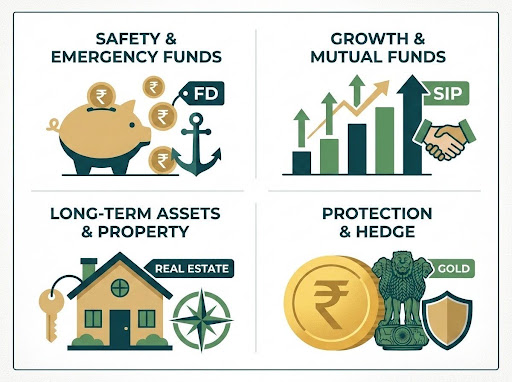
Seafarers have many investment options in India, but every option works differently. Fixed deposits can give safety and predictability. Mutual funds can offer market-linked growth with professional management. Direct stocks can provide growth potential but need knowledge and tracking. Gold can act as a protection asset. Real estate can help build long-term wealth but may be difficult to sell quickly. ULIPs combine insurance and investment, but they need careful understanding. A seafarer should not choose any product only because someone else is investing in it. The first step is understanding the purpose of each investment.
Before investing, a seafarer should first ask one simple question: “When will I need this money?” If the money is needed within a few months, it should not be exposed to high market risk. If the money is for retirement after many years, it should not remain only in a savings account. If the money is for emergency use, it should remain liquid and easily accessible. Seafarers often have contract-based income and vacation gaps, so investment planning should begin with safety, cash flow, and family needs before chasing returns.
Fixed deposits can be good for seafarers who want safety, predictable returns, and short-term stability. FDs are simple to understand and can be useful for planned expenses like course fees, document renewal, children’s school fees, medical needs, and family expenses. Deposit insurance in India covers principal and interest up to ₹5 lakh per depositor per insured bank, as explained by DICGC. However, fixed deposits may not be enough for long-term wealth creation because returns can be limited compared to market-linked investments.
Seafarers should use fixed deposits when the goal is safety and the money may be needed in the near future. For example, if a seafarer needs money for exams, certificates, medical check-ups, travel, family expenses, or a planned purchase, FD can be a practical option. The main benefit is stability. The main limitation is growth. If all money remains only in FDs for many years, inflation may reduce the real value of savings. So, FD can be useful, but it should not be the full investment plan.
Mutual funds can be useful for seafarers who want long-term growth but cannot track the market every day. A mutual fund collects money from many investors and invests it in assets such as equities, bonds, government securities, and money market instruments. AMFI explains that mutual fund money is pooled from investors and managed according to the scheme’s investment objective. This structure can help busy seafarers because the investment decisions are handled by a professional fund manager and research team.
A seafarer’s onboard life is full of duties, watchkeeping, inspections, safety checks, documents, exams, and limited rest time. Tracking market news, company results, and share prices daily may not be practical. Mutual funds do not remove risk, but they reduce the need to personally select every stock. A fund manager manages the portfolio based on the scheme’s objective. This can make mutual funds a more organised option for seafarers who want disciplined investing without depending on random stock tips.
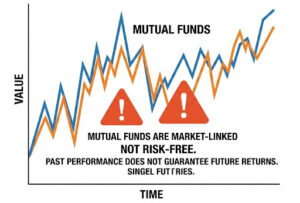
No, mutual funds are not risk-free. This is one of the most important points every seafarer should understand. AMFI states that mutual fund schemes are not guaranteed or assured return products, and investment in mutual fund units involves risks, including possible loss of principal. This means mutual funds should not be treated like fixed deposits. They are market-linked products, and their value can go up or down depending on market conditions, fund type, and investment period.
Before investing in mutual funds, seafarers should check the fund objective, risk level, expense ratio, exit load, time horizon, past performance, fund category, and taxation. SEBI explains that the Riskometer is used in mutual funds to show the scheme’s risk level, ranging from low to very high, and asset management companies must display it. A seafarer should not invest only by looking at past returns or social media recommendations. The fund should match the goal and risk comfort.
Mutual funds and direct stocks are not the same. In direct stocks, the seafarer personally selects companies, decides when to buy, when to sell, and how much to invest. This requires time, research, knowledge, and emotional discipline. In mutual funds, the fund manager handles investment decisions according to the scheme’s objective. For seafarers who cannot track markets daily, mutual funds may be easier to manage than direct stocks. Direct stocks can give control, but they also demand responsibility and regular monitoring.
Seafarers can invest in stocks if they have proper knowledge, time, research ability, and risk appetite. But buying shares only because a friend, colleague, WhatsApp group, or YouTube video suggested it can be dangerous. Direct stock investing requires understanding the company, business model, financial results, management quality, valuation, and market conditions. During sailing, internet access and time may be limited. If a seafarer cannot track companies properly, random stock buying can become risky and may affect hard-earned savings.
Gold can be useful for seafarers as a protection asset or hedge, but it should not become the entire investment plan. Many Indian families trust gold because it has emotional and cultural value. However, physical gold has issues such as making charges, purity, storage, and safety. Gold may help during uncertain times, but it may not always generate regular income or strong long-term growth. Seafarers can consider gold as a small part of a balanced portfolio, but not as the only wealth-building option.
Many seafarers dream of buying land, a flat, or a house. Property can provide emotional security, family stability, and long-term wealth if selected carefully. But real estate also comes with responsibilities such as legal verification, loan burden, maintenance cost, registration, property tax, location risk, and resale difficulty. A seafarer should not buy property only because someone says “property always increases.” Proper document checking, cash flow planning, and emergency fund preparation are important before making a large property investment.
Real estate can be a good long-term asset for seafarers, but it has one major limitation: low liquidity. Liquidity means how quickly an asset can be converted into cash. If a seafarer needs urgent money for a hospital bill, family emergency, travel, or business opportunity, selling property may take time. A buyer may not be available immediately. If the sale is urgent, the property may have to be sold at a lower price. This is why property should not replace emergency money.
ULIP means Unit Linked Insurance Plan. It combines insurance and investment in one product. Many seafarers buy ULIPs because they are told they will get both protection and returns. But ULIPs should be understood carefully before purchase. IRDAI’s life insurance handbook states that ULIPs have varying degrees of risk and rewards, and various charges apply to unit-linked policies. This means seafarers should check charges, lock-in period, fund value, life cover, surrender rules, and risk before buying.
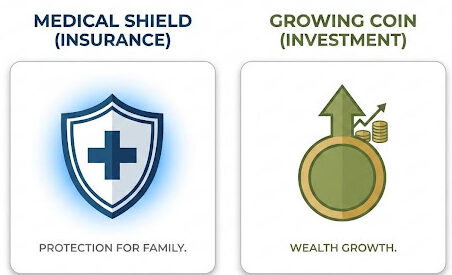
Insurance and investment have different jobs. Insurance protects the family if something happens to the earning member. Investment helps grow money for future goals. When both are mixed in one product, it may become difficult to understand the true cost, cover, return, and lock-in conditions. Many seafarers may find it simpler to keep insurance and investment separate. Before buying any ULIP or similar product, the seafarer should ask: “Do I need insurance, investment, or both?”
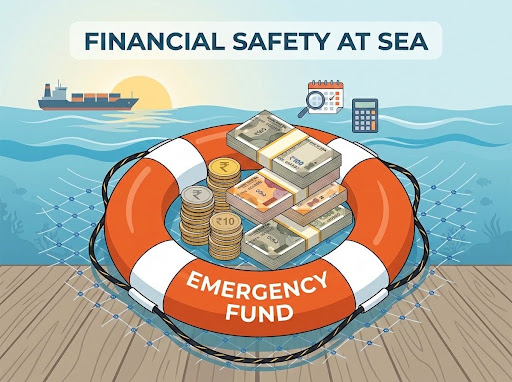
Before investing aggressively, seafarers should first build an emergency fund. This money should be safe, liquid, and easily accessible. Seafarers may face contract delays, family emergencies, medical expenses, urgent travel, document renewal, course fees, or unexpected home expenses. If all money is locked in property, gold, ULIP, or market-linked investments, emergency situations can become stressful. Emergency money is not meant for high returns. It is meant for financial safety and peace of mind.
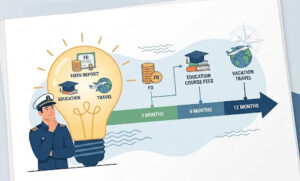
For short-term goals, safety and liquidity are more important than high returns. Money needed within a few months or one to two years should generally not be exposed to high market risk. Seafarers can consider safer options such as bank balance, fixed deposits, recurring deposits, or other low-risk choices depending on the goal. This money may be needed for documents, courses, family expenses, school fees, medical needs, or travel. The main aim for short-term money is stability, not aggressive growth.
For long-term goals, growth becomes important. Retirement planning, children’s higher education, home planning, and wealth creation need time and discipline. Mutual funds may be considered for long-term market-linked growth if the seafarer understands the risk and chooses suitable funds. Property may help in long-term family stability. Gold may play a limited role as a hedge. Direct stocks may suit only those who have knowledge and time. Long-term investing should be goal-based, not based on tips or emotions.
FD is useful for safety and short-term stability. Mutual funds can help with long-term market-linked growth through professional management. Gold can work as a hedge but should not become the full plan. Property can build long-term assets but has low liquidity. Direct stocks can offer growth, but they need time, research, and discipline. ULIPs mix insurance and investment, so they require careful understanding. No single investment is best for every seafarer. The right choice depends on goal, time, risk, and liquidity.
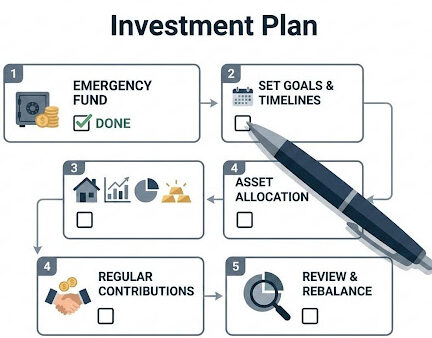
A simple investment plan for seafarers can start with emergency money. After that, family protection through proper insurance should be considered. Then short-term goals can be kept in safer options such as bank balance or FDs. Long-term goals can be planned with suitable growth assets such as mutual funds or other investments based on risk capacity. Property and gold can be added only after understanding their role. Every year, seafarers should review investments, nominees, documents, goals, and cash flow.
Seafarers should avoid investing all money in one asset. They should not buy stocks only from tips. They should not lock emergency money in property or long-term products. They should not buy ULIPs without understanding charges. They should not invest in mutual funds only by looking at past returns. They should not keep all savings idle for years. Another major mistake is not informing family members about investments, nominee details, and important documents. Planning should be simple, clear, and organised.
The correct investment is not decided by popularity. It is decided by purpose. Before investing, seafarers should ask five questions: When will I need this money? How much risk can I take? Do I need quick access to this money? Is this for safety or growth? Do I understand this product? If the answer is not clear, the seafarer should not invest in hurry. A delayed good decision is better than a fast wrong decision.
Seafarers work hard for every rupee, and that money should not be invested blindly. Fixed deposits, mutual funds, stocks, gold, real estate, and ULIPs all have different roles. FD gives safety. Mutual funds offer market-linked growth. Stocks need knowledge. Gold can protect value. Property can build long-term assets but lacks liquidity. ULIPs need careful understanding. The best investment plan for seafarers is not about chasing the highest return. It is about matching money with goals, time, risk, and liquidity.
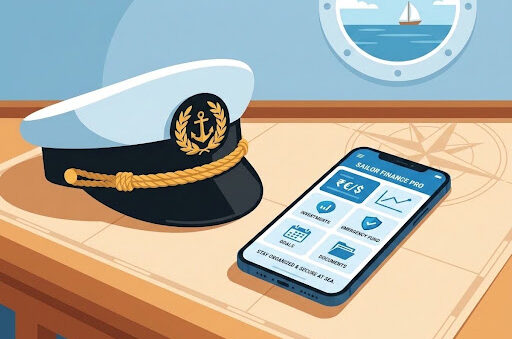
For seafarers, mutual fund investing is not only about selecting one scheme. It is about understanding goals, managing risk, protecting family, and making disciplined financial decisions. Download Sailor Pro app Built for Seafarers, an Initiative by Merchant Navy Decoded, to stay more organised and confident in your financial planning. You can also follow finance_for_seafarers on Instagram and join the WhatsApp channel Financial Management for Seafarer for practical money guidance created especially for seafarers.

Seafarers should invest based on goals, time horizon, risk comfort, and liquidity needs. Emergency money should stay safe and accessible, while long-term money can be planned for growth.
Fixed deposits can be good for short-term safety, predictable returns, and planned expenses such as courses, document renewal, family needs, and travel.
Mutual funds can be useful for long-term goals because they offer professional management and diversification, but they are market-linked and do not guarantee returns.
Seafarers should invest directly in stocks only if they have time, knowledge, research ability, and risk appetite. Random stock tips can be risky.
Gold can be useful as a hedge or protection asset, but it should not become the entire investment plan.
Property can be useful for long-term wealth and family security, but it has low liquidity and requires proper legal and financial checks.
ULIP combines insurance and investment. Seafarers should understand charges, lock-in period, risk, life cover, and surrender rules before buying.
For short-term goals, safer and more liquid options such as bank balance, FD, or RD may be suitable depending on the timeline and purpose.
For long-term wealth creation, seafarers may consider mutual funds, suitable growth assets, property, or other options based on risk capacity and financial goals.
The biggest mistake is investing without a clear goal. Many seafarers chase returns, follow tips, ignore emergency funds, or invest in products they do not understand.
Disclaimer :- The opinions expressed in this article belong solely to the author and may not necessarily reflect those of Merchant Navy Decoded. We cannot guarantee the accuracy of the information provided and disclaim any responsibility for it. Data and visuals used are sourced from publicly available information and may not be authenticated by any regulatory body. Reviews and comments appearing on our blogs represent the opinions of individuals and do not necessarily reflect the views of Merchant Navy Decoded. We are not responsible for any loss or damage resulting from reliance on these reviews or comments.
Reproduction, copying, sharing, or use of the article or images in any form is strictly prohibited without prior permission from both the author and Merchant Navy Decoded.
Decoded Discount Alert! up to 50% OFF
Use Coupon Code Deep50