Hi this is Team Merchant Navy Decoded !!!

Please fill the below form with your query and we will get back to you in next 12 hours.

Rest assured your data is safe with us !!!🙂

Ask Your Query

Shell and Tube Fresh Water Generator

Freshwater is one of the most critical resources on a ship. Due to the limited storage capacity of a ship, it becomes unviable to carry sufficient drinking and domestic water for long voyages. Hence, ships utilize Fresh Water Generators (FWG) to produce drinkable and usable water from seawater. The most common types of FWG are Shell and Tube FWG, which is simple in design, reliable and requires low maintenance.

Shell and Tube Fresh Water Generator

What is Shell and Tube Fresh Water Generator?

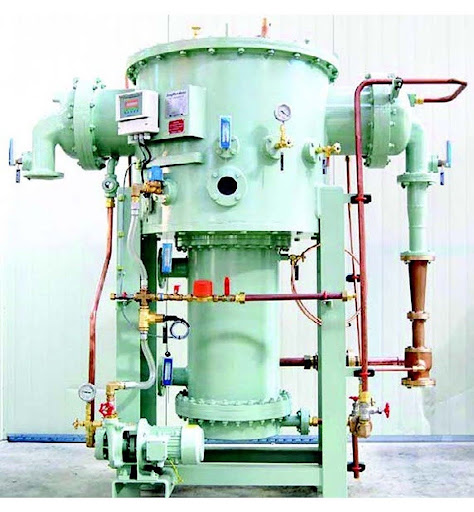
Shell and Tube Fresh Water Generator is a condensation type desalination system that produces fresh water from seawater using the waste heat from the main engine jacket cooling water.

The evaporation process takes place under a vacuum so that seawater boils at a temperature lower than the normal boiling point around 45-60°C.

Main Components

The components of Shell and Tube FWG are:

  • Evaporator – used to heat seawater by passing it through the evaporator tubes heated by jacket cooling water.
  • Condenser – used to condense the resultant steam from the evaporator into fresh water.
  • Shell and Tube Heat Exchanger – facilitates heat exchange between two mediums.
  • Air ejector or vacuum pump – creates a vacuum within the system
  • Brine ejector – used to remove the concentrated salt solution from the evaporator.
  • Distillate pump – pumps fresh water from the condenser to the fresh water storage tank.
  • Salinometer – measures the salinity level of the produced fresh water.
  • Demister – removes salt droplets from the water vapor to ensure that the produced water is free from salt.

Working Principle

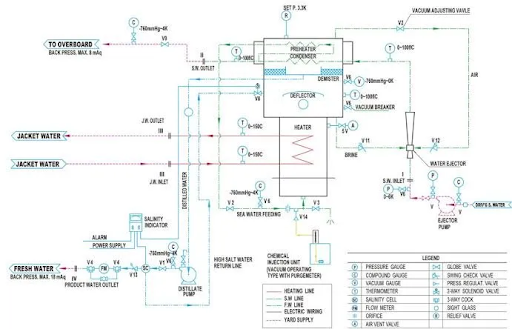
Working Principle of fresh water genrator

The Shell and Tube Fresh Water Generator works in a series of simple steps:

  • Seawater supply

Seawater is drawn into the system by the ejector. Part of this water is used for cooling in the condenser, while the remaining portion enters the evaporator.

  • Vacuum creation

An air ejector or vacuum pump creates a vacuum inside the generator. This reduces the boiling point of seawater allowing evaporation at relatively low temperatures.

  • Evaporation

Hot jacket cooling water from the main engine flows through the tubes of the evaporator. The surrounding seawater absorbs this heat and begins to evaporate.

  • Salt removal

The generated steam passes through a demister, which removes salt particles and water droplets. This ensures that only clean water vapour reaches the condenser.

  • Condensation

Cold seawater flowing through the condenser tubes cools the water vapour converting it into fresh water.

  • Fresh Water Collection

The distilled water is collected in a chamber and pumped to the ship’s fresh water tank. Before storage, the salinity is checked by a salinometer to ensure the water meets acceptable quality standards.

Table of Contents

Advantages

Some key benefits include:

  • Utilizes waste heat from the main engine, reducing fuel consumption.
  • Produces high quality fresh water for domestic and technical use.
  • Simple and robust construction.
  • Reliable operation during long voyages.
  • Low operating and maintenance costs.
  • Suitable for continuous freshwater production.
  • Easy inspection and cleaning of heat exchanger tubes.
  • Reduces dependency on shore based freshwater supply.

Applications

  • Produces fresh water for drinking, cooking and domestic use onboard
  • Supplies low salinity water for boilers and engine cooling systems
  • Reduces the need for freshwater bunkering at ports
  • Uses waste heat from the main engine, improving fuel efficiency
  • Provides a continuous freshwater supply during long voyages
  • Supports sustainable and cost effective ship operations

Common Operational Problems

Despite its reliability, certain issues may affect the system’s performance:

  • Low vacuum due to air leakage or ejector malfunction.
  • Scaling inside tubes reduces heat transfer efficiency.
  • High salinity caused by damaged demister or leaking condenser tubes.
  • Reduced freshwater production because of insufficient heating temperature.
  • Blocked tubes resulting from marine deposits or sediment.
  • Air leakage leading to poor evaporation efficiency.
  • Regular inspection and preventive maintenance help minimize these problems.

Basic Maintenance

To ensure efficient operation:

  • Clean condenser and evaporator tubes periodically.
  • Inspect the demister for damage or salt deposits.
  • Check the vacuum level before starting the system.
  • Monitor salinity readings regularly.
  • Inspect ejectors for blockage or wear.
  • Remove scale formation using approved cleaning methods.
  • Check gaskets and seals for leakage.
  • Follow the manufacturer’s maintenance schedule.

Safety Precautions

  • Ensure a proper vacuum before starting the FWG
  • Monitor salinity readings regularly to maintain water quality
  • Clean evaporator and condenser tubes to prevent scaling
  • Inspect the demister and ejectors for damage or blockage
  • Check for leaks in gaskets, seals and condenser tubes

Conclusion

In conclusion, Shell and Tube Fresh Water Generator is one of the most reliable systems used to provide freshwater in the maritime industry. It provides a sustainable way of obtaining fresh water from a plentiful supply of seawater while also saving fuel. This system achieves significant improvement in energy efficiency by using the main engine’s jacket waste heat to evaporate seawater stored in the evaporator. 

Moreover, the system operates under a vacuum to allow the evaporation process to take place effectively at relatively low temperatures. 

Hence, with proper maintenance and inspection, FWG can be a crucial component of a ship’s operation.

Frequently Asked Questions (FAQs)

Operating under vacuum lowers the boiling point of seawater, allowing evaporation at low temperatures using waste heat.

The demister removes salt droplets from water vapour before condensation, ensuring high quality fresh water.

The system generally uses the main engine jacket cooling water as its heat source.

It continuously monitors the salt content of the produced water and diverts water with excessive salinity to drain if necessary.

Disclaimer :- The opinions expressed in this article belong solely to the author and may not necessarily reflect those of Merchant Navy Decoded. We cannot guarantee the accuracy of the information provided and disclaim any responsibility for it. Data and visuals used are sourced from publicly available information and may not be authenticated by any regulatory body. Reviews and comments appearing on our blogs represent the opinions of individuals and do not necessarily reflect the views of Merchant Navy Decoded. We are not responsible for any loss or damage resulting from reliance on these reviews or comments.

Reproduction, copying, sharing, or use of the article or images in any form is strictly prohibited without prior permission from both the author and Merchant Navy Decoded.

DIWALI SALE

Decoded Discount Alert! up to 50% OFF

DIWALI SALE

Decoded Discount Alert! up to 50% OFF

Use Coupon Code Deep50

Days
Hours
Seconds
0
Would love your thoughts, please comment.x
()
x