Hi this is Team Merchant Navy Decoded !!!

Please fill the below form with your query and we will get back to you in next 12 hours.

Rest assured your data is safe with us !!!🙂

Ask Your Query

Compressed Air System on Ships: Working, Components, Applications & Maintenance

One of a ship’s most important utility systems is the compressed air system. It is essential to the safe and effective operation of many pieces of machinery and equipment, even though it frequently works in the background. Compressed air powers nearly every department of a ship, including the main and auxiliary engines, pneumatic tools, control systems, and emergency equipment. A ship cannot safely carry out a number of operational and maintenance activities or start its propulsion machinery without a dependable compressed air system.

What is a Compressed Air System?

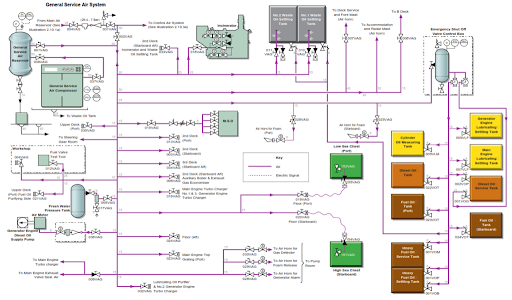
Compressed Air System

A compressed air system is a network of compressors, air receivers, filters, dryers, valves, and pipelines that compress atmospheric air, store it under pressure, and distribute it throughout the ship for various applications.

Air is compressed by reducing its volume, thereby increasing its pressure. The stored compressed air contains potential energy that can later be converted into mechanical work whenever required. Since compressed air is clean, readily available, and safe compared to hydraulic fluids or electrical systems in hazardous environments, it is widely used in marine engineering.

Major Applications of Compressed Air on Ships

Compressed air has numerous applications onboard, making it one of the most versatile utility systems.

Some of its major uses include:

  • Starting the main engine using high-pressure starting air.
  • Starting auxiliary diesel generators.
  • Operating pneumatic control valves and automation systems.
  • Powering pneumatic tools such as grinders, chipping hammers, and drills.
  • Pressurizing freshwater and drinking water hydrophore tanks.
  • Operating the ship’s whistle and fog horn.
  • Dry washing of turbochargers.
  • Boiler soot blowing.
  • Spray painting and cleaning operations.
  • Operating pneumatic pumps for oil and water transfer.
  • Emergency shut-down systems and quick-closing valves.
  • Aeration in sewage treatment plants.

These applications demonstrate why uninterrupted compressed air availability is crucial for vessel operation.

Table of Contents

Types of Air Compressors Used on Ships

Types of air compressors are used in marine applications.

  1. Reciprocating Air Compressor

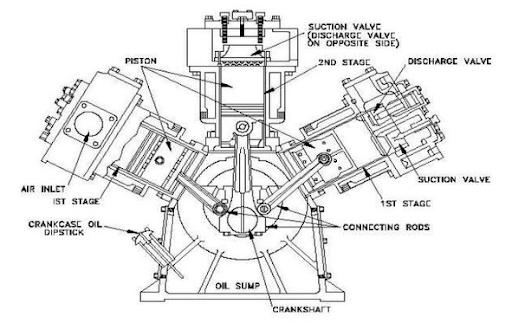
The most prevalent type of compressor on board a ship is the reciprocating compressor. It compresses air using pistons that move inside cylinders. In order to increase efficiency and lower discharge temperature, the majority of marine starting air compressors are two-stage or three-stage reciprocating compressors with intercoolers and aftercoolers.

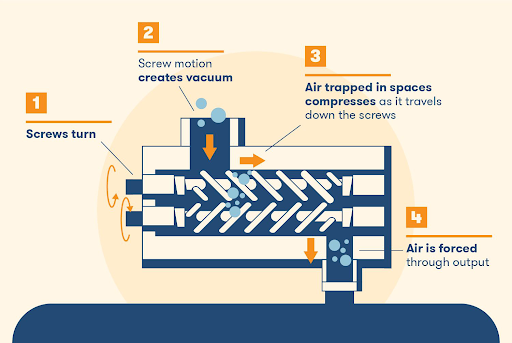
  1. Rotary Screw Compressor

Rotary Screw Compressor

Rotary screw compressors use two intermeshing helical screws to compress air continuously. They are commonly used for service air because of their smooth operation and high efficiency.

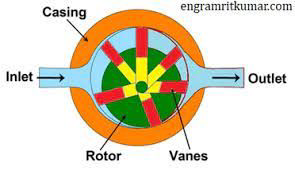
  1. Rotary Vane Compressor

Rotary Vane Compressor

These compressors use rotating vanes inside an eccentric housing to trap and compress air. They are generally employed for low-pressure applications.

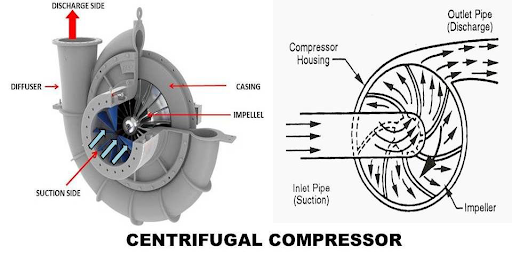
  1. Centrifugal Compressor

Centrifugal Compressor

Centrifugal compressors increase air pressure by converting kinetic energy into pressure energy through a rotating impeller. They are suitable for applications requiring high air flow rates.

Working Principle of the Compressed Air System

Working Principle of the Compressed Air System

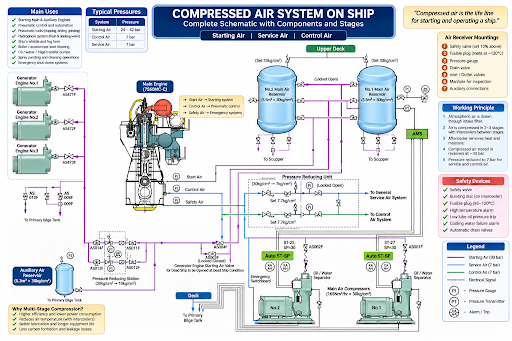
Atmospheric air first enters the compressor through an intake filter where dust and contaminants are removed.

Inside the compressor, air undergoes compression in multiple stages. Between each stage, intercoolers reduce air temperature, improving compression efficiency. After the final stage, the compressed air passes through an aftercooler where additional heat and moisture are removed.

The compressed air is then delivered to the main air receiver, where it is stored at approximately 30 bar. From the air receiver, high-pressure air is supplied directly to the main engine starting system, while pressure-reducing valves lower the pressure to around 7 bar for service air and control air applications.

Control air passes through additional filters and membrane dryers to remove oil, moisture, and impurities before reaching sensitive pneumatic control equipment.

Main Components of a Compressed Air System

Main Air Compressor

air compressor is the heart of the compressed air system. It converts mechanical energy into pressure energy by compressing atmospheric air.

Modern marine compressors are equipped with:

  • Multi-stage compression
  • Intercoolers
  • Aftercoolers
  • Automatic unloading devices
  • Automatic moisture drains
  • Safety valves

Most ships are fitted with two or three compressors to provide redundancy.

Main Air Receiver (Air Bottle)

Main Air Receiver

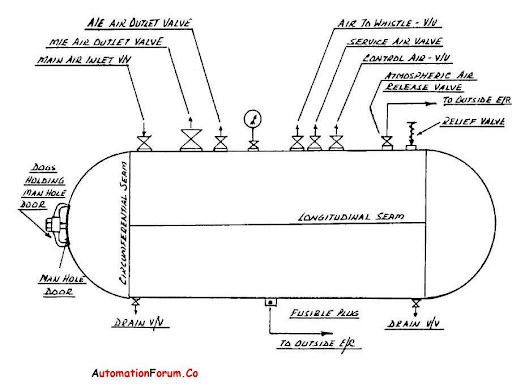
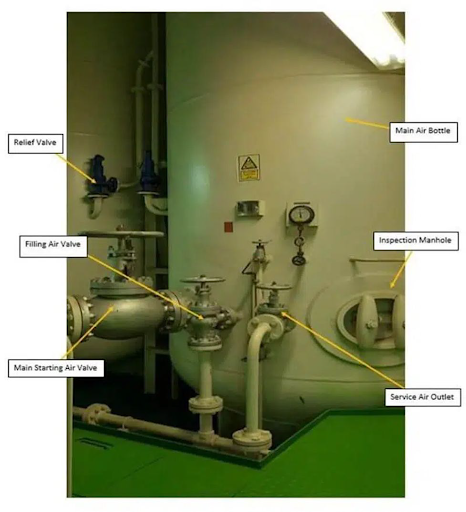
The air receiver stores compressed air and provides a reserve for engine starting.

According to marine safety requirements, ships generally have two identical air receivers capable of supplying enough air for multiple consecutive engine starts.

Main Air Receiver

Typical mountings on an air receiver include:

  • Pressure gauge
  • Safety valve
  • Fusible plug
  • Manual or automatic drain valve
  • Air inlet and outlet valves
  • Manhole for inspection

Regular draining prevents moisture accumulation and internal corrosion.

Control Air System

Control air is a clean, dry branch of the service air system.

Sensitive pneumatic instruments require air that is completely free from moisture and oil contamination. Therefore, control air passes through:

  • Primary filters
  • Secondary coalescing filters
  • Membrane air dryers

This ensures reliable operation of pneumatic controllers, automation equipment, and engine control systems.

Service Air System

Service air operates at approximately 7 bar and supplies air for general shipboard applications including:

  • Pneumatic tools
  • Cleaning
  • Spray painting
  • Hydrophore tanks
  • Whistle operation
  • Turbocharger cleaning
  • Boiler soot blowing

Unlike control air, service air does not require extremely high levels of filtration.

Emergency Air Compressor

Every ship carries an emergency air compressor independent of the main compressors.

It is powered separately and charges the emergency air bottle, allowing auxiliary engines to be started even during complete power failure.

Emergency compressed air also operates:

  • Quick-closing valves
  • Fire dampers
  • Emergency shut-down systems

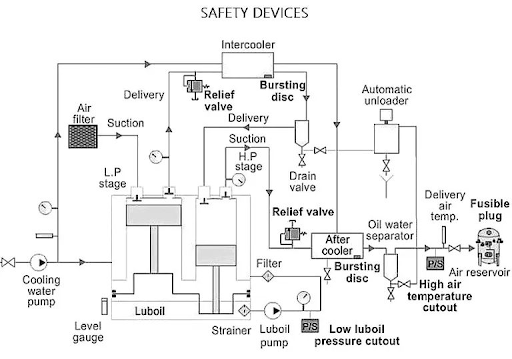
Safety Devices

Safety Devices

Compressed air systems operate under high pressure and therefore require several safety devices.

Important safety devices include:

  • Safety valve to prevent overpressure.
  • Fusible plug that melts during excessive temperatures to release pressure safely.
  • Pressure gauges for continuous monitoring.
  • Automatic drain valves to remove moisture.
  • Low-pressure alarms to warn operators.
  • Relief valves on compressors and receivers.
  • Bursting discs on intercoolers to protect against sudden pressure rise.

These devices significantly reduce the risk of explosions and equipment failure.

Maintenance of the Compressed Air System

Proper maintenance improves efficiency, extends equipment life, and prevents costly failures.

Routine maintenance includes:

  • Draining condensate from air receivers daily.
  • Cleaning intake air filters.
  • Checking lubricating oil levels.
  • Inspecting intercoolers and aftercoolers.
  • Testing safety valves.
  • Monitoring compressor discharge temperature.
  • Inspecting pipelines for leaks.
  • Replacing membrane filters as per the Planned Maintenance System (PMS).
  • Inspecting air bottles internally for corrosion and thickness loss.
  • Calibrating pressure gauges and alarms.

Regular inspections help maintain reliable engine starting and safe ship operations.

Common Problems

Several issues can reduce compressor performance, including:

  • Dirty air filters restricting airflow.
  • Leaking suction or discharge valves.
  • Worn piston rings.
  • Excessive moisture carry-over.
  • Oil contamination in control air.
  • Blocked intercoolers.
  • Air leaks in pipelines.
  • High compressor discharge temperature.

Early detection through routine monitoring minimizes downtime and improves efficiency.

Conclusion

One of a ship’s most important auxiliary systems is the compressed air system. It supplies the energy needed to power pneumatic equipment, run automation systems, start the main engine, and assist with emergency operations. In order to provide dependable performance under challenging operating conditions, modern maritime compressed air systems include effective multi-stage compressors, air receivers, dryers, filters, and safety measures. To guarantee system dependability, operational effectiveness, and adherence to marine safety regulations, routine maintenance, moisture removal, air receiver inspection, and safety equipment testing are crucial. In addition to improving mechanical efficiency, a well-maintained compressed air system greatly increases a vessel’s overall safety and continuous operation.

Frequently Asked Questions (FAQs)

It supplies high- and low-pressure air for engine starting, automation, pneumatic tools, cleaning, emergency systems, and other onboard operations.

Most ships use starting air at approximately 30 bar, though some systems may operate between 24–42 bar depending on design.

 Intercoolers reduce air temperature between compression stages, improving efficiency and reducing power consumption.

An air receiver stores compressed air, smooths pressure fluctuations, and provides reserve air for engine starting.

 Moisture and oil can damage pneumatic instruments, causing sticking, corrosion, and inaccurate control.

 Service air powers pneumatic tools, hydrophores, cleaning equipment, whistles, soot blowers, and spray-painting systems.

 They remove condensate automatically, preventing corrosion and maintaining air quality.

 It melts at high temperatures to release compressed air safely during a fire or abnormal heating.

 Most merchant ships have two or three main air compressors for redundancy and reliability.

 Routine maintenance prevents air leaks, corrosion, overheating, equipment failure, and ensures reliable operation of critical ship systems.

Disclaimer :- The opinions expressed in this article belong solely to the author and may not necessarily reflect those of Merchant Navy Decoded. We cannot guarantee the accuracy of the information provided and disclaim any responsibility for it. Data and visuals used are sourced from publicly available information and may not be authenticated by any regulatory body. Reviews and comments appearing on our blogs represent the opinions of individuals and do not necessarily reflect the views of Merchant Navy Decoded. We are not responsible for any loss or damage resulting from reliance on these reviews or comments.

Reproduction, copying, sharing, or use of the article or images in any form is strictly prohibited without prior permission from both the author and Merchant Navy Decoded.

DIWALI SALE

Decoded Discount Alert! up to 50% OFF

DIWALI SALE

Decoded Discount Alert! up to 50% OFF

Use Coupon Code Deep50

Days
Hours
Seconds
0
Would love your thoughts, please comment.x
()
x