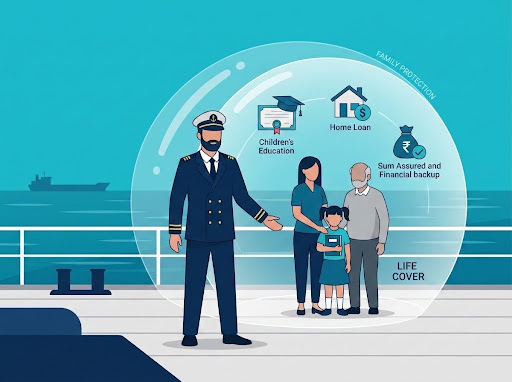
Many seafarers buy life insurance only after someone approaches them with a policy. Sometimes it is an agent, sometimes a relative, sometimes a bank executive, and sometimes a friend who says, “This policy will give insurance also and return also.” On paper, it sounds attractive. But life insurance should not be bought blindly. Its main purpose is not to give returns. Its main purpose is to protect the family if the earning person is no longer there.
What is Life Insurance for Seafarers?
Life insurance is a promise between the insurance company and the policyholder. The policyholder pays a premium. If the insured person dies during the covered period, the nominee or claimant may receive the policy benefit as per policy terms. This money can help the family manage expenses, loans, children’s education, and future needs. Life insurance does not remove emotional pain, but it can reduce financial shock during a difficult time.
Life Insurance is for Family Protection
The first purpose of life insurance is family protection. It is not mainly for investment return. If your family depends on your sea salary, life insurance can act as a financial backup. A seafarer may be young and healthy today, but family responsibility can be large. If income suddenly stops, the family should not be forced to sell assets, stop education, or take loans. Life insurance protects the family during responsibility years.
Life Insurance vs Investment for Seafarers
Life insurance and investment are different. Life insurance protects the family from financial loss. Investment helps money grow for future goals. A seafarer should not confuse these two. If you buy insurance only for returns, the life cover may be low. If you invest without insurance, your family may remain exposed. A clean plan is better: buy life insurance for protection and invest separately for wealth creation. Protection and growth should not be mixed blindly.
Life Insurance Riders for Seafarers
Riders are additional benefits attached to the main policy. They may include accidental death benefit, critical illness benefit, permanent disability benefit, waiver of premium, or other options depending on the insurer. IRDAI’s rules require life insurance policies to state details of riders attached to the main policy. Seafarers should not add riders blindly. Check what is covered, what is excluded, waiting period, claim process, premium impact, and whether the rider is useful for your situation.
Accidental Death Benefit Rider
An accidental death benefit rider may provide additional payout if death happens due to an accident, subject to policy terms. Seafarers may feel this is important because their profession involves travel and operational risks. But every rider has conditions. Check what counts as an accident, what exclusions apply, whether marine work is covered, and what documents are required for claim. Do not assume automatically. Read the policy wording and ask the insurer in writing if needed.
Critical Illness Rider
A critical illness rider may provide a fixed benefit if the insured person is diagnosed with a covered serious illness, subject to policy terms. Covered illnesses may include conditions like cancer, heart attack, kidney failure, or others depending on the policy. Seafarers should check the exact illness list, waiting period, survival period, exclusions, and claim documents. Do not assume every serious disease is covered. A rider is useful only when you understand its conditions clearly.
Permanent Disability Rider
Permanent disability rider may help if the insured person suffers permanent disability due to an accident or other covered event, depending on policy terms. For seafarers, disability can affect future earning capacity. But rider conditions must be understood properly. Check how permanent disability is defined, whether partial disability is covered, what documents are required, and whether seafaring-related risks have any special condition. Never depend only on verbal explanation. Ask for policy wording and read the rider clause.
High Premium Does Not Mean Better Protection
A high premium does not always mean better protection. Sometimes premium is high because the policy has returns, investment component, riders, money-back feature, or longer commitment. The real question is not only, “How much premium am I paying?” The real question is, “How much life cover is my family getting?” A simple term plan may provide higher cover at lower premium compared with a mixed product. Compare cover first, then compare features.
Life Cover Amount for Seafarers
Life cover amount should not be selected randomly. A seafarer should calculate family expenses, loans, children’s education, parents’ support, spouse’s needs, future goals, and inflation. If the cover is too low, the family may still struggle. A policy of a few lakh rupees may look good on paper but may not be enough for long-term support. Life cover should match responsibility. Do not buy insurance only to say, “I have a policy.”
How Much Life Insurance Cover Should Seafarers Take?
There is no single fixed cover amount for every seafarer. A cadet, rating, officer, chief engineer, unmarried seafarer, and married seafarer with children will all have different needs. The cover should depend on income, family expenses, liabilities, future goals, dependents, and existing assets. A practical method is to calculate how much money the family will need if sea income stops. Then subtract existing assets and insurance. The gap becomes the protection need.
Family Responsibilities Before Buying Life Insurance
Before buying life insurance, list your family responsibilities clearly. Who depends on your income? Spouse, children, parents, siblings, or loans? How much monthly expense is needed? How many years will support be required? What are the big future goals? This exercise helps you choose the right cover amount. Many seafarers buy policies without calculation. This can create false confidence. A policy should be based on family need, not only premium affordability or agent suggestion.
Home Loan and Life Insurance Planning
If a seafarer has a home loan, life insurance becomes more important. If something happens to the earning member, the loan should not become a burden on the family. The cover amount should ideally consider outstanding loans along with family expenses. Some people take only loan-linked insurance, but that may not cover other family needs. The family may need loan repayment plus living expenses plus education money. Plan the total protection requirement, not only the loan amount.
Children’s Education and Life Cover Planning
Children’s education is one of the biggest responsibilities for many seafarers. School fees, college fees, professional courses, hostel expenses, and future education costs can be high. Life insurance cover should consider this goal. If the seafarer is no longer there, children’s education should not stop because money is not available. This is why small life cover may not be enough. When calculating insurance need, include education goals separately and realistically.
Parents’ Support and Life Insurance Planning
Many Indian seafarers support their parents financially. Parents may need monthly support, medical expenses, medicines, hospital care, and emergency help. If the seafarer’s income stops, parents may also face difficulty. Life insurance planning should include parents’ support if they depend on the seafarer. Do not calculate cover only for spouse and children. Family responsibility may be wider. A seafarer should think honestly about who depends on his income and how much support they need.
Policy Term for Seafarers
Policy term means how long the policy provides cover. A seafarer should select the term based on responsibility years. If children are young, loans are active, and family depends on income, cover should last through the main responsibility period. IRDAI’s policyholder duty material says consumers should select the term of the policy as per their needs. Do not choose a short term only because premium is lower. Choose based on family responsibility.
Premium Payment Term for Seafarers
Premium payment term means how long you need to pay premium. Some policies require premium for the full policy term, while some have limited payment options. Seafarers should select a premium payment structure they can continue even during contract gaps. IRDAI’s policyholder material advises selecting a premium amount one can afford and paying premium regularly to avoid lapse. A policy that becomes difficult to continue later can create problems.
Nominee Details in Life Insurance
Nominee details are very important in life insurance. The nominee or assignee can intimate a death claim to the insurance company, as per IRDAI’s claim guidance. IRDAI’s policyholder duties also advise registering nomination and filling nominee details correctly. Seafarers should update nominee details after marriage, childbirth, divorce, or death in family. Family members should know the policy number, insurer name, nominee details, and claim contact.
Claim Process Family Should Know
Your family should know the life insurance claim process before any emergency. IRDAI’s life claim guidance says claim intimation should be sent to the insurance company as early as possible, with details like date, place, and cause of death. Family should not search for policy details after the problem happens. Keep insurer contact, policy document, nominee details, and claim documents organised. A good policy is useful only when family knows how to claim it.
Documents Required for Life Insurance Claim
For a death claim, IRDAI’s claim guidance says the insurer may ask for documents such as filled claim form, death certificate, policy document, deeds of assignment or reassignment if any, legal evidence of title if not assigned or nominated, and discharge form. Other documents may be required depending on the case. Seafarers should keep the policy bond, nominee details, identity documents, medical records, and family contact information organised.
Exclusions in Life Insurance Policy
Exclusions are situations where the insurance company may not pay the claim, depending on policy terms. IRDAI rules require life insurance policies to state contingencies excluded from the scope of cover and special clauses or conditions such as suicide clause. Seafarers should read exclusions carefully before buying. Do not depend only on agent explanation. Ask what is not covered, whether occupation-related conditions apply, and what documents are needed during claim.
Medical Tests Before Buying Life Insurance
Medical tests may be required before buying life insurance, depending on age, cover amount, health history, and insurer rules. Seafarers should not hide medical history, past illness, smoking, alcohol use, surgeries, or health conditions. Incorrect information can create claim problems later. IRDAI’s policyholder duties clearly say the proposal form should be filled correctly and truthfully, and all material information should be disclosed. Honest disclosure is important for family protection.
Occupation Details for Seafarers in Life Insurance
Seafarers must disclose their sailing profession correctly while buying life insurance. Do not hide that you work at sea just to get cheaper premium or faster approval. Occupation can be a material fact for risk assessment. IRDAI’s policyholder duties say the proposal form is the basis of the insurance contract and material information about the risk should be disclosed. Wrong occupation details can create problems during claim investigation.
NRI or Resident Status While Buying Life Insurance
Seafarers should also be careful about residential status and location while buying life insurance. Some policies may have rules for Indian residents, NRIs, or people working abroad. Since seafarers may earn abroad, sail internationally, or have changing tax residential status, they should ask the insurer clearly. Do not assume eligibility. Confirm whether the policy can be bought, serviced, and claimed while working at sea. Keep written confirmation wherever possible for clarity.
Policy Bought From Agent, Bank or Relative
Many seafarers buy policies from an agent, bank executive, friend, or relative. There is nothing wrong with taking help, but blind trust can be risky. The policy should suit your family need, not the seller’s target. IRDAI’s rules say a life insurance policy should clearly state benefits payable, premium details, riders, exclusions, surrender value provisions, nomination, and claim documents. Read these details yourself before buying. Do not sign only because someone is known.
Questions to Ask Before Buying Life Insurance
Before buying, ask these questions. What is the life cover? What is the premium? What is the policy term? Is it term insurance, endowment, ULIP, money back, or whole life? What are the exclusions? Is my occupation disclosed correctly? Who is the nominee? What happens if premium is missed? What documents are needed for claim? Is there any surrender value? What are the charges? If answers are not clear, do not buy immediately.
Common Mistakes Seafarers Make in Life Insurance
Common mistakes include buying only for returns, taking low life cover, hiding sailing profession, not updating nominee, not reading exclusions, choosing unaffordable premium, mixing insurance and investment blindly, and depending only on verbal promises. Another mistake is not telling family about the policy. A seafarer may buy a policy, but if the family does not know the policy number or claim process, the policy becomes difficult to use. Avoid these mistakes before signing.
Keep Insurance and Investment Separate
For most seafarers, a clean approach is better: keep insurance and investment separate. Buy life insurance for protection. Invest separately for wealth creation. This gives clarity. You know how much life cover your family has, and you know where your investment money is going. Mixed products are not always bad, but they should be understood properly. If you do not understand the product, charges, cover, and returns, do not buy blindly.
Table of Contents
Protect Your Family With Clarity
Life insurance is one of the most important financial decisions for a seafarer. But it should be bought with clarity, not confusion. The first purpose is family protection, not investment return. For many seafarers, simple term insurance can be a strong starting point because it provides protection clearly. The right policy can protect your family; the wrong policy can create false confidence.
For practical financial guidance made for seafarers, explore Sailor Pro App – Built for Seafarers, an Initiative by Merchant Navy Decoded. You can also follow finance_for_seafarers on Instagram and join the WhatsApp channel Financial Management for Seafarer for more insights on insurance, savings, investments, and smart money planning at sea.
ULIPs combine insurance and market-linked investment. Seafarers should understand charges, risk, lock-in, fund options, and cover amount before buying.
Yes. Seafarers should disclose their occupation correctly because the proposal form is the basis of the insurance contract.
Disclaimer :- The opinions expressed in this article belong solely to the author and may not necessarily reflect those of Merchant Navy Decoded. We cannot guarantee the accuracy of the information provided and disclaim any responsibility for it. Data and visuals used are sourced from publicly available information and may not be authenticated by any regulatory body. Reviews and comments appearing on our blogs represent the opinions of individuals and do not necessarily reflect the views of Merchant Navy Decoded. We are not responsible for any loss or damage resulting from reliance on these reviews or comments.
Reproduction, copying, sharing, or use of the article or images in any form is strictly prohibited without prior permission from both the author and Merchant Navy Decoded.