Hi this is Team Merchant Navy Decoded !!!
Please fill the below form with your query and we will get back to you in next 12 hours.
Rest assured your data is safe with us !!!🙂
Ask Your Query| For Beginner | For Professional |
|---|---|
| GME | Engine Side |
| G.P. Rating | Deck Side |
| ETO | G.P. Rating |
| IMUCET & Sponsorship | Combo Offers |
| Free Course | MEO |
| Free Course |
| For Beginner | For Professional |
|---|---|
| GME | Engine Side |
| G.P. Rating | Deck Side |
| ETO | G.P. Rating |
| IMUCET & Sponsorship | Combo Offers |
| Free Course | MEO |
| Free Course |
Modern ships are equipped with sophisticated air conditioning systems to provide a comfortable living and working environment for the crew while protecting sensitive equipment from excessive heat and humidity. Unlike conventional building air conditioning systems, marine air conditioning plants are designed to operate continuously under varying sea conditions, high ambient temperatures, and limited space. They rely on the vapour compression refrigeration cycle to cool and dehumidify the air efficiently.

The primary objective of a marine air conditioning system is to maintain the desired temperature, humidity, and air quality inside accommodation spaces, control rooms, navigation bridges, and electronic equipment rooms. Besides improving crew comfort, it also prevents condensation, protects electrical equipment, and ensures reliable operation of onboard systems.
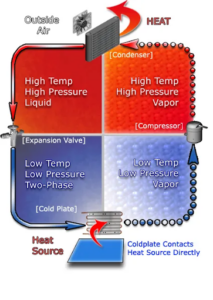
Marine air conditioning systems operate on the vapour compression refrigeration cycle, where heat is removed from indoor spaces and rejected to seawater through a continuous refrigeration process.

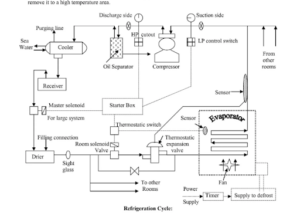
The cycle begins at the compressor, which draws low-pressure refrigerant vapour from the evaporator. The compressor compresses the refrigerant, increasing both its pressure and temperature. The high-pressure, high-temperature refrigerant gas is then discharged to the condenser.
The hot refrigerant enters the condenser, where it is cooled by circulating seawater or freshwater. As heat is transferred to the cooling water, the refrigerant changes from a high-pressure vapour into a high-pressure liquid.
An oil separator is usually installed in the discharge line to remove lubricating oil carried over by the refrigerant gas. The separated oil is returned to the compressor crankcase, improving compressor efficiency and reducing wear.
The high-pressure liquid refrigerant then flows through a filter drier and sight glass before reaching the thermostatic expansion valve (TXV).
The expansion valve meters the correct quantity of refrigerant into the evaporator while simultaneously reducing its pressure. This sudden pressure drop causes part of the liquid refrigerant to flash into vapour, producing a significant reduction in temperature.
The thermostatic expansion valve automatically regulates refrigerant flow based on the superheat at the evaporator outlet, ensuring efficient cooling under varying load conditions.
The cold, low-pressure refrigerant enters the evaporator, where it absorbs heat from the air circulated by blower fans. As heat is absorbed, the refrigerant completely evaporates into a low-pressure vapour.
At the same time, moisture present in the warm air condenses on the evaporator coils, reducing humidity inside the accommodation spaces. The cooled and dehumidified air is then supplied throughout the ship via the ventilation duct system.
The refrigerant vapour returns to the compressor, and the cycle repeats continuously
Marine air conditioning systems are equipped with several automatic controls for safe and efficient operation, including:
These controls protect the refrigeration plant from abnormal operating conditions while maintaining the required cooling performance.
A properly maintained marine air conditioning system offers numerous benefits:
The marine air conditioning system is an essential auxiliary system that ensures comfort, safety, and operational efficiency onboard ships. By utilizing the vapour compression refrigeration cycle, the system continuously removes heat and moisture from indoor spaces while maintaining precise temperature control. Components such as the compressor, condenser, thermostatic expansion valve, evaporator, and automatic safety controls work together to provide efficient and dependable cooling throughout the voyage. A thorough understanding of its working principle is fundamental for every marine engineer responsible for operating and maintaining shipboard refrigeration and HVAC systems.
The primary purpose of a marine air conditioning system is to maintain a comfortable temperature, control humidity, provide proper ventilation, and improve air quality onboard. It also protects electrical and electronic equipment from excessive heat, moisture, and condensation, ensuring reliable operation.
A marine air conditioning system works on the vapour compression refrigeration cycle. The compressor compresses the refrigerant, the condenser removes heat using seawater or freshwater, the thermostatic expansion valve (TXV) reduces the refrigerant pressure, and the evaporator absorbs heat and moisture from the cabin air, supplying cool and dehumidified air throughout the ship.
The main components include the compressor, condenser, oil separator, filter drier, sight glass, thermostatic expansion valve (TXV), evaporator, blower fan, thermostat, solenoid valve, and various pressure and safety controls. These components work together to provide efficient cooling and humidity control onboard.
Regular maintenance helps ensure efficient cooling, reduces energy consumption, prevents refrigerant leaks, protects the compressor from damage, and extends the lifespan of the system. Routine tasks include cleaning filters and condenser coils, checking refrigerant levels, inspecting seawater flow, testing safety devices, and monitoring operating pressures and temperatures.
Disclaimer :- The opinions expressed in this article belong solely to the author and may not necessarily reflect those of Merchant Navy Decoded. We cannot guarantee the accuracy of the information provided and disclaim any responsibility for it. Data and visuals used are sourced from publicly available information and may not be authenticated by any regulatory body. Reviews and comments appearing on our blogs represent the opinions of individuals and do not necessarily reflect the views of Merchant Navy Decoded. We are not responsible for any loss or damage resulting from reliance on these reviews or comments.
Reproduction, copying, sharing, or use of the article or images in any form is strictly prohibited without prior permission from both the author and Merchant Navy Decoded.
Decoded Discount Alert! up to 50% OFF
Use Coupon Code Deep50