Hi this is Team Merchant Navy Decoded !!!

Please fill the below form with your query and we will get back to you in next 12 hours.

Rest assured your data is safe with us !!!🙂

Ask Your Query

Common Rail Fuel Injection System

The maritime industry is continuously evolving to improve fuel efficiency, reduce emissions, and enhance engine performance. One of the most significant technological advancements in modern marine diesel engines is the Common Rail Fuel Injection System (CRFI). Unlike conventional mechanical fuel injection systems, common rail technology separates fuel pressure generation from injection timing, allowing precise electronic control over the combustion process.

Today, common rail systems are widely used in electronically controlled marine engines such as MAN ME and Wärtsilä RT-flex engines, helping ship operators meet stringent environmental regulations while improving operational efficiency.

What is a Common Rail Fuel Injection System?

Common Rail Fuel Injection System

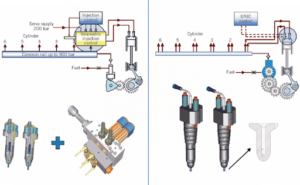
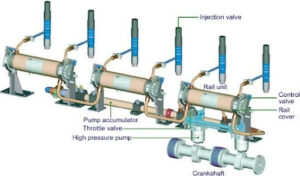
Wartsila common rail system

Wartsila common rail system


MAN common rail system

A Common Rail Fuel Injection System is an electronically controlled fuel delivery system where fuel is stored at very high pressure in a common manifold called the common rail. This pressurized fuel is then supplied to individual injectors, which are controlled electronically by the Engine Control Unit (ECU).

Unlike traditional camshaft-driven fuel pumps, the common rail system maintains constant fuel pressure regardless of engine speed or load. This allows precise control of injection timing, duration, and quantity, resulting in optimal combustion under all operating conditions.

Table of Contents

Working Principle

Common Rail Fuel Injection System

The system operates in the following sequence:

1. Fuel Pressurization

High-pressure fuel pumps continuously compress fuel and deliver it to the common rail. Fuel pressures typically range from 1,000 to over 1,800 bar, depending on engine design and operating conditions.

2. Fuel Storage

The common rail acts as a high-pressure accumulator, storing fuel and maintaining a constant pressure. It also absorbs pressure fluctuations, ensuring a stable fuel supply to all cylinders.

3. Electronic Control

Various sensors continuously monitor engine parameters such as:

  • Engine speed
  • Load demand
  • Fuel pressure
  • Exhaust temperature
  • Air intake conditions

The ECU processes this information and determines the exact injection timing and fuel quantity required for each cylinder.

4. Fuel Injection

Electronically controlled injectors receive commands from the ECU and inject highly atomized fuel into the combustion chamber at precisely the right moment. Multiple injection events can occur during a single combustion cycle.

Major Components of a Common Rail System

 Common Rail System

  1. High-Pressure Fuel Pumps: These pumps generate and maintain the required fuel pressure within the rail system.
  2. Common Rail: A high-pressure manifold that stores fuel and distributes it to all injectors while damping pressure pulsations.
  3. Fuel Injectors: Electronically actuated injectors that deliver fuel into the cylinders with exceptional precision.
  4. Injection Control Unit (ICU): Found on Wärtsilä engines, the ICU controls fuel injection using servo oil and electronic signals.
  5. FIVA Valve: Used in MAN ME engines, the Fuel Injection Valve Actuation (FIVA) system controls both fuel injection and exhaust valve operation.
  6. Electronic Control Unit (ECU): The “brain” of the system that processes sensor data and optimizes engine performance.
  7. Sensors: Various sensors monitor critical operating parameters and provide real-time feedback to the ECU.

Multiple Injection Strategy

One of the biggest advantages of common rail technology is the ability to perform multiple injection events during a single engine cycle:

Pilot Injection

A small quantity of fuel is injected before the main injection to initiate smooth combustion and reduce engine knocking.

Main Injection

The primary fuel delivery responsible for generating engine power.

Post Injection

A small quantity injected after the main combustion event to reduce emissions and improve exhaust gas treatment performance.

This flexibility allows engineers to optimize combustion characteristics across the entire operating range.

Advantages of Common Rail Systems

  1. Improved Fuel Efficiency: Precise control over fuel delivery ensures complete combustion, reducing specific fuel oil consumption.
  2. Smokeless Operation: Traditional mechanical injection systems often produce smoke at low engine loads due to insufficient injection pressure. Common rail systems maintain high pressure regardless of engine speed, ensuring proper atomization and smokeless combustion.
  3. Reduced Emissions: Better combustion control significantly lowers emissions of:
    1. Nitrogen Oxides (NOx)
    2. Particulate Matter (PM)
    3. Unburned Hydrocarbons (HC)
  4. Lower Engine Noise: Pilot injections soften the combustion process, reducing knocking and vibration.
  5. Flexible Engine Operation: The engine can operate smoothly at extremely low speeds, which is particularly beneficial during maneuvering and slow steaming.
  6. Improved Reliability: Electronic monitoring continuously optimizes engine performance and provides advanced diagnostic capabilities.

Challenges and Limitations

Despite its advantages, common rail technology also presents several challenges:

  1. Increased Complexity: The system contains sophisticated electronics, sensors, actuators, and software, requiring specialized training for maintenance personnel.
  2. Higher Maintenance Requirements: Components such as injectors, control valves, and electronic modules require regular inspection and calibration.
  3. Sensitivity to Fuel Quality: Contaminated fuel can damage precision injectors and high-pressure components.
  4. Starting Dependence on Rail Pressure: A sufficient rail pressure must be established before fuel injection can occur. Failure of the pressure generation system may result in starting difficulties.
  5. Higher Initial Cost: The advanced technology increases manufacturing and installation costs compared to conventional systems.

Applications in Modern Marine Engines

Common rail technology is extensively used in modern electronically controlled marine engines, including:

  • Wärtsilä RT-flex and X-series engines
  • MAN ME and ME-C engines
  • Auxiliary diesel generators
  • Offshore and LNG-powered vessels

These engines benefit from improved efficiency, reduced emissions, and compliance with IMO environmental regulations.

Conclusion

The Common Rail Fuel Injection System represents a major advancement in marine diesel engine technology. By separating fuel pressure generation from injection timing and enabling precise electronic control, it delivers superior fuel economy, lower emissions, smoother operation, and enhanced engine flexibility. Although the system is more complex than traditional mechanical injection systems, its operational benefits have made it the preferred choice for modern marine propulsion engines. As environmental regulations continue to tighten, common rail technology will remain a key solution for achieving cleaner, more efficient, and more reliable maritime transportation.

Frequently Asked Questions (FAQs)

A Common Rail Fuel Injection System (CRFI) is an electronically controlled fuel injection system in which fuel is stored at high pressure in a common rail and supplied to each injector. The Engine Control Unit (ECU) precisely controls the timing, quantity, and duration of fuel injection, resulting in improved engine performance, fuel efficiency, and lower emissions.

Compared to conventional mechanical fuel injection systems, a common rail system offers higher fuel efficiency, precise fuel metering, lower exhaust emissions, smoother engine operation, reduced engine noise, improved low-load performance, and better control over combustion through multiple injection events.

Common rail technology is widely used in modern electronically controlled marine diesel engines, including MAN ME/ME-C and Wärtsilä RT-flex/X-series engines. It is also commonly found in auxiliary diesel generators, offshore vessels, and LNG-powered ships to improve efficiency and meet IMO emission standards.

Routine maintenance includes checking fuel quality, replacing fuel filters, inspecting high-pressure pumps and injectors, monitoring common rail pressure, testing sensors and electronic control units (ECU), and diagnosing faults using the engine’s monitoring system. Using clean fuel and following the manufacturer’s maintenance schedule helps ensure reliable operation and extends component life.

Disclaimer :- The opinions expressed in this article belong solely to the author and may not necessarily reflect those of Merchant Navy Decoded. We cannot guarantee the accuracy of the information provided and disclaim any responsibility for it. Data and visuals used are sourced from publicly available information and may not be authenticated by any regulatory body. Reviews and comments appearing on our blogs represent the opinions of individuals and do not necessarily reflect the views of Merchant Navy Decoded. We are not responsible for any loss or damage resulting from reliance on these reviews or comments.

Reproduction, copying, sharing, or use of the article or images in any form is strictly prohibited without prior permission from both the author and Merchant Navy Decoded.

DIWALI SALE

Decoded Discount Alert! up to 50% OFF

DIWALI SALE

Decoded Discount Alert! up to 50% OFF

Use Coupon Code Deep50

Days
Hours
Seconds
0
Would love your thoughts, please comment.x
()
x