Hi this is Team Merchant Navy Decoded !!!
Please fill the below form with your query and we will get back to you in next 12 hours.
Rest assured your data is safe with us !!!🙂
Ask Your Query| For Beginner | For Professional |
|---|---|
| GME | Engine Side |
| G.P. Rating | Deck Side |
| ETO | G.P. Rating |
| IMUCET & Sponsorship | Combo Offers |
| Free Course | MEO |
| Free Course |
| For Beginner | For Professional |
|---|---|
| GME | Engine Side |
| G.P. Rating | Deck Side |
| ETO | G.P. Rating |
| IMUCET & Sponsorship | Combo Offers |
| Free Course | MEO |
| Free Course |
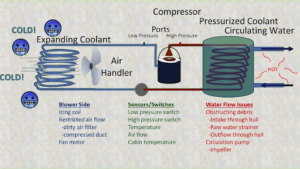
A marine air conditioning system plays a vital role in maintaining a comfortable and safe environment onboard ships. It controls temperature, humidity, and ventilation in accommodation spaces, engine control rooms, and navigation areas. Since the system operates continuously under demanding marine conditions, occasional faults are inevitable. A marine engineer must understand common air conditioning problems, their causes, and appropriate corrective actions to ensure reliable operation.
Timely troubleshooting helps prevent system breakdowns, improves cooling efficiency, reduces energy consumption, and extends the life of refrigeration equipment. Regular monitoring of operating pressures, temperatures, refrigerant levels, and electrical parameters enables engineers to detect faults before they become serious.

High condensing pressure places excessive load on the compressor, increases power consumption, and may trip the high-pressure safety switch.
Possible Causes
Corrective Measures
Low condenser pressure reduces refrigeration efficiency and affects expansion valve performance.
Possible Causes
Corrective Measures
Frost formation on the liquid line usually indicates restriction or flashing of refrigerant before the expansion valve.
Possible Causes
Corrective Measures
High suction pressure generally results in poor cooling performance.
Possible Causes
Corrective Measures
Low suction pressure often activates the low-pressure cut-out and reduces refrigeration capacity.
Possible Causes
Corrective Measures
The thermostatic expansion valve (TXV) controls refrigerant flow into the evaporator. Its malfunction directly affects system performance.
Common Problems
Corrective Measures
When evaporator performance decreases, cabin temperatures begin to rise.
Possible Causes
Corrective Measures
Frequent compressor starting and stopping increases electrical consumption and accelerates wear.
Possible Causes
Corrective Measures
A continuously running compressor usually indicates that the cooling demand is not being satisfied.
Possible Causes
Corrective Measures
The compressor discharge pressure should always remain within manufacturer limits.
Possible Causes
Corrective Measures
A compressor that refuses to start may have either electrical or mechanical problems.
Possible Causes
Corrective Measures
Reduced refrigeration capacity results in longer cooling times and increased energy consumption.
Possible Causes
Corrective Measures
Modern marine compressors often use automatic capacity control.
Possible Causes
Corrective Measures
Abnormal noise usually indicates mechanical deterioration.
Possible Causes
Corrective Measures
Oil circulating with refrigerant reduces heat transfer efficiency.
Possible Causes
Corrective Measures
Many refrigeration failures can be avoided by following a planned maintenance schedule:
Most air conditioning faults can be avoided through regular maintenance. Engineers should:
Routine inspections improve system reliability and reduce the likelihood of unexpected failures at sea.
When troubleshooting marine air conditioning systems:
Efficient troubleshooting is essential for maintaining the performance and reliability of a marine air conditioning system. By understanding common faults such as insufficient cooling, high discharge pressure, low suction pressure, compressor cycling, and evaporator icing, marine engineers can quickly identify problems and restore normal operation. Combined with a structured preventive maintenance program, effective troubleshooting ensures continuous comfort for the crew, protects onboard equipment, and enhances the overall efficiency of the ship’s refrigeration and HVAC systems.
Some of the most common faults include high or low condensing pressure, low suction pressure, compressor short cycling, poor cooling performance, evaporator icing, refrigerant leaks, compressor failure to start, excessive noise and vibration, and faulty thermostatic expansion valves (TXVs).
Poor cooling can be caused by low refrigerant charge, dirty condenser or evaporator coils, clogged air filters, insufficient seawater flow through the condenser, faulty expansion valves, poor airflow, or compressor problems. Identifying the root cause through pressure and temperature checks is essential for effective troubleshooting.
Regular preventive maintenance helps prevent compressor failures. This includes monitoring suction and discharge pressures, maintaining the correct refrigerant charge, checking compressor oil levels, cleaning condenser tubes and air filters, testing safety cut-out switches, and inspecting electrical components and control circuits.
Preventive maintenance improves cooling efficiency, reduces energy consumption, minimizes unexpected breakdowns, extends the lifespan of compressors and other components, and ensures reliable operation throughout the voyage. Routine inspections also help detect faults early, reducing repair costs and downtime.
Disclaimer :- The opinions expressed in this article belong solely to the author and may not necessarily reflect those of Merchant Navy Decoded. We cannot guarantee the accuracy of the information provided and disclaim any responsibility for it. Data and visuals used are sourced from publicly available information and may not be authenticated by any regulatory body. Reviews and comments appearing on our blogs represent the opinions of individuals and do not necessarily reflect the views of Merchant Navy Decoded. We are not responsible for any loss or damage resulting from reliance on these reviews or comments.
Reproduction, copying, sharing, or use of the article or images in any form is strictly prohibited without prior permission from both the author and Merchant Navy Decoded.
Decoded Discount Alert! up to 50% OFF
Use Coupon Code Deep50