Hi this is Team Merchant Navy Decoded !!!
Please fill the below form with your query and we will get back to you in next 12 hours.
Rest assured your data is safe with us !!!🙂
Ask Your Query| For Beginner | For Professional |
|---|---|
| GME | Engine Side |
| G.P. Rating | Deck Side |
| ETO | G.P. Rating |
| IMUCET & Sponsorship | Combo Offers |
| Free Course | MEO |
| Free Course |
| For Beginner | For Professional |
|---|---|
| GME | Engine Side |
| G.P. Rating | Deck Side |
| ETO | G.P. Rating |
| IMUCET & Sponsorship | Combo Offers |
| Free Course | MEO |
| Free Course |
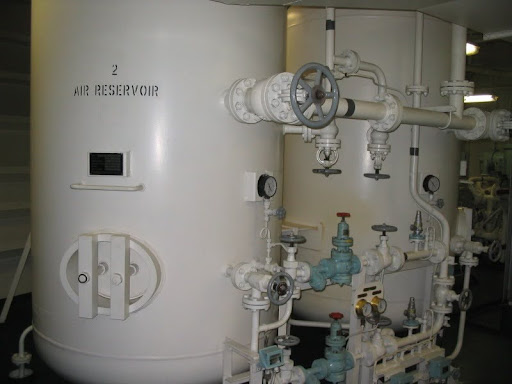
An Air Bottle, also known as an Air Receiver, is a pressure vessel used to store compressed air supplied by the ship’s air compressors. The compressed air is typically stored at a pressure of 28–30 bar and is mainly used for starting the main engine and auxiliary engines.
Air receivers are among the most critical components of a ship’s starting air system because engine starting becomes impossible if sufficient air pressure is unavailable.
The primary functions of an air bottle onboard are:
According to SOLAS regulations, air receivers must have sufficient capacity to provide:
This requirement ensures that the vessel can safely restart the engine during emergency situations.
Several important mountings are fitted on an air bottle for safe operation.
The relief valve is the most important safety device fitted on the receiver.
Function:
The fusible plug protects the air bottle during engine room fires.
Function:
Normally two drain cocks are fitted.
Function:
Pressure gauges continuously indicate receiver pressure.
Normal Pressure Range:
A sluggish-opening valve fitted on the main air supply line.
Function:
Provides starting air to diesel generators and auxiliary engines.
Allows compressed air from the air compressor to enter the receiver.
An elliptical manhole is fitted for internal inspection and maintenance.
One of the most important alarms associated with the air receiver.
Purpose:
When this alarm activates, starting of the main engine and auxiliary engines may not be possible.
Air bottle draining should be carried out every watch.
Compressed air always contains water vapor which condenses inside the receiver.
If not removed:
Compressor lubricating oil may enter the receiver.
If accumulated:
Therefore, drain valves should be opened regularly until all moisture and oil are removed.
Regular inspection is essential to ensure safe operation.
Open drain cocks and completely remove:
When pressure reaches zero, open the manhole cover.
Thoroughly ventilate the receiver using portable fans.
Follow enclosed space entry procedures under the supervision of the Chief Engineer.
Oxygen concentration should be approximately:
20.8%
before entry is permitted.
After entering the receiver, inspect the following:
Check for:
Inspect for:
Check the condition of compensating rings fitted around the manhole opening.
These rings compensate for strength lost due to cutting the manhole opening.
Ensure drains are not blocked from inside.
Inspect:
In some cases, internal inspection can be carried out without entering the bottle.
A Boroscope is used to:
This reduces inspection time and improves safety.
Engineers frequently encounter:
Early detection helps prevent serious failures.
The Air Bottle (Air Receiver) is one of the most important components of a ship’s starting air system. It stores compressed air for starting engines, provides emergency reserve air, and ensures compliance with SOLAS requirements. Regular draining, inspection, and maintenance of safety devices such as relief valves, fusible plugs, and pressure gauges are essential for safe and reliable ship operations.
The normal operating pressure is around 28–30 bar.
To release compressed air safely during engine room fires and prevent bottle explosion.
12 starts for reversible engines and 6 starts for non-reversible engines.
If one drain valve becomes blocked, the second can still drain moisture and oil.
Approximately 20.8% oxygen is required before entry.
Disclaimer :- The opinions expressed in this article belong solely to the author and may not necessarily reflect those of Merchant Navy Decoded. We cannot guarantee the accuracy of the information provided and disclaim any responsibility for it. Data and visuals used are sourced from publicly available information and may not be authenticated by any regulatory body. Reviews and comments appearing on our blogs represent the opinions of individuals and do not necessarily reflect the views of Merchant Navy Decoded. We are not responsible for any loss or damage resulting from reliance on these reviews or comments.
Reproduction, copying, sharing, or use of the article or images in any form is strictly prohibited without prior permission from both the author and Merchant Navy Decoded.
Decoded Discount Alert! up to 50% OFF
Use Coupon Code Deep50