Hi this is Team Merchant Navy Decoded !!!

Please fill the below form with your query and we will get back to you in next 12 hours.

Rest assured your data is safe with us !!!🙂

Ask Your Query

Electric Circuit Diagram

An electric circuit diagram may look confusing at first, but the idea behind it is actually simple. It is just a drawing that shows how electrical parts are connected and how current flows in a circuit.

If you want to learn basic electrical systems, then understanding a circuit diagram is very important. It helps you know which component is connected where, what each part does, and how the full system works.

In this blog, you will understand electric circuit diagrams in simple words. This is written for beginners, so the language is easy and clear.

Electric Circuit Diagram

What Is an Electric Circuit Diagram?

An electric circuit diagram is a simple drawing that shows the parts of an electrical circuit by using symbols.

Instead of drawing the real shape of a bulb, switch, battery, or motor, we use small standard symbols. These symbols make the circuit easy to draw and easy to understand.

In short, a circuit diagram shows:

  • what components are used
  • how they are connected
  • how electricity flows through the circuit

It is like a map for an electrical system.

Why Is a Circuit Diagram Important?

A circuit diagram is important because it helps us understand the full circuit before working on it.

It is useful for:

  • learning how a circuit works
  • finding faults
  • repairing electrical systems
  • building new circuits
  • understanding connections clearly

Without a circuit diagram, electrical work can become confusing. With a diagram, everything becomes more organised.

Table of Contents

Main Parts Shown in a Circuit Diagram

A basic electric circuit diagram usually shows these parts:

1. Power Source

This is where electricity comes from.

Examples:

  • battery
  • cell
  • generator
  • power supply

2. Wires or Conductors

These connect all the parts and allow current to flow.

3. Switch

A switch opens or closes the circuit.

  • switch ON = circuit complete
  • switch OFF = circuit broken

4. Load

The load is the device that uses electrical power.

Examples:

  • bulb
  • fan
  • motor
  • buzzer
  • heater

5. Protection Device

These protect the circuit from damage.

Examples:

  • fuse
  • circuit breaker

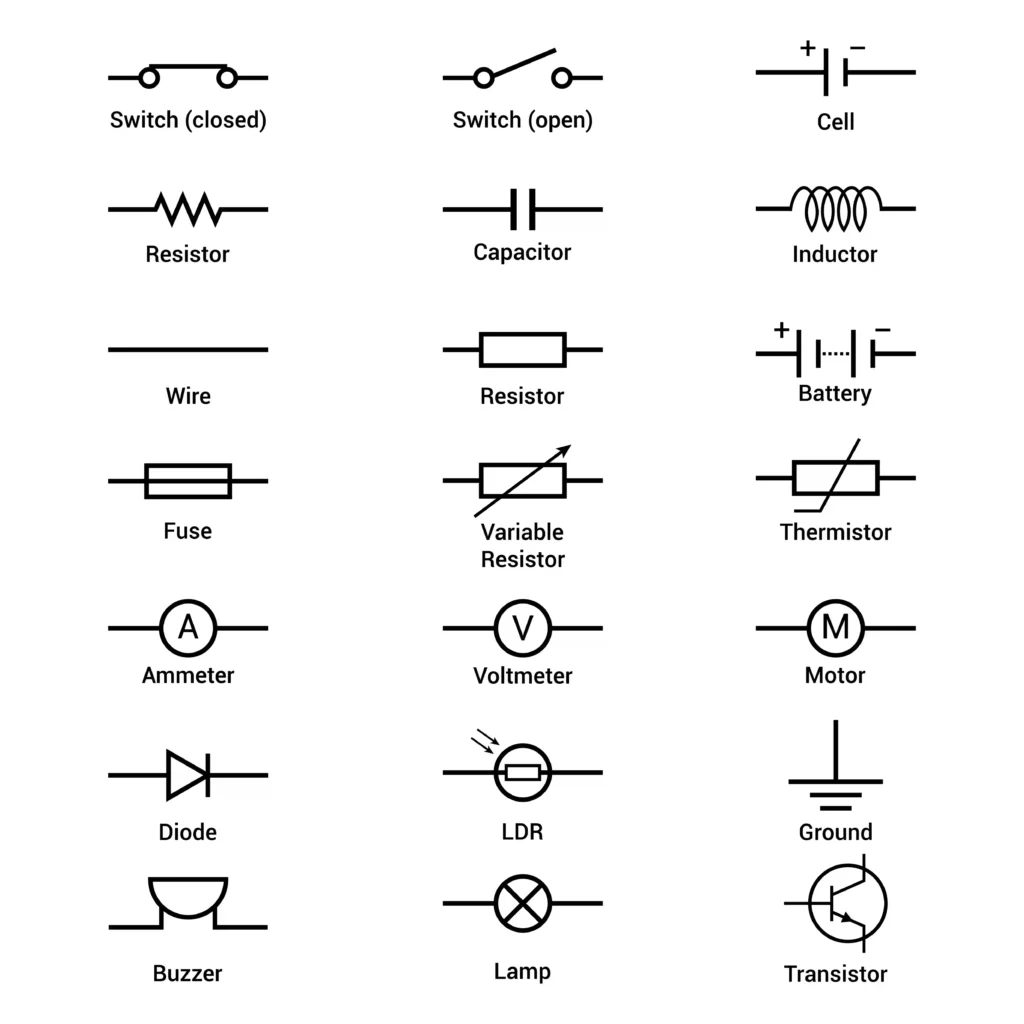
Common Symbols Used in Circuit Diagrams

Circuit diagrams use symbols because they are faster and easier than drawing real parts.

Some common symbols are:

  • Cell – shows one source of power
  • Battery – shows more than one cell
  • Bulb – shows a lamp or light
  • Switch – shows control of current
  • Resistor – shows resistance in the circuit
  • Fuse – shows protection device
  • Motor – shows mechanical load
  • Earth – shows grounding connection

If you learn these symbols, reading a circuit diagram becomes much easier.

How to Read an Electric Circuit Diagram

Many people get scared when they see a circuit diagram, but the right way is to read it step by step.

Step 1: Find the Power Source

First, see where the circuit gets its power from. It may be a battery or another supply.

Step 2: Follow the Path

Check how the wire goes from one part to another.

Step 3: Identify the Components

Look at the symbols and understand which part is a switch, bulb, motor, fuse, or resistor.

Step 4: Check the Circuit Flow

See how current moves through the circuit from source to load and back.

Step 5: Understand the Purpose

Ask yourself:

  • what is this circuit doing?
  • which component controls it?
  • what happens if one part fails?

This simple method makes circuit diagrams easier to understand.

Simple Example of a Circuit Diagram

Let us take a very basic example.

Circuit:

Battery → Switch → Bulb

This simple circuit has:

  • one battery
  • one switch
  • one bulb
  • connecting wires

Working:

When the switch is ON, the circuit becomes complete and current flows. The bulb glows.

When the switch is OFF, the path breaks and current stops. The bulb goes off.

This is one of the easiest circuit diagrams to understand.

Types of Circuit Diagrams

There is not only one type of circuit diagram. Different diagrams are used for different purposes.

1. Simple Circuit Diagram

This is the most basic type. It shows the circuit using symbols only.

Used for:

  • learning
  • basic electrical work
  • simple understanding

2. Wiring Diagram

A wiring diagram shows more practical connection details.

It helps in:

  • installation work
  • repair work
  • real wire connection tracing

3. Schematic Diagram

A schematic diagram is more focused on how the circuit works, not how it physically looks.

It is used in:

  • electronics
  • control systems
  • advanced troubleshooting

Difference Between Circuit Diagram and Wiring Diagram

Many beginners think both are the same, but they are not exactly the same.

Circuit Diagram

  • uses symbols
  • shows logic of the circuit
  • helps understand working

Wiring Diagram

  • shows actual wire connections
  • shows physical layout
  • helps in installation and repair

So, a circuit diagram helps you understand the system, while a wiring diagram helps you connect it in real life.

Real-Life Use of Electric Circuit Diagrams

Electric circuit diagrams are used almost everywhere.

At Home

  • lighting systems
  • fan circuits
  • doorbells
  • chargers
  • appliances

In Industry

  • motor control panels
  • pump systems
  • alarm systems
  • machine circuits

In Vehicles and Ships

  • starting circuits
  • lighting circuits
  • battery charging systems
  • alarm and safety circuits

Wherever electricity is used, circuit diagrams are useful.

Example 1: Doorbell Circuit

A doorbell circuit is a simple example.

Parts:

  • power source
  • push button switch
  • bell
  • wires

Working:

When the push button is pressed, the circuit becomes complete and current flows to the bell. The bell rings.

When the button is released, the circuit opens and the bell stops.

This is a very common and simple circuit diagram.

Example 2: Home Light Circuit

A home light circuit is another easy example.

Parts:

  • power supply
  • switch
  • bulb
  • wires

Working:

When the switch is turned ON, current flows through the bulb and it glows.

If the switch is OFF or the wire is broken, the bulb will not glow.

This example helps beginners understand the role of the switch in a circuit.

Common Mistakes Beginners Make

Many people make the same mistakes while learning circuit diagrams.

1. Ignoring Symbols

If you do not learn symbols, you will not understand the diagram properly.

2. Reading Too Fast

Beginners often look at the full diagram together and get confused. It is better to read one path at a time.

3. Not Understanding Current Flow

If you do not know where current starts and where it goes, the diagram will feel difficult.

4. Mixing Up Diagram Types

Some people confuse schematic diagrams with wiring diagrams.

5. Learning Only Theory

You also need practical examples. Only theory is not enough.

How to Learn Circuit Diagrams Better

If you want to improve, follow this simple approach:

  • first learn basic symbols
  • start with very simple diagrams
  • understand one circuit at a time
  • trace the current path slowly
  • connect theory with real examples
  • practice again and again

Do not jump directly into complex diagrams. That is where most beginners fail.

Why Beginners Should Learn Circuit Diagrams

Learning circuit diagrams is useful because it builds your basic electrical understanding.

It helps you:

  • understand equipment better
  • find faults faster
  • work with more confidence
  • improve technical knowledge
  • understand practical systems clearly

Even if you are not an expert, basic diagram knowledge is very useful.

Conclusion

An electric circuit diagram is simply a drawing that shows electrical parts and their connections by using symbols. It helps us understand how a circuit works and how electricity flows through it.

At first, it may look difficult, but once you learn the basic symbols and start reading step by step, it becomes much easier.

The best way to learn is to begin with simple examples like a bulb circuit, light circuit, or doorbell circuit. Once your basics become strong, larger diagrams will also start making sense.

Disclaimer :- The opinions expressed in this article belong solely to the author and may not necessarily reflect those of Merchant Navy Decoded. We cannot guarantee the accuracy of the information provided and disclaim any responsibility for it. Data and visuals used are sourced from publicly available information and may not be authenticated by any regulatory body. Reviews and comments appearing on our blogs represent the opinions of individuals and do not necessarily reflect the views of Merchant Navy Decoded. We are not responsible for any loss or damage resulting from reliance on these reviews or comments.

Reproduction, copying, sharing, or use of the article or images in any form is strictly prohibited without prior permission from both the author and Merchant Navy Decoded.

DIWALI SALE

Decoded Discount Alert! up to 50% OFF

DIWALI SALE

Decoded Discount Alert! up to 50% OFF

Use Coupon Code Deep50

Days
Hours
Seconds
0
Would love your thoughts, please comment.x
()
x