Hi this is Team Merchant Navy Decoded !!!
Please fill the below form with your query and we will get back to you in next 12 hours.
Rest assured your data is safe with us !!!🙂
Ask Your Query| For Beginner | For Professional |
|---|---|
| GME | Engine Side |
| G.P. Rating | Deck Side |
| ETO | G.P. Rating |
| IMUCET & Sponsorship | Combo Offers |
| Free Course | MEO |
| Free Course |
| For Beginner | For Professional |
|---|---|
| GME | Engine Side |
| G.P. Rating | Deck Side |
| ETO | G.P. Rating |
| IMUCET & Sponsorship | Combo Offers |
| Free Course | MEO |
| Free Course |
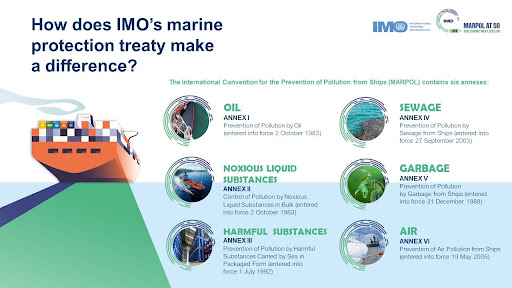
The full form of MARPOL is “International Convention for the Prevention of Pollution from Ships”. It was adopted by IMO to prevent and keep the oceans clean from marine pollution such as oil spills, disposals, and harmful emissions. MARPOL is made up of 6 different annexes, and regulations to keep a close watch on the substance and operations that can cause huge pollution in the seawater and harm marine life.
Some people joined the link of MARPOL to the OILPOL of 1954 which was used to check the oil discharge by ship. However, incidents like the Torrey Canyon Oil Spill in 1967 sparked the need to more stricter regulation in the marine industry. So, the International Maritime Organization developed MARPOL 1973 to keep discharges from ships in check. A significant turning point came with the 1978 MARPOL Protocol, introduced after several tanker accidents, which merged with the 1973 convention to form the MARPOL 73/78 framework still in use today.
Efforts were made to create regulations to prevent pollution from ships but some incidents fueled the need for specific regulations for the prevention of pollution at sea. Hence MARPOL was created. Some big incidents of 1967 and 1978 sparked strict requirements for a regulation like MARPOL. These are the famous incidents that took place before MARPOL.
Marpol Annex 1 is Regulations for the Prevention of Pollution by OIL. It covers the prevention of pollution of seawater by the oil discharge from day-to-day marine operations. MARPOL Annex 1 declared it mandatory for all oil tankers to have a double hull.
Marpol Annex 2 is Regulations for Control of Pollution by Noxious Liquid Substances in Bulk. This annex regulates the pollution by the noxious liquid carried in bulk. In any case, no residue discharge of noxious liquids is permitted within the 12 miles of the nearest land.
Marpol Annex 3 is Prevention of Pollution by Harmful Substances Carried by Sea in Packaged Form. This annex gives general requirements about the detailed standards on packing, marking, labeling, documentation, stowage, quantity limitations, exceptions, and notifications.
Marpol Annex 4 is Prevention of Pollution by Sewage from Ships. It gives requirements to minimize the pollution by the sewage from ships. It also gives regulations and guidelines for the discharge of sewage and sewage treatment plants. A new amendment has been added where Marpol Annex 4 introduces the Baltic Sea as a special area under Annex 4 for passenger ships.
Marpol Annex 5 is Prevention of Pollution by Garbage from Ships. Annex 5 deals with different types of garbage disposal from ship and garbage disposal plan. It is because of Annex 5 of MARPOL that any kind of plastic disposal is completely banned in the ocean.
Marpol Annex 6 is Prevention of Air Pollution from Ships. This annex of Marpol sets limits on the emission of SOx and NOx from the ship exhaust and operations and also prohibits other ozone-depleting substances from being released into the air.
Related Read: Steps taken by IMO to prevent the pollution.
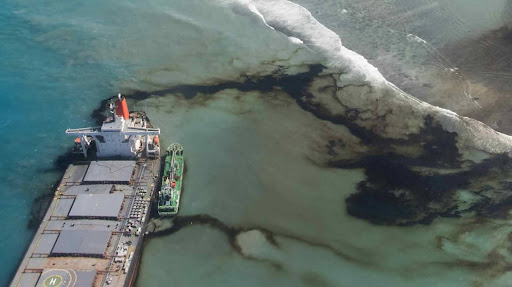
Ships generate oily waste from various operations every day. This waste can end up in the sea through both legal and illegal discharges. Ships have several options for handling this waste, such as delivering it to shore facilities, incinerating it onboard, or discharging it into the sea under regulated conditions.
Discharging oil or oily mixtures into the sea from ships of 400 gross tonnage or more is strictly prohibited unless all of the following conditions are met:
The discharge of oil or oily mixtures into the sea from ships of 400 gross tonnage or more is not allowed unless all of the following conditions are met:
Additionally, in the Antarctic area, the discharge of oil or oily mixtures from any ship is completely prohibited.
Ships of 400 gross tonnage or more must have approved oil filtering systems to ensure discharged water has no more than 15 parts per million of oil. The system must have an alarm and automatically stop the discharge if this limit is exceeded.
All tankers above 150 GRT and all ships above 400 GRT should have Oil Record Book Part 1 for machinery space. Entry should be made in ORB when:
Oil or oily mixtures from the cargo area of an oil tanker can only be discharged into the sea if all the following conditions are met:
Any discharge into the sea of oil or oily mixture from the cargo area of an oil tanker shall be prohibited while in a special area.
Oil tankers of 150 gross tonnage or more must have an Oil Record Book Part II (Cargo/Ballast Operations) to record the following activities:
Each completed operation should be signed by the officer in charge of the operations.
Marpol Annex 2 gives guidelines to prevent pollution of seawater by noxious liquids. Annex 2 divides the noxious liquids into 3 categories, i.e. X, Y, and Z groups.
Category X: Substances that pose a major threat to marine resources or human health if discharged during tank cleaning or deballasting operations, making their discharge completely prohibited.
Category Y: Substances that present a hazard to marine resources, human health, or amenities if discharged. Their discharge is restricted by limits on quantity and quality.
Category Z: Substances with a minor hazard to marine resources or human health. Discharge restrictions for these substances are less strict.
Other Substances (OS): Substances classified as “Other Substances” in Chapter 18 of the International Bulk Chemical Code. These are deemed to have no significant harm to marine resources, human health, or amenities when discharged during tank cleaning or deballasting.
Every ship on which Marpol Annex 2 applies has to have a Cargo Record Book. Every operation related to cargo operation should be entered in the Cargo Record Book. The cargo record book should be signed by the officer in charge of the operations.
The cargo record book shall be kept in such a place so that it is readily available for inspection.
Every ship of 150 GRT carrying noxious liquid substances in bulk needs to carry a Shipboard Marine Pollution Emergency Plan for Noxious Liquid Substances. The plan should inform about:
with national and local authorities in combating the pollution.
Packages containing harmful substances shall be:
The method of marking the correct technical name of the affiliated labels on packages containing harmful substances shall be such that:
The International Maritime Dangerous Goods (IMDG) Code is a global standard for safely transporting dangerous goods by sea. It provides guidelines on packaging, container handling, and storage, with a focus on keeping incompatible substances separate.
IMDG Code is divided into 2 Volumes:
Each volume deals with different subjects such as definitions, classifications, consignment procedures, and transport operations.
The discharge of sewage into the seawater can create a health hazard. Sewage disposal can also lead to the depletion of oxygen in the ecosystem. Sewage disposal in seawater is a major pollutant, especially in the coastal areas with tourists. Sources of sewage from ships can be:
The discharge of sewage is prohibited except when:
.
Every ship that comes under Annex 4 of marpol has to have a Sewage Treatment Plant. It should be approved by the government of the state under whose authority the ship is operating.
Marpol Annex 5 works for the Regulations for the Prevention of Pollution by Garbage from Ships. Garbage from ships can harm marine life as much as oil or chemicals. Plastic is especially dangerous because it can stay in the ocean for years. Marine animals may mistake it for food or become tangled in plastic items like ropes, nets, bags, or drink can holders.
Every ship above 100 GRT and certified to carry 15 people needs to have a garbage management plan onboard. It should contain:
| Type of Garbage | Ships Outside Special Areas | Ships Within Special Areas | Offshore Platforms (more than 12 nm from land) and Ships Within 500 m of Such Platforms |
|---|---|---|---|
| Food waste comminuted or ground | Discharge permitted >3 nm from the nearest land, en route and as far as practicable | Discharge permitted >12 nm from the nearest land, en route and as far as practicable | Discharge prohibited |
| Food waste not comminuted or ground | Discharge permitted >12 nm from the nearest land, en route and as far as practicable | Discharge prohibited | Discharge prohibited |
| Cargo residues1 not contained in wash water | Discharge permitted >12 nm from the nearest land, en route and as far as practicable | Discharge prohibited | Discharge prohibited |
| Cargo residues1 contained in wash water | Discharge permitted >12 nm from the nearest land, en route and as far as practicable and subject to additional conditions | Discharge permitted >12 nm from the nearest land, en route and as far as practicable and subject to additional conditions | Discharge prohibited |
| Cleaning agents and additives1 contained in cargo hold wash water | Discharge permitted | Discharge permitted | Discharge prohibited |
| Cleaning agents and additives1 in deck and external surfaces wash water | Discharge permitted | Discharge permitted | Discharge prohibited |
| Carcasses of animals carried on board as cargo and which died during the voyage | Discharge permitted as far from the nearest land as possible and en route | Discharge prohibited | Discharge prohibited |
| All other garbage including plastics, synthetic ropes, fishing gear, plastic garbage bags, incinerator ashes, cooking oil, floating dunnage, lining, packing materials, paper, rags, glass, metal, bottles, crockery, etc. | Discharge prohibited | Discharge prohibited | Discharge prohibited |
When Should you make entries in the garbage record book?
Marpol Annex 6 is Prevention of Air Pollution from Ships. This annex of Marpol sets limits on the emission of SOx and NOx from the ship exhaust and operations.
All ships of 400 GRT and above have to carry an International Air Pollution Prevention Certificate (IAPP Certificate) to comply with Marpol Annex 6. Ships less than 400 GRT still have to comply with Annex 6 where applicable by the administration.
Exhaust Gas Component | Why is It Bad? |
Nitrogen Oxides (NOx) |
|
Sulfur Oxides (SOx) |
|
Particulate Matter (PM) |
|
Hydrocarbons (HC) |
|
Carbon Monoxide(CO) |
|
Carbon Dioxide (CO2) |
|
Decoded Discount Alert! up to 50% OFF
Use Coupon Code Deep50